

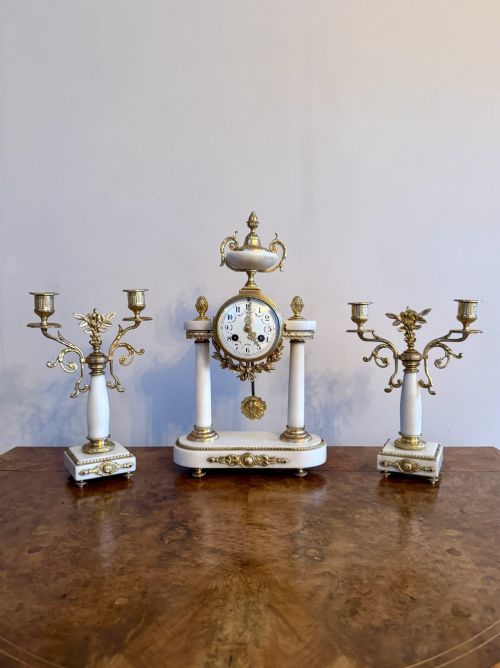
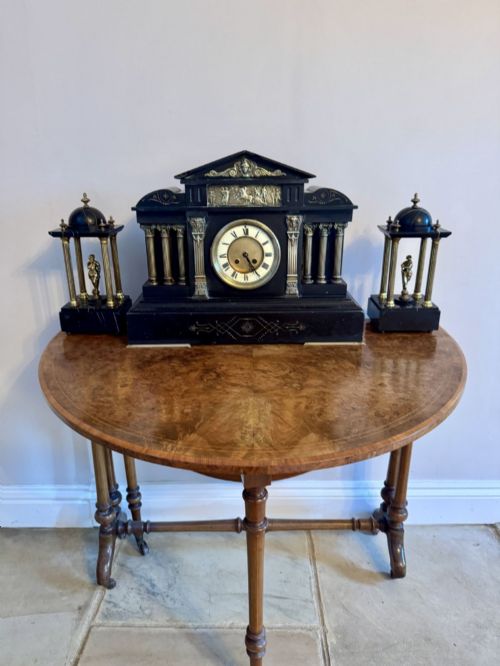
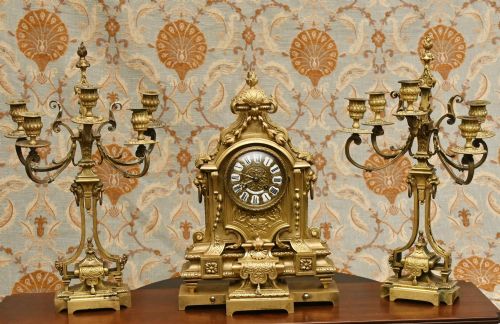
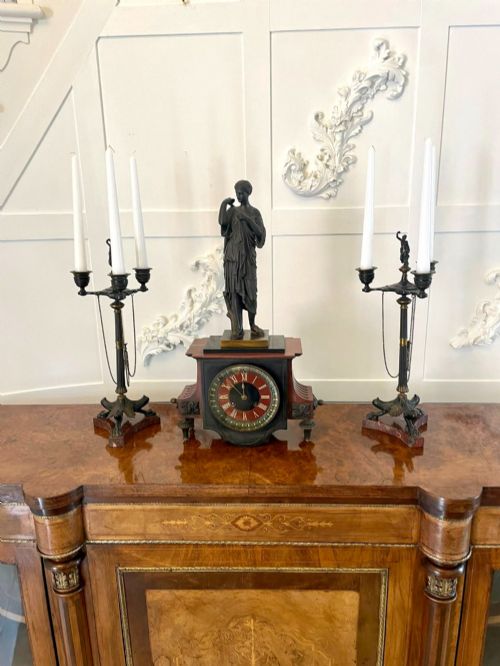

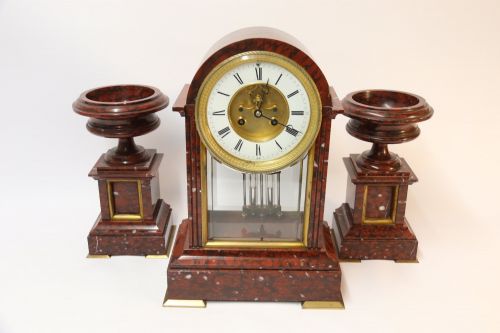


Classical Mantel Garniture Set
A classical mantel garniture set arranges matching decorative ornaments around a central clock to balance a chimney piece with symmetry and proportion.
Classical Mantel Garniture Set
A classical mantel garniture set typically comprises a central clock flanked by matching pairs of vases, urns, ewers or candelabra. These arrangements survive predominantly from the nineteenth century, drawing heavily on French Empire, Louis XVI and Neoclassical design vocabularies.
The compositions incorporate architectural marble bases, cast bronze figures and porcelain bodies arranged for formal display. Pieces date from the Victorian era and the broader nineteenth century, reflecting European domestic interiors of that period.
Materials and construction
Maker workshops combined heavy natural stones such as marble and onyx with cast metals including brass, bronze and ormolu. Ormolu application required mercurial gilding over bronze to achieve a durable golden lustre.
Porcelain elements featured hand-painted enamel decoration alongside glazed surfaces, while clock movements employed mechanical brass gear trains driving eight-day striking mechanisms.
Classical Mantel Garniture Set Retail Price Guide 2026
Typical asking prices for classical mantel garniture set among the pieces listed under this phrase on Sellingantiques today, from the lower quarter to the upper quarter. They describe what is for sale here now, not the wider market.
Listings feature nineteenth century pieces incorporating marble, ormolu, bronze and porcelain across French Empire and Louis XVI styles.
Craftsmanship and proportion
Superior sets display crisp chiselling in the ormolu mounts, where hand-tooling after casting defines intricate acanthus leaves and classical figures rather than leaving surfaces soft. The density and colour matching of the marble or onyx bases also separate standard production from superior examples.
The harmony of proportion between the central clock and its flanking sidepieces dictates visual success, with higher quality sets maintaining consistent detail across every component in the garniture.
Samuel Marti·A.D Mougin·H Luppens Paris·Deniere Paris·Thomas Steel
The Classical Mantel Garniture Set Glossary
- Garniture
- A set of matching decorative ornaments designed to be displayed together on a mantelpiece or sideboard. The arrangement usually includes a central clock accompanied by two side vases or candelabra.
- Ormolu
- Gilt bronze created by applying a mixture of gold and mercury to a cast bronze base and firing it to drive off the mercury. This technique produces a rich golden finish characteristic of French decorative arts.
- Bleu De Roi
- A deep rich cobalt blue ceramic glaze developed at the Sèvres porcelain factory. It frequently serves as a ground colour for decorative vases and clock panels.
- Portico clock
- A mantel clock housed within a architectural framework supported by columns. These structures often utilise contrasting marble colours.
- Ewer
- A large jug with a wide spout and elaborate handle, frequently produced in matched pairs as decorative elements within a garniture.
Classical Mantel Garniture Set: Frequently Asked Questions
How do you style a garniture set?
Place the central clock at the exact centre of the mantelpiece to anchor the display. Position the matching side pieces symmetrically on either side to maintain visual balance.
Ensure adequate clearance around each object so the individual details of the bronze mounts and marble bases remain visible from across the room.
How do eight day clock movements work?
An eight day movement requires winding once a week using a dedicated key inserted into the dial holes. Springs or hanging weights store mechanical energy to drive the escapement and strike the hours.
Professional servicing every few years ensures the brass gears and pivots continue to run accurately without excessive wear.
What materials make up these sets?
Nineteenth century makers relied on quarried stones including white, pink and sienna marble paired with cast bronze and gilded ormolu. Porcelain bodies and enamel dials add colourful contrast to the metallic and stone elements.
These mixed media constructions demand careful handling during relocation to prevent stress on joined components.
How do you identify Louis XVI style pieces?
Louis XVI style items display strict symmetry, straight architectural lines and classical motifs such as ribbons, urns and floral swags. These designs react against earlier rococo asymmetry through restrained geometric discipline.
Ormolu mounts on these pieces emphasise classical columns, friezes and laurel wreaths.