

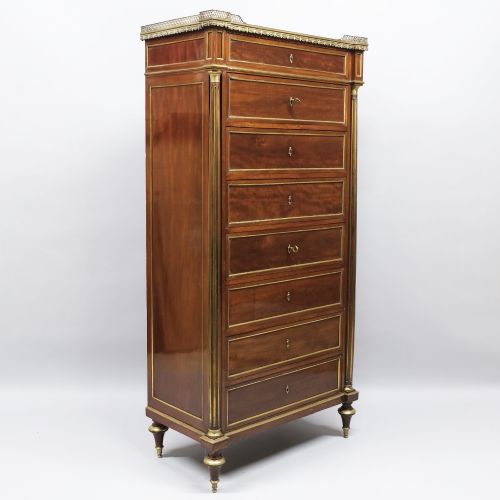


Classical Chest of Drawers
A classical chest of drawers brings architectural proportion and generous storage to a room, offering the enduring warmth of mahogany or walnut.
Classical Chest of Drawers
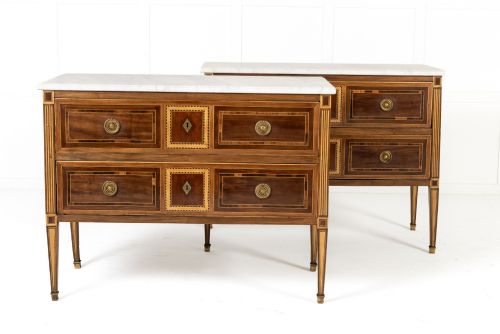
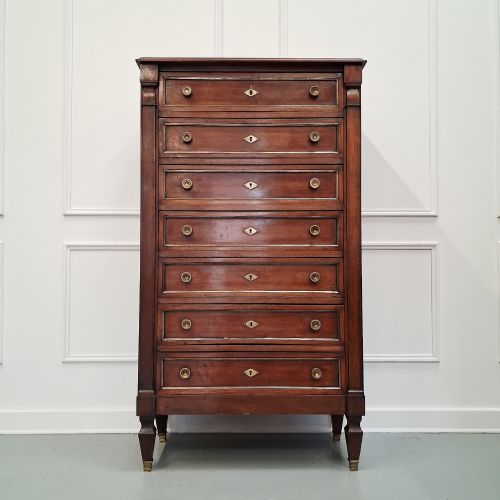
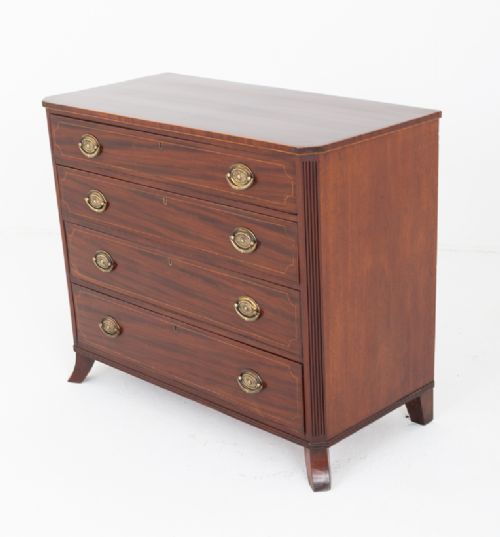
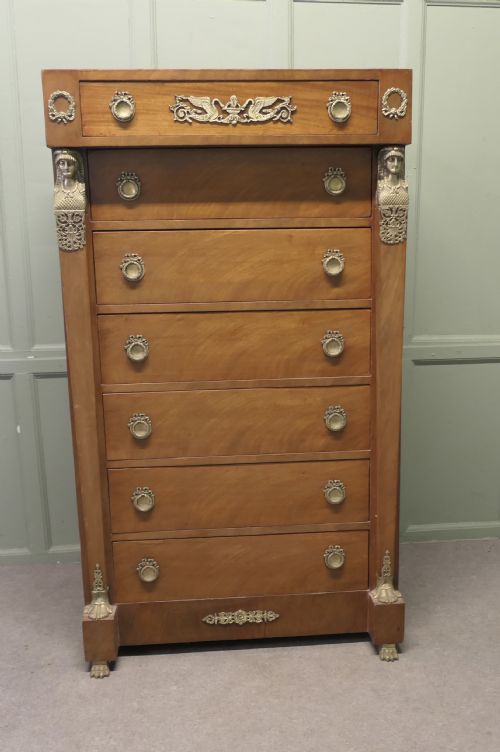
A classical chest of drawers provides structured storage through disciplined forms rooted in Georgian, Regency, and French Empire design traditions. These pieces range from upright semainiers to serpentine fronts and robust commodes, reflecting distinct periods from the eighteenth century onwards.
Buyers most frequently encounter mahogany examples alongside walnut pieces featuring brass hardware or marble tops. The selection spans straightforward British cabinet work and elaborate continental interpretations with marquetry or gilt bronze mounts.
How they were made
Cabinet makers utilised dense native and exotic timbers, constructing carcases primarily in mahogany, walnut, and oak. Solid boards and carefully selected veneers form the main structure, often enhanced by contrasting stringing and geometric inlay.
Metalwork played a defining role, with cast brass handles, escutcheons, and ormolu mounts securing the neoclassical aesthetic. Heavy grey marble tops appear on French examples, providing a cool and durable surface above the timber drawers.
Classical Chest of Drawers Retail Price Guide 2026
Typical asking prices for classical chest of drawers among the pieces listed under this phrase on Sellingantiques today, from the lower quarter to the upper quarter. They describe what is for sale here now, not the wider market.
Semainier chests arrive with seven drawers, ready for an orderly soul to organise the week by timber grain alone.
What varies in quality
The distinction between ordinary and exceptional pieces lies in the precision of the cabinet work and the integrity of the timber selection. Finer examples display continuous grain patterns across drawer fronts and crisp hand-cut dovetails within the drawer construction.
The sophistication of the mounts and the depth of the carving determine the status of a piece within its period. High-status commodes incorporate finely chased gilt bronze or distinct marquetry, whereas simpler chests rely on proportion and timber figure alone.
Jean-Henri Riesener
The Classical Chest of Drawers Glossary
- Commode
- A low French chest of drawers or cabinet originating in the seventeenth century. These pieces frequently incorporate decorative veneers and metal mounts.
- Ormolu
- Gilded bronze used for decorative mounts and hardware on continental furniture. The technique involves applying a gold amalgam to cast bronze.
- Serpentine
- A curved furniture front characterised by a convex centre flanked by concave sides. This shape requires advanced woodworking skill to execute cleanly.
- Marquetry
- The art of applying pieces of veneer to a structure to form decorative patterns and pictures. Craftsmen selected various tinted woods to achieve tonal contrast.
Classical Chest of Drawers: Frequently Asked Questions
What is a classical chest of drawers?
A classical chest of drawers is a storage piece built according to historical neoclassical design principles, featuring orderly proportions and restrained ornamentation.
Such pieces emerge primarily from Georgian, Regency, and continental traditions, utilising timbers like mahogany and walnut.
How do I identify a French commode?
A French commode typically presents a lower, broader profile than a standard British chest, frequently topped with marble and decorated with ormolu mounts.
These pieces often display complex parquetry or marquetry patterns across the drawer fronts and sides.
Where should I place a semainier?
A semainier suits tight spaces or bedrooms where floor area is limited, thanks to its tall and narrow footprint.
Originally designed to hold a week's worth of undergarments, it functions well today for storing smaller items while adding vertical interest to a room.
How do I care for antique timber?
Antique timber requires stable indoor humidity levels and protection from direct sunlight to prevent the wood from drying and splitting.
Applying a traditional beeswax polish helps maintain the finish and nourishes the grain over time.