






Classical Brass Holders
Classical brass holders bring the formal symmetry of Regency, Victorian, and French Empire interiors directly onto a modern mantelpiece or table.
Classical Brass Holders
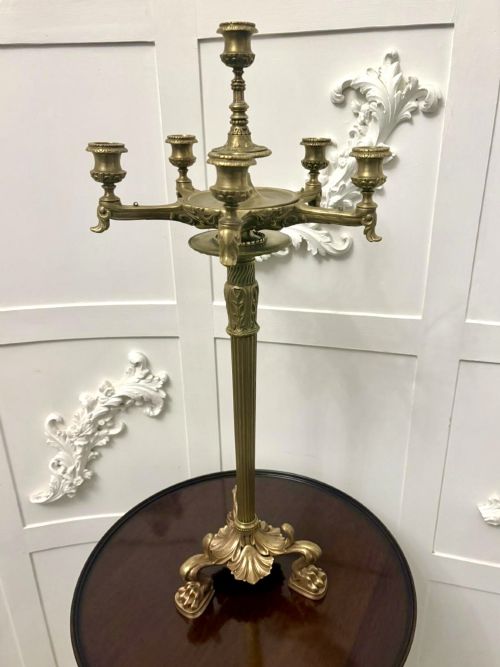
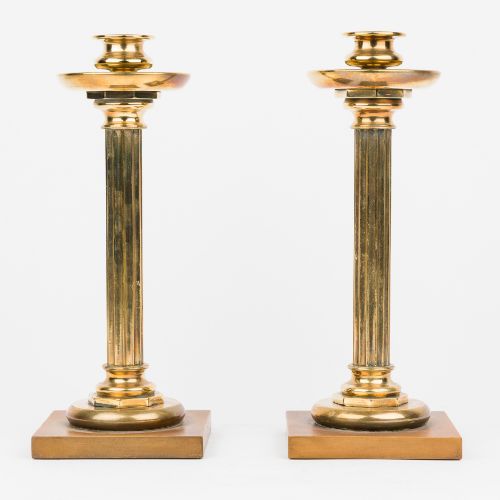
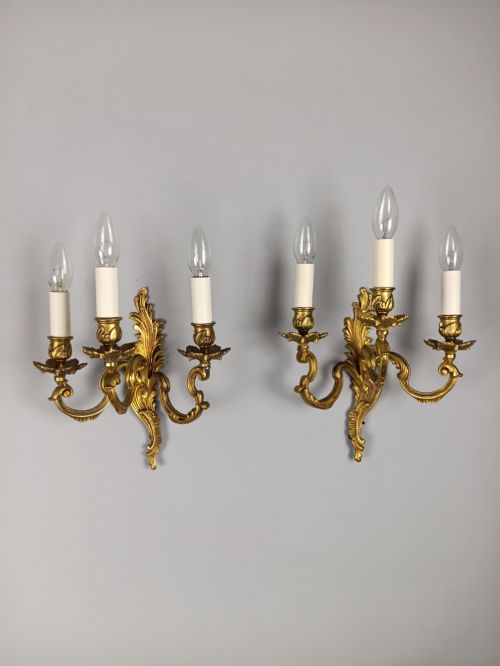
When you search for classical brass holders, you encounter a diverse range of metalwork designed for illumination and display, spanning from the eighteenth century into the early twentieth century. These pieces encompass candlesticks, multi-branch candelabra, wall lights, and specialised stands created during the Regency, Victorian, and Edwardian periods.
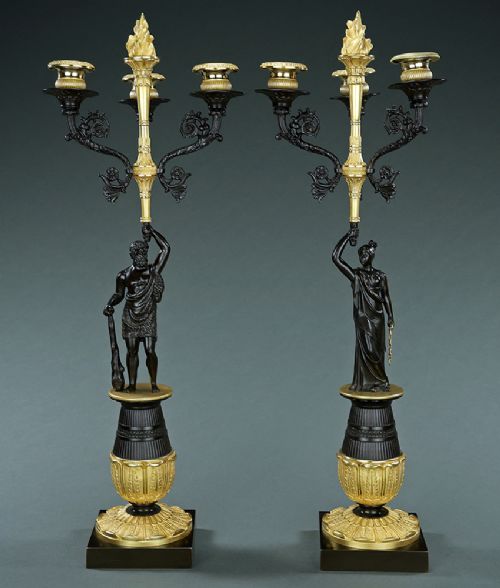
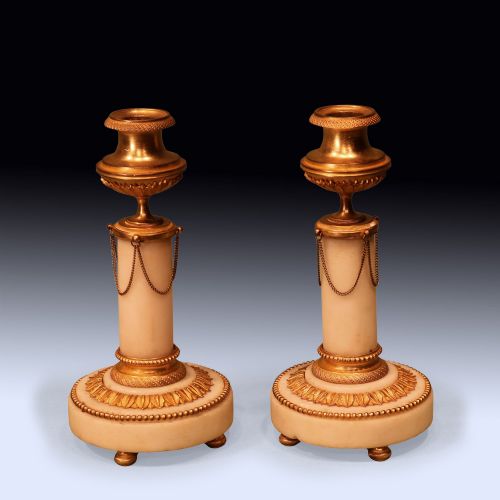
The objects frequently combine polished brass or gilt bronze with contrasting elements such as white marble, patinated bronze, and occasionally glass. Many examples reflect specific historical revivals including French Empire, Louis XVI style, and neoclassical design principles.
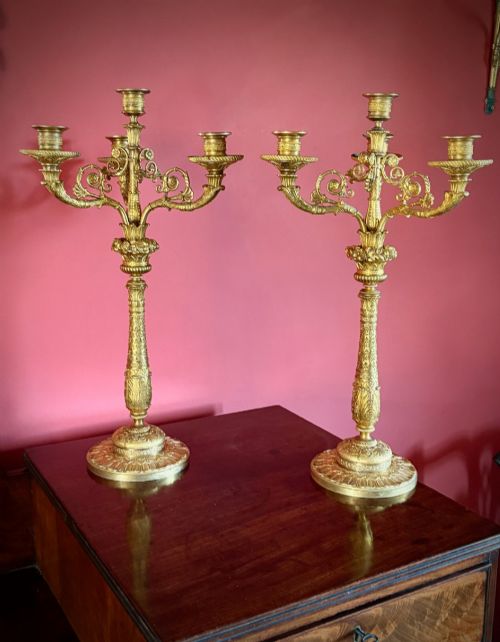
The selection ranges from sturdy domestic brass candlesticks to grand ormolu candelabra featuring figural motifs like cherubs, dolphins, and mythological subjects. Pairs dominate the offerings, providing the balanced ornamentation characteristic of formal nineteenth-century room schemes.
Materials and construction methods
The primary structural metal is cast brass or bronze, which frequently receives a mercury-gilded finish known as ormolu or surface patination to create contrasting dark and bright areas. Metal components are cast in sections using traditional foundry methods before being chased, turned, and assembled with threaded pins or screws.
Many heavy examples incorporate natural white marble bases or columns to add visual weight and tonal variety to the metallic elements. Secondary materials like rosewood or glass appear in specific functional forms such as music stands and bouillotte lamps.
Classical Brass Holders Retail Price Guide 2026
Typical asking prices for classical brass holders among the pieces listed under this phrase on Sellingantiques today, from the lower quarter to the upper quarter. They describe what is for sale here now, not the wider market.
Listings feature items spanning the eighteenth century to the 1930s, incorporating brass, ormolu, marble, and patinated bronze.
Markers of distinction and craftsmanship
Quality in these metalwares reveals itself in the crispness of the chasing and the depth of the original gilding or patination. Finer examples display sharp, hand-finished details on figural elements and foliage rather than the soft contours typical of mass production.
The integration of mixed materials also signals superior manufacture, particularly where bronze, ormolu, and marble fit together with absolute precision without visible gaps or inferior modern replacements.
J. Miller
The Classical Brass Holders Glossary
- Ormolu
- A gilded bronze finish achieved by applying a mercury and gold amalgam to a bronze object and heating it. This technique produces a rich, durable golden surface seen on high-end French and English pieces.
- Candelabra
- A branched lighting fixture designed to hold multiple candles simultaneously. These pieces often feature removable arms that allow the main body to function as a simple candlestick.
- Patinated bronze
- Bronze that has been chemically treated to darken its surface tone. This treatment highlights the polished highlights and gilded details of a casting.
- Pricket candlestick
- A candlestick that utilises an upward-facing metal spike to skewer and secure the base of a candle. This form is often associated with ecclesiastical or earlier domestic lighting.
- Grand Tour
- A traditional journey through Europe undertaken by upper-class young men in the eighteenth and nineteenth centuries to collect art and antiquities. Souvenirs from these travels frequently included bronze sculptures and decorative metalwork.
Classical Brass Holders: Frequently Asked Questions
How do I clean antique brass and ormolu?
Antique brass and ormolu require gentle dusting with a soft, dry cloth to remove surface particles. Chemical metal polishes should be avoided entirely because they strip away historic patination and original gilding.
If the metal requires deeper cleaning, a mild solution of warm water and neutral soap applied sparingly with a soft brush is safest. Dry the piece thoroughly immediately afterwards to prevent oxidation.
Were these pieces originally wired for electricity?
None of these antique holders were electrified when first made; they were strictly designed for wax candles, oil, or gas illumination. The introduction of wiring usually occurred much later during the twentieth century for domestic convenience.
Many surviving examples retain their original unblemished sockets and proportions without having undergone conversion. If you find a lamp version, such as a bouillotte standard, it may incorporate integrated wiring suited for modern interior use.
How can I tell a Regency piece from a Victorian one?
Regency pieces, dating from the early nineteenth century, typically exhibit clean neoclassical restraint, crisp cast bronze, and architectural motifs inspired by ancient Greece and Rome. They favor austere geometry alongside refined classical figures.
Victorian metalwork from the mid to late nineteenth century often displays heavier proportions and more ornate surface decoration. These later items frequently draw upon Rococo revival styles, incorporating elaborate scrolling foliage and mixed materials like white marble.