




Circular Bedside Cabinet
These circular bedside cabinets offer compact storage with architectural form, keeping nighttime necessities neatly enclosed within distinctive cylindrical wooden bodies.
Circular Bedside Cabinet
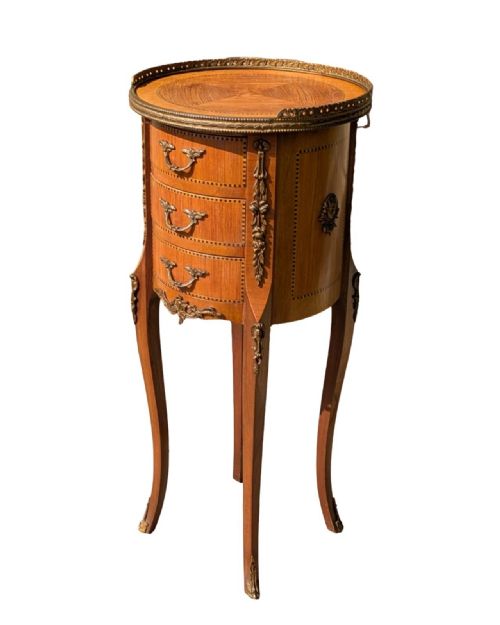
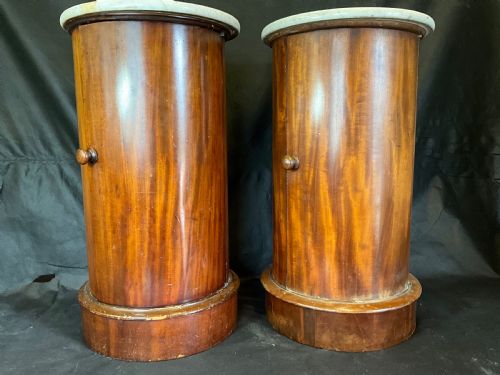
A circular bedside cabinet provides a distinct cylindrical silhouette designed to sit beside a bed while concealing storage behind a curved door. These pieces appear in forms ranging from plain mahogany cylinders to inlaid kingwood and marble-topped variants.
The versions most frequently met on this page date from the Victorian period, alongside Regency examples and later twentieth-century Art Deco interpretations. Cabinet makers constructed these items primarily as bedside tables, pot cupboards, and cylinder lamp stands.
Originating in English and French workshops, the designs incorporate varied timber veneers and mounted stone surfaces. The form prioritises enclosed storage within a footprint that avoids sharp corners in smaller sleeping chambers.
How they were made
Craftsmen built the curved bodies of these cabinets using bent wood techniques or vertical staves covered with fine veneers such as flame mahogany, walnut, and kingwood. These timber surfaces frequently received polished finishes to highlight the natural grain patterns across the cylindrical doors.
Many specimens integrate inset marble tops or faux marble surfaces designed to resist water from washing jugs and bedside pitchers. Brass elements appear as handles, gallery rails, and decorative mounts, particularly on French pieces influenced by Louis XV and Empire styles.
Listings feature mahogany, walnut, and kingwood veneers, alongside marble tops and brass details across Victorian, Regency, and Art Deco periods.
What varies in quality
The standard of a circular bedside cabinet rests on the precision of the curved door fitting and the integrity of the underlying timber construction. Superior examples maintain smooth operation of the cylindrical door within its frame without warping or binding.
Choice of materials significantly separates the tiers of production, distinguishing simple solid mahogany carcases from elaborately figured flame veneers, intricate marquetry inlays, and heavy, well-fitted marble slabs.
The Circular Bedside Cabinet Glossary
- Flame mahogany
- A veneer cut from timber where the branch joins the main trunk, producing a distinctive flickering, flame-like grain pattern. This decorative figuring is highly prized on nineteenth-century cabinet doors.
- Pot cupboard
- A small enclosed bedside cabinet originally designed to house a chamber pot. These practical pieces evolved into general bedside storage units.
- Kingwood
- A dense, richly coloured exotic timber with contrasting dark veins used extensively in French marquetry and fine cabinet making. It frequently appears in decorative panel borders.
- Cylinder
- A geometric solid with parallel sides and circular ends that forms the primary body shape of these cabinets. The curved wooden door follows this exact radius.
- Marquetry
- The art of applying decorative pieces of veneer to a structure to form intricate patterns and pictures. Craftsmen utilise various coloured woods to create contrast.
Circular Bedside Cabinet: Frequently Asked Questions
What were circular bedside cabinets used for?
These cabinets served primarily to hold night-time essentials and chamber pots out of sight within bedrooms. Their enclosed cylindrical bodies kept personal items neatly tucked away beside the bed.
Over time, their practical role shifted toward supporting lamps, decorative figures, and bedside books while maintaining a tidy domestic appearance.
How do I identify a Regency period cabinet?
Regency pieces often display clean architectural lines, dark flame-mahogany veneers, and minimal surface ornament. They reflect classical proportions inspired by ancient Greek and Roman designs.
Makers working in this era focused on the natural beauty of the timber grain rather than heavy carvings or applied metal mounts.
Why do some cabinets have marble tops?
Marble tops provided a durable, water-resistant surface for washing equipment, jugs, and drinking water pitchers used in bedrooms before indoor plumbing. The stone protected the wood underneath from spills and dampness.
Cabinet makers also used marble to add weight, stability, and a contrasting classical texture to the timber furniture.
How do I fit a circular cabinet into a room?
The curved footprint of a cylindrical cabinet allows it to fit comfortably into tight corners or beside low beds without sharp rectangular edges protruding into the pathway. Their compact diameter provides useful storage without dominating small spaces.
These pieces pair well with both traditional antique furnishings and simpler modern interiors due to their sculptural, self-contained form.