


Church Floor Candlestick Holder
A church floor candlestick holder is an architectural floor-standing light source designed to elevate ritual candles.
Church Floor Candlestick Holder
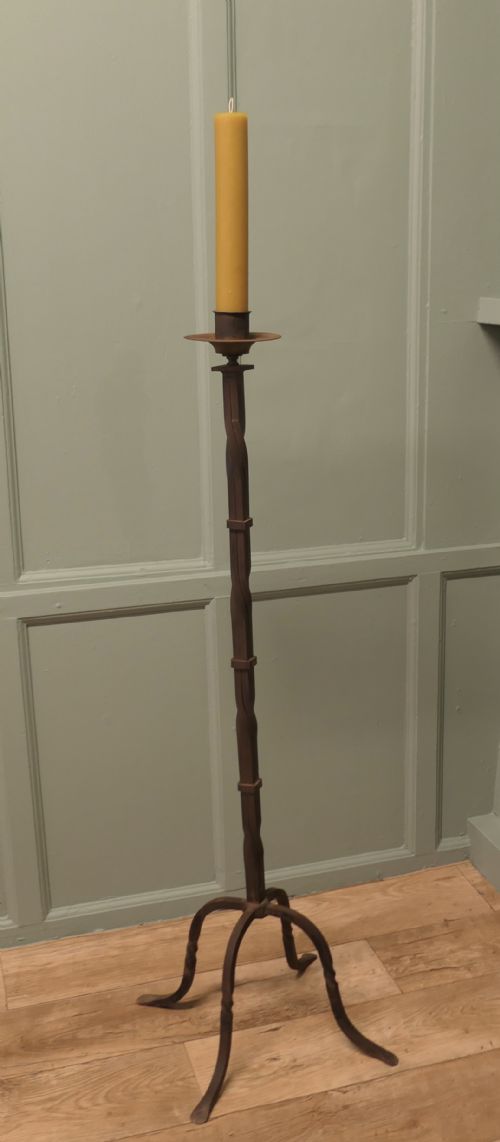
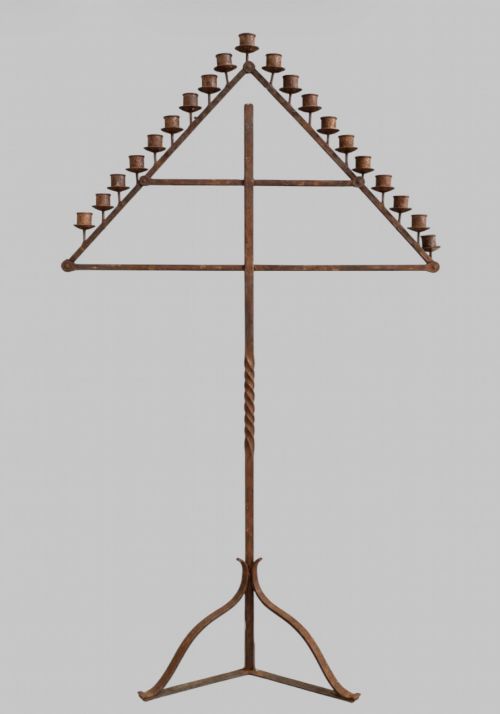
A church floor candlestick holder brings vertical presence to a room, drawing the eye upward with tall proportions suited for heavy candles or multi-candle arrays. When you search for a church floor candlestick holder, you encounter forms ranging from simple blacksmith-made wrought iron stands to elaborate carved wooden torcheres.
The pieces listed on this page span several centuries, with the nineteenth century heavily represented alongside examples from the eighteenth and early twentieth centuries. Originating from diverse European traditions, these objects include Italian giltwood altarpiece fixtures and French brass candle sticks.
The functional forms vary from single pricket sticks designed to hold large candles directly on a spike to multi-candle floor candelabra and architectural columns. Buyers encounter styles extending from Gothic Revival and Italian Baroque to Victorian Neoclassical and French Chateau.
Materials and construction methods
The construction relies on sturdy traditional materials, predominantly metals such as wrought iron, brass, and gilt metal alongside structural timber including carved pinewood and gesso-prepared giltwood. Blacksmiths hammered and shaped iron into robust floor stands, whilst woodworkers carved intricate architectural details and decorative columns.
Surface treatments play a vital role in the finish of these pieces, incorporating applied gold leaf, polychrome paint, and natural patinas on bare metal or aged wood. These finishes are applied directly to the base material, whether protecting exterior ironwork or enriching ornamental Italian baroque style altar-type holders.
Several tall stands come prepared for Masonic rituals, proving that church architecture occasionally found itself moonlighting in very private clubs.
Distinctions in craftsmanship
Quality rests in the architectural harmony of the proportions and the crispness of the hand-carved or hand-hammered details. Superior examples exhibit deliberate balance and weight, ensuring stability for tall stands without sacrificing elegance in the turned or forged elements.
The integrity of the original surface finishes, such as aged giltwood, polychrome paint, or blacksmith-forged textures, defines the character of the piece. Better preserved decorative schemes retain their intended depth and visual presence within a room.
The Church Floor Candlestick Holder Glossary
- Pricket
- A sharp metal spike on the top of a candlestick designed to secure a candle in place. This traditional mounting method appears frequently on older church candle holders.
- Torchere
- A tall ornamental stand or candlestick designed to support a light source. These pieces often feature column or pedestal forms.
- Giltwood
- Wood that has been coated with a thin layer of gold leaf. It is commonly found on ornate Italian and French baroque candlesticks.
- Polychrome
- Decorated in multiple colours. This technique is often seen on painted wooden altar-type candle holders from continental traditions.
- Candelabrum
- A large branched candlestick holding multiple lights. Floor-standing versions create substantial architectural statements.
Church Floor Candlestick Holder: Frequently Asked Questions
How were church floor candlesticks used originally?
These tall stands were placed near altars or within chancels to provide illumination and visual ceremony during religious services. Their height ensured that candlelight projected effectively across large ecclesiastical spaces.
Over time, many of these fixtures transitioned into domestic settings, serving as architectural statements or ambient lighting sources in large rooms.
How do I date a wooden floor candlestick?
Dating relies on examining the construction methods, tool marks, and stylistic indicators such as baroque carving or neoclassical column details. Wood shrinkage and the wear patterns beneath the base also provide clues to age.
Finish layers, including gesso and original polychrome paint, help align the piece with periods like the eighteenth or nineteenth century.
Are wrought iron candle stands stable?
Blacksmith-made iron stands are generally heavy and structurally robust, designed to support substantial candles safely on stone floors. Their weight is concentrated in the base to prevent tipping.
When placed on modern flooring, their sturdy leg configurations provide reliable balance for everyday decorative use.
What is the difference between a pricket stick and a socket candlestick?
A pricket stick uses an upward-pointing metal spike to impale the base of a candle, which is typical of older ecclesiastical designs. Socket candlesticks feature a cup or nozzle that cradles the bottom of the candle instead.
Many antique church holders utilise the pricket system for larger ceremonial candles.