
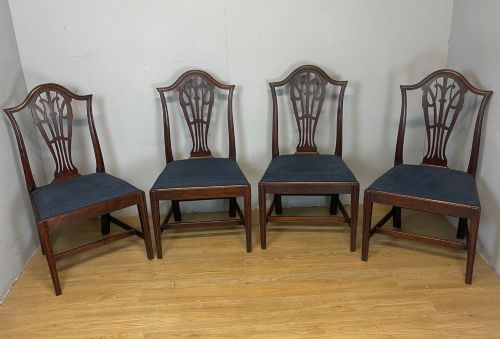
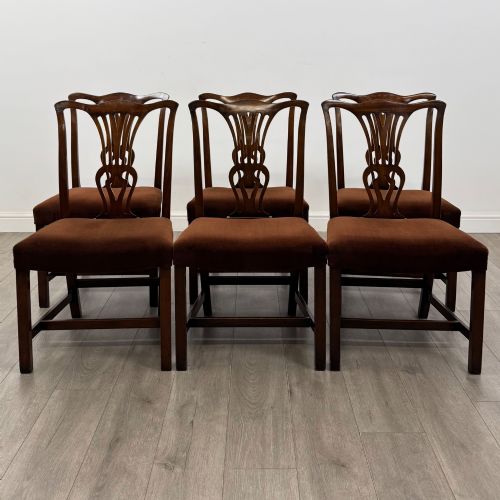
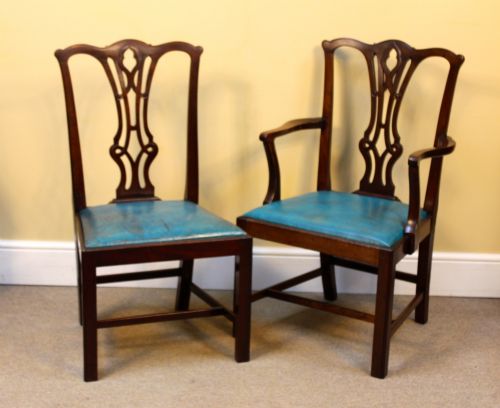
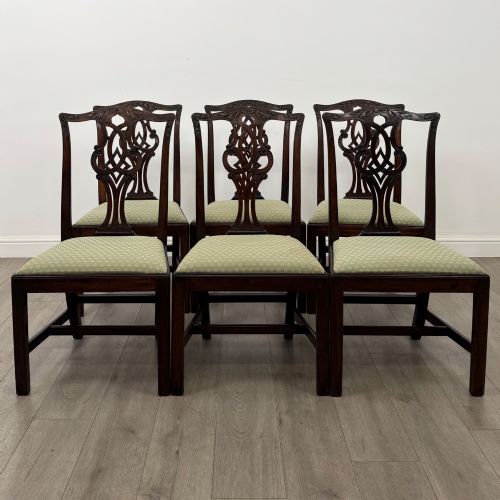



Chippendale Dining Room Chairs
Chippendale dining room chairs are timber seats defined by carved splats and robust frames, sought after for formal dining.
Chippendale Dining Room Chairs
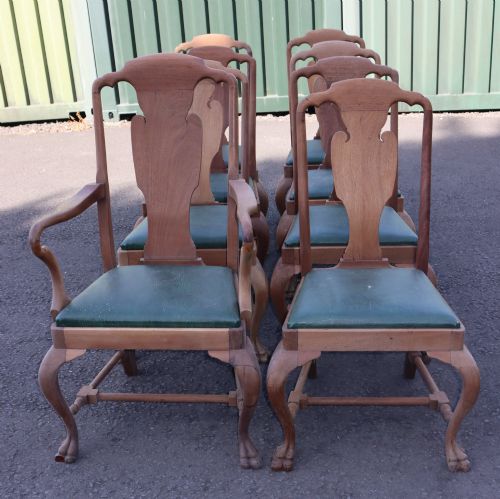
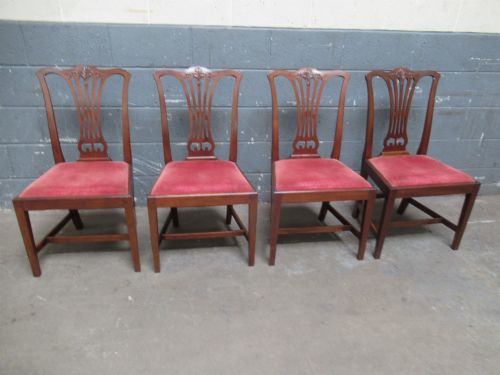
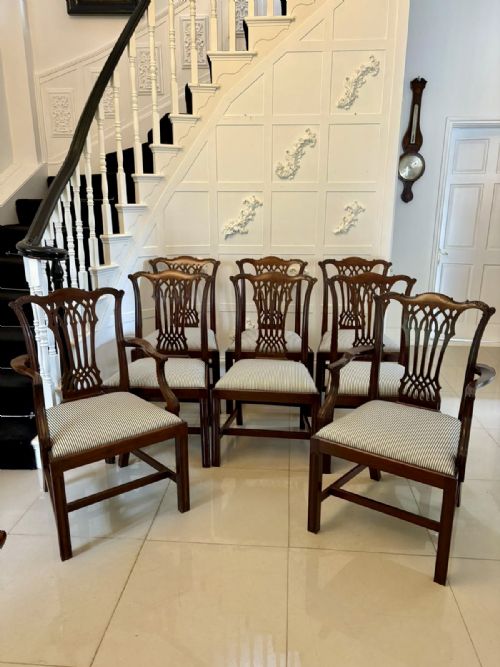
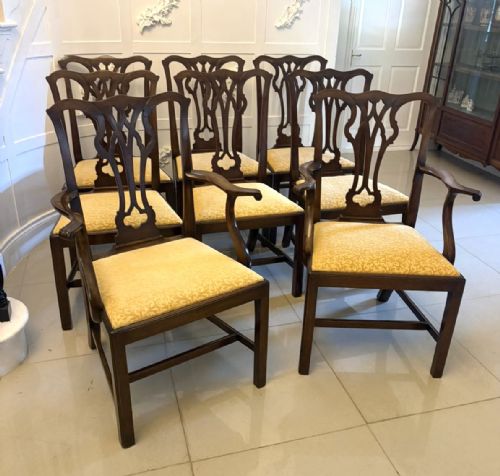
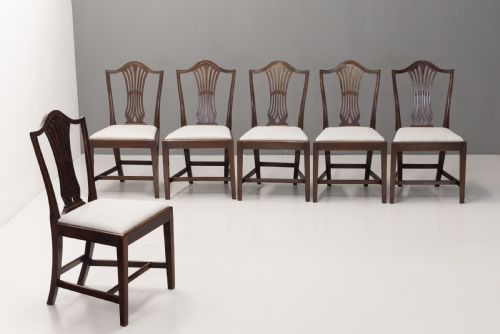
These Chippendale dining room chairs encompass pieces originating from the Georgian period through to later revival eras, including Edwardian and Victorian interpretations. Buyers typically encounter sets ranging from four to twelve chairs, frequently arranged as combinations of single side chairs and carver elbow chairs.
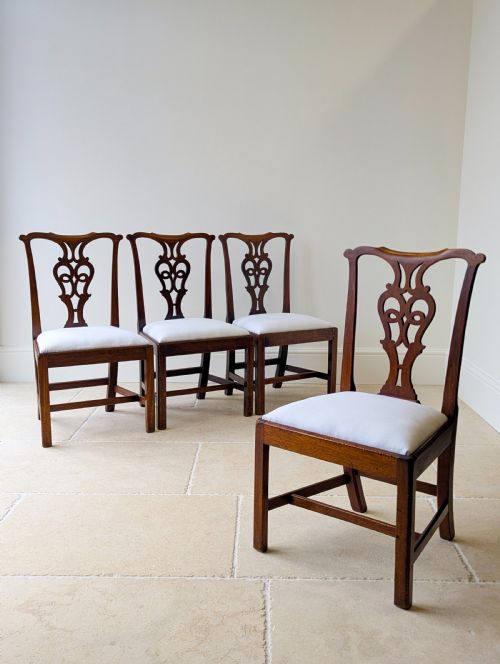
The forms draw directly upon eighteenth-century aesthetic traditions, materialising as dining chairs, side chairs, and carver chairs with distinctive pierced splat backs. Many options on this page reflect the enduring appeal of Chippendale style and Chippendale revival workmanship across the nineteenth and twentieth centuries.
Materials and construction methods
Mahogany serves as the primary timber across the vast majority of these listings, chosen for its structural strength and grain depth, alongside occasional examples rendered in walnut or ebonised wood. Joinery relies on traditional methods to support upright frames and heavily carved components.
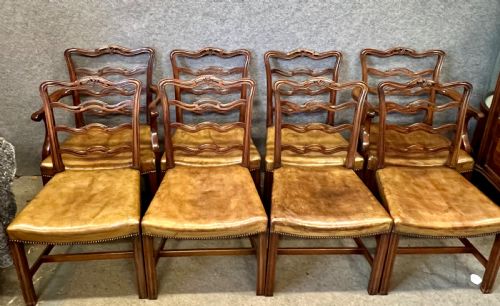
Seating areas are finished with various materials including leather, fabric upholstery, brass detailing, velvet, and textile coverings. Some specific pieces incorporate hand-dyed leather and intricate embroidery on the seat pads.
Listings feature mahogany as the dominant timber, accompanied by alternative materials such as leather, brass, velvet, and textile upholstery.
Distinctions in craftsmanship and form
The standard of carving on the back splats and top rails sets apart the finer examples, where crisp detail and deep relief work distinguish master execution from simpler production. Proportions and the symmetry of the legs and stretcher arrangements further separate ordinary sets from exceptional ones.
Uniformity across large sets of chairs dictates the overall desirability, as matching timber grain and consistent patination across six, eight, or ten chairs require careful selection by the original maker. The integrity of the frame construction and the quality of the upholstery integration contribute equally to the standing of a set.
William Walker & Sons
The Chippendale Dining Room Chairs Glossary
- Carver chair
- An armchair designed with elbow supports, traditionally placed at the head of a dining table. These often accompanied sets of smaller single side chairs.
- Splat
- The vertical central strip of wood within a chair back that connects the top rail to the seat. In these designs, the splat is frequently pierced and intricately carved.
- Georgian revival
- A stylistic movement spanning the nineteenth and twentieth centuries where makers replicated or reinterpreted eighteenth-century aesthetics. This encompasses much of the Chippendale style output seen here.
- Ebonised
- Wood finished with a dark coating or stain to imitate ebony. This treatment appears on specific nineteenth-century revival dining chairs.
- Side chair
- An upright chair without arms, intended for placement along the sides of a dining table. These form the numerical majority in larger dining sets.
Chippendale Dining Room Chairs: Frequently Asked Questions
How do I clean leather seat pads?
Leather seat pads on these chairs require gentle dusting with a soft, dry cloth to remove surface particles. Avoid harsh chemical cleaners that might strip the natural finish.
Conditioning creams formulated for antique leather help maintain suppleness over decades of use. Apply sparingly and buff gently with a clean cloth.
Can I mix carvers and single chairs?
Mixing carvers and single chairs reflects historical dining room traditions. Carvers traditionally stood at the head and foot of the table, flanked by side chairs.
Matching timber tones and similar carved back splats help maintain visual harmony when combining disparate chairs into a single dining set.
How do I identify Georgian revival pieces?
Georgian revival pieces display eighteenth-century stylistic traits executed with nineteenth or twentieth-century timber preparation and tool marks. Examining the underside of the frames and the wear patterns helps determine the true age.
Consulting the specific period listed alongside the design style provides clear chronological context for each set of chairs.
Are these chairs suitable for daily use?
Robust mahogany construction and traditional joinery make these timber chairs suitable for regular dining room use. Regular inspection of the leg joints ensures long-term stability.
Placing felt pads beneath the feet protects both the chair legs and domestic flooring during everyday movement around the table.