

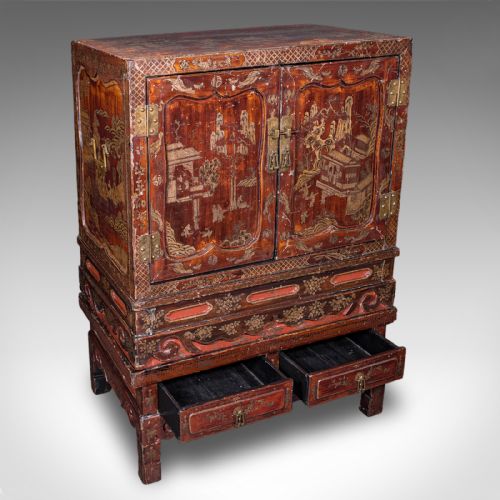


Chinese Gilt Cabinet
These Chinese gilt cabinet examples bring lacquered surfaces and gilded decoration into rooms that need depth and colour.
Chinese Gilt Cabinet
A Chinese gilt cabinet is a storage piece finished with lacquer and detailed with gold leaf or gilded ornamentation, appearing across periods such as the eighteenth century, the Victorian era, and the Edwardian years. The selection includes table cabinets, corner cabinets, cocktail cabinets, and larger cupboards on stands.
Most pieces seen here belong to the nineteenth century, alongside earlier eighteenth-century examples and items from the early twentieth century up to nineteen-ten. Makers and workshops produced these works in forms ranging from Regency Chinoiserie and Chinese Export to Qing Dynasty styles and traditional Chinoiserie.
Buyers also encounter related decorative plates when searching this category, notably pieces by C.J. Mason from the Georgian period. The primary focus remains on table cabinets, desk cabinets, and cabinets on stands that display intricate surface work.
How they were made
Makers constructed these cabinets using wood as a base material before applying coats of lacquer, often in black or red finishes. Artisans then added gilded decoration and gold leaf to create the pictorial scenes and ornamental borders characteristic of the style.
Hardware such as brass hinges, locks, and mounts complemented the wooden structures and lacquered exteriors. Some pieces also incorporated earthenware or ironstone elements alongside enamel details, particularly in related tablewares.
Chinese Gilt Cabinet Retail Price Guide 2026
Typical asking prices for chinese gilt cabinet among the pieces listed under this phrase on Sellingantiques today, from the lower quarter to the upper quarter. They describe what is for sale here now, not the wider market.
Some nineteenth-century makers hid tiny gilded insects within the lacquer foliage, rewarding anyone who looked closely at the corner of a door.
What varies in quality
The fineness of the gilded decoration and the depth of the lacquer finish distinguish the better examples from simpler ones. Cabinets with crisp pictorial detailing and well-preserved gold leaf demonstrate superior workshop execution.
Proportion and form also determine distinction, particularly in how cabinets integrate with their stands or how cleanly the brass hardware aligns with the timber body.
C.J. Mason
The Chinese Gilt Cabinet Glossary
- Chinoiserie
- European interpretations and adaptations of Chinese artistic traditions, popular in furniture and decorative arts during various periods. This style heavily influences the surface decoration of many cabinets.
- Lacquer
- A durable finish applied in multiple layers to wood and polished to a smooth surface. It provides the dark or red ground typical of these cabinets.
- Gilt
- Covered thinly with gold leaf or gold paint to highlight ornamental details. It creates the characteristic metallic contrast against the dark lacquer background.
- Qing Dynasty
- The last imperial dynasty of China, spanning from sixteen-forty-four to nineteen-shill-and-twelve. Pieces from this era often inform the export and Chinoiserie designs seen in European collections.
Chinese Gilt Cabinet: Frequently Asked Questions
What is a Chinese gilt cabinet?
A Chinese gilt cabinet is a wooden storage piece finished in lacquer and decorated with gold leaf or gilded motifs. These range from small table cabinets and desk versions to large cupboards mounted on stands.
Such pieces often reflect Chinoiserie taste or Chinese Export production, spanning the eighteenth, nineteenth, and early twentieth centuries.
Where were these cabinets used?
These cabinets served as focal points in reception rooms, drawing rooms, and studies for storing precious items or writing materials. Table cabinets sat upon larger furniture pieces while cabinet on stand versions stood independently.
Cocktail cabinets provided specialised storage for glassware and bottles in later nineteenth-century and early twentieth-century interiors.
How do I care for lacquer and gilt?
Keep lacquered surfaces away from direct sunlight and steady heat sources to prevent the finish from drying or cracking. Dust gently with a soft, dry cloth without applying modern chemical polishes.
Maintain stable room humidity to protect both the wooden carcass and the delicate gold leaf decoration.