



Chinese Cloisonne Enamel Lamps
Chinese cloisonne enamel lamps bring brilliant colour and intricate wirework into a room, offering functional lighting combined with historic craftsmanship.
Chinese Cloisonne Enamel Lamps
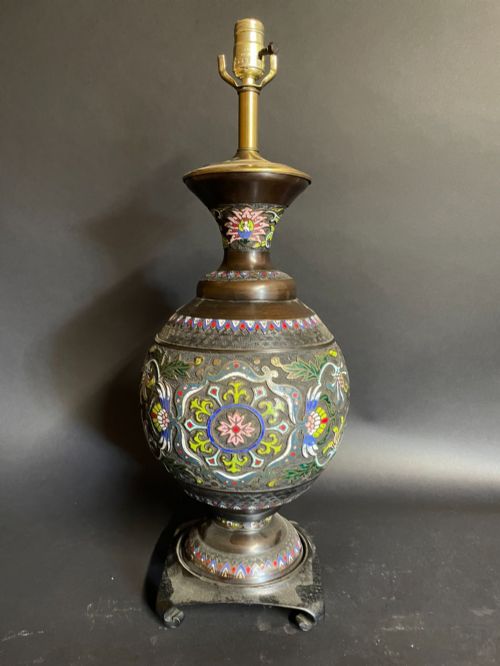
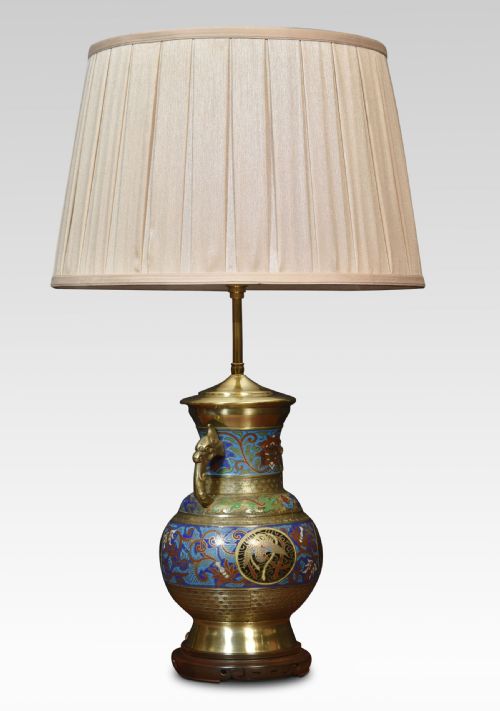
Chinese cloisonne enamel lamps are typically formed from historic vases or vessel bases that have been converted into table lamps over time. These pieces span the nineteenth century and the early twentieth century, taking the form of single lamp bases and balanced pairs.
The objects originate from Qing Dynasty production, Chinese Export output, and the subsequent Chinese Republic period, alongside pieces worked in an oriental style. They showcase the traditional vessel forms that collectors seek when searching for Chinese cloisonne enamel lamps.
Most examples found here appear as table lamps, frequently retaining their original vase bodies mounted with modern or period electrical fittings. Buyers encounter single items as well as matched pairs suitable for placing on sideboards or mantelpieces.
How they were made
Craftsmen built these pieces using metal foundations such as brass, copper, and bronze, sometimes applying gilt bronze or ormolu mounts to the base and collar. Fine metal wire was soldered onto the surface in intricate patterns to form the individual cells, known as cloisons, which would hold the coloured enamels.
Coloured enamel pastes were packed into the wire compartments before the vessel underwent high-temperature firing. After cooling, the surface was ground down and polished until the metal wire rims and the smooth glass enamel rested on an even plane.
Some vases spent decades holding flowers before someone finally decided they looked even better glowing under a fabric lampshade.
What varies in quality
Quality rests upon the precision of the wirework and the richness of the enamel palette filling each cell. Finer vessels display tightly controlled geometric or floral patterns with minimal pitting in the vitreous paste.
The choice of base metal and the presence of supplementary materials, such as gilt bronze mounts or carved wood stands, elevate the distinction of the piece. Conversion work also matters, as professional wiring that preserves the integrity of the original vase distinguishes superior examples from hurried adaptations.
The Chinese Cloisonne Enamel Lamps Glossary
- Cloisonne enamel
- A decorative metalwork technique where fine wires create small compartments filled with vitreous paste. This method defines the primary surface decoration of the pieces.
- Gilt bronze
- Bronze treated with a layer of gold to produce a rich metallic sheen. It frequently appears on mounts and fittings.
- Ormolu
- Cast brass or bronze that has been gilded and finished with precision. Makers utilised it to provide decorative collars and bases.
- Qing Dynasty
- The final imperial dynasty of China, spanning from sixteen-forty-four to nineteen-twelve. Many foundational vessels date from the later years of this era.
- Chinoiserie
- European artistic styles reflecting Chinese decorative motifs. Pieces on this page stem directly from Chinese production rather than European imitation.
Chinese Cloisonne Enamel Lamps: Frequently Asked Questions
How do I identify a nineteenth-century piece?
Nineteenth-century examples typically display heavier metal foundations, deeper enamel tones, and traditional Qing Dynasty or export motifs. The weight of the bronze or copper core often points to this earlier period.
Closer inspection of the wirework reveals the hand-formed cellular patterns characteristic of nineteenth-century production before twentieth-century standardisation took hold.
Do these lamps come in pairs?
Many listings feature matched pairs of lamps created from symmetrical cloisonne vases. These are particularly sought after for balanced placement on sideboards or large desks.
Single lamp bases also appear frequently, offering standalone decorative lighting for smaller spaces or occasional tables.
What metals are used beneath the enamel?
The underlying metal body is generally formed from brass, copper, or bronze. Some pieces incorporate gilt bronze or ormolu mounts to accent the neck and foot.
These durable base metals provided a stable canvas for the delicate wire cells and coloured glass pastes fired upon them.