



Champleve Clock
A champleve clock brings together heavy gilt bronze and vibrant recessed enamel panels, offering a striking centrepiece for a mantel or desk.
Champleve Clock
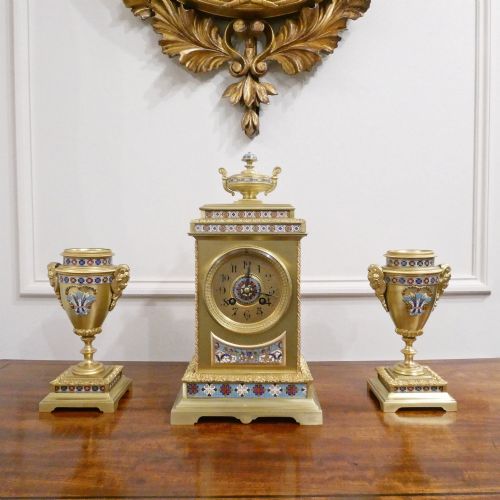
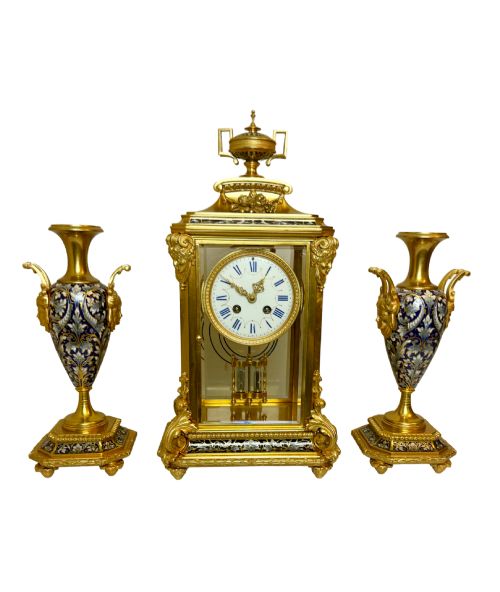
A champleve clock is a timepiece housed in a heavy metal case decorated with recessed enamel designs, predominantly originating from French workshops during the nineteenth and early twentieth centuries. These pieces appear in forms ranging from grand mantel clock garniture sets to delicate carriage clocks and small desk timepieces.
Buyers will most frequently encounter mantel clocks and carriage clocks dating from the late nineteenth century, particularly from the eighteen-eighties and eighteen-nineties. Many of these incorporate glass panels in crystal regulator designs or feature ornamental gilt bronze and brass framing.
The aesthetic leans heavily towards French styles such as the Belle Epoque, Second Empire, and Rococo Revival, alongside Victorian interpretations. These clocks served both a functional domestic purpose and a decorative role in grand nineteenth-century interiors.
How they were made
Makers constructed the cases primarily from cast bronze, brass, or ormolu, sinking troughs directly into the metal surface to hold the coloured vitreous enamel. This champleve technique created intricate patterns and bands that were then fired and polished flush with the metal framework.
Movements were typically housed within bevelled glass enclosures or heavy metal casings, often accompanied by hand-painted ceramic dials and delicate enamel detailing. Gilt finishes were applied to the bronze or brass frames to provide a rich, reflective surface alongside the vibrant enamel panels.
Champleve Clock Retail Price Guide 2026
Typical asking prices for champleve clock among the pieces listed under this phrase on Sellingantiques today, from the lower quarter to the upper quarter. They describe what is for sale here now, not the wider market.
Available forms range from miniature bedside timepieces and carriage clocks to large mantel clock garniture sets.
What varies in quality
Quality in a champleve clock rests primarily on the depth and crispness of the metal casting and the precision of the enamel work within the recessed channels. Finer examples display meticulous hand-chasing on the gilt bronze and vibrant, uniform enamel colours without pitting or uneven firing.
The sophistication of the clock movement also distinguishes the range, with repeating striking mechanisms and complex escapements representing higher standards of horological craftsmanship. Complete clock sets that retain their original matched garniture vases or candelabra demonstrate superior original curation.
Le Roy and Fils·Barwise London
The Champleve Clock Glossary
- Champleve enamel
- A technique where troughs are hollowed out of a metal surface and filled with vitreous enamel before being fired and polished. This method creates bold coloured patterns bordered by thin lines of exposed metal.
- Ormolu
- A method of applying finely ground high-carat gold to an object of bronze or brass using mercury. It provides a rich, durable golden finish characteristic of many nineteenth-century French clock cases.
- Crystal regulator
- A mantel clock featuring bevelled glass panels on all sides, allowing the movement to be viewed from multiple angles. These often incorporate delicate enamel dial rings and decorative mercury pendulums.
- Carriage clock
- A portable spring-driven timepiece fitted with a handle, originally designed for travelling. Many feature glazed panels and intricate enamel banding around the dial and case.
Champleve Clock: Frequently Asked Questions
How do I wind a champleve clock?
Most of these clocks use a key inserted into winding holes on the dial to tension the spring-driven movement. Care should be taken not to over-wind the mechanism.
Striking clocks should be allowed to complete their chime cycle without interruption during the time-setting process to prevent damage to the gear train.
Where should I place a crystal regulator?
Crystal regulators benefit from placement on a stable, level surface away from direct sunlight and sudden temperature shifts. Because their movements are visible through glass on all sides, a freestanding mantel or prominent desk allows adequate appreciation of the internal mechanics.
Ensure the location is free from heavy vibrations to maintain accurate timekeeping in these delicate spring-driven mechanisms.
What is a clock garniture set?
A clock garniture set comprises a central mantel clock accompanied by matching side ornaments such as urns, vases, or candelabra. These matched pieces were designed to be displayed together on a mantelpiece to create a balanced decorative scheme.
Surviving sets share identical material finishes, such as gilt bronze and champleve enamel, matching the central timekeeper.
How do I identify a Victorian carriage clock?
Victorian carriage clocks typically feature a rectangular brass or gilt metal case with a swinging handle at the top and bevelled glass inspection panels. Many incorporate enamelled dials or decorative enamel banding around the bezel and side pillars.
Platform escapements visible through the top glass panel help distinguish these nineteenth-century portable timepieces from standard desk clocks.