



Celestial Star Brooch
A celestial star brooch captures the night sky in precious metal and old cut stones, offering versatile elegance as both a pendant and a pin.
Celestial Star Brooch
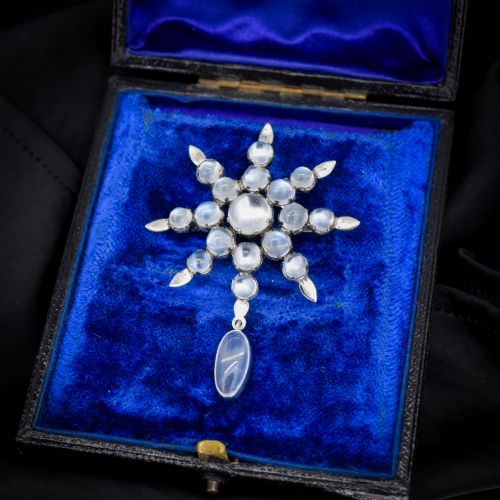
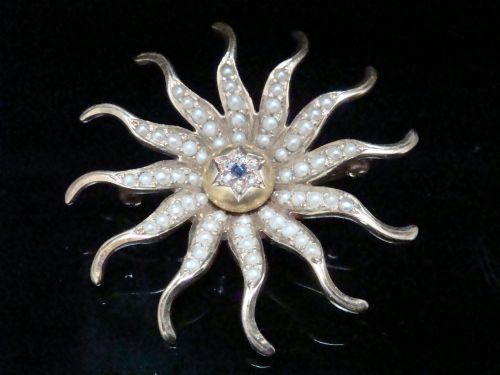
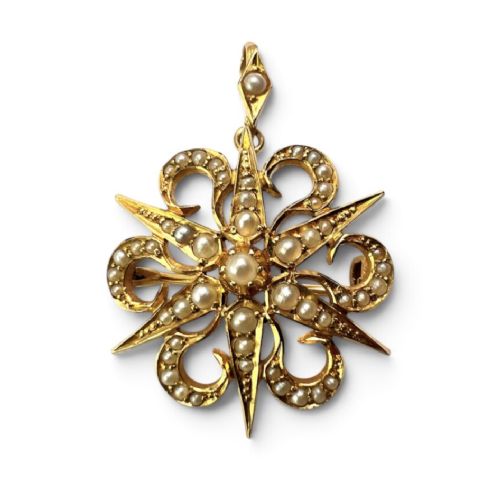
A celestial star brooch represents a major design theme across the Victorian and Edwardian periods, taking the form of multi-rayed starbursts and sunbursts. These ornaments combine the functions of brooches and pendants, often featuring convertible mounts that allow them to be worn on chains or pinned directly to garments.
The most common examples on this page date from the Victorian era down to Edwardian times, utilising high carat gold, silver settings, and seed pearls. Many pieces span dual categories, appearing as tiaras and brooches or pendant brooches that demonstrate the multi-purpose ingenuity of nineteenth-century jewellers.
How they were made
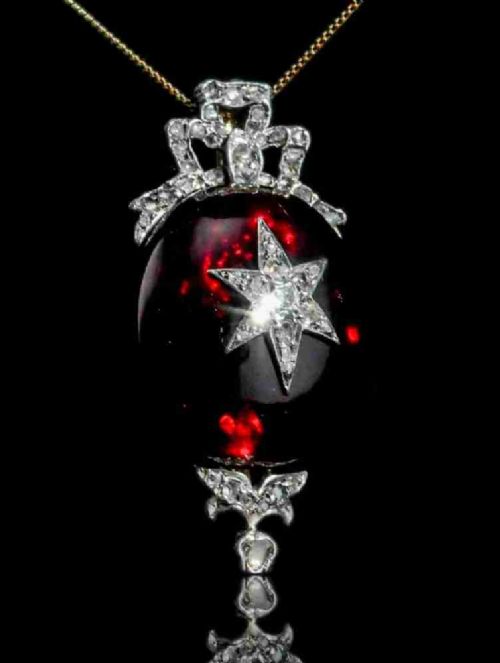
Craftsmen of the nineteenth century built these stellar jewels using combinations of silver and gold, frequently mounting diamonds in silver-topped gold to enhance the brilliance of old European and rose cut stones. Seed pearls and larger pearls are meticulously set into the radiating rays of gold sunbursts.
Metals such as 9ct, 14ct, and 15ct yellow gold form the structural bases and convertible fittings, while garnets and sapphires occasionally provide centres of colour amidst the diamond fields.
Celestial Star Brooch Retail Price Guide 2026
Typical asking prices for celestial star brooch among the pieces listed under this phrase on Sellingantiques today, from the lower quarter to the upper quarter. They describe what is for sale here now, not the wider market.
Object forms span standard brooches, pendant brooches, convertible tiaras, and dedicated sunburst pendants.
What varies in quality
Quality in a celestial star brooch rests upon the scale, weight, and cut of the gemstones, where larger carat weights of old European cut diamonds command greater presence than smaller rose cut stones. The complexity of the metalwork, seen in multi-tiered starbursts and convertible tiara mechanisms, defines the upper tier of execution.
The integration of materials also dictates standing, with silver-set diamond faces backed in gold representing a more elaborate construction than simpler single-metal seed pearl designs.
The Celestial Star Brooch Glossary
- Old European cut
- An early form of brilliant cut diamond featuring a small table, high crown, and large culet, typical of nineteenth-century stones. These cuts display distinct hand-fashioned facets that catch candlelight.
- Rose cut
- A vintage diamond cut with a flat base and a domed crown composed of triangular facets. This style resembles an unopened rosebud.
- Convertible
- A piece of jewellery designed with detachable or hidden fittings to serve multiple purposes, such as transitioning from a brooch to a pendant or a tiara. This versatility was highly prized in period wardrobes.
- Seed pearl
- A very small natural or cultured pearl, often undrilled or half-drilled, used in clusters or delicate lines to create intricate floral and stellar motifs in Victorian and Edwardian pieces.
- Sunburst
- A decorative motif radiating outward from a central point, mimicking the rays of the sun. It shares structural similarities with the starburst in antique celestial designs.
Celestial Star Brooch: Frequently Asked Questions
How do I wear a convertible star brooch?
Many of these pieces feature hidden loops or detachable fittings that allow the star to slide onto a neck chain or secure onto a tiara frame. This dual functionality was built into the original mount.
When worn as a brooch, sturdy pin stems and safety catches keep the heavier diamond and gold settings secure against fabric.
What is the difference between Victorian and Edwardian stars?
Victorian celestial pieces often pair silver-set diamonds with yellow gold backs, sometimes incorporating garnets or cabochon stones in heavier, more substantial frames. Edwardian examples frequently lean towards lighter gold mountings with seed pearls and delicate sunburst proportions.
Both periods embraced the night sky motif, but Edwardian work tends towards airier, more lace-like gold structures.
Are all star brooches also pendants?
A large proportion of these jewels are manufactured with dual capabilities, featuring fold-down loops or screw-in bails tucked behind the rays. This lets the owner switch between pinning the piece to a lapel and hanging it from a chain.
Examining the reverse side reveals whether the conversion hardware is an original integrated feature.
What metals are typically found in these pieces?
Nineteenth-century jewellers commonly utilised 9ct, 14ct, and 15ct yellow gold for the structural rays and pin mechanisms. Silver was frequently employed as a top setting over gold to reflect white light through old cut diamonds.
This two-tone metal combination is a hallmark of period manufacturing techniques.