
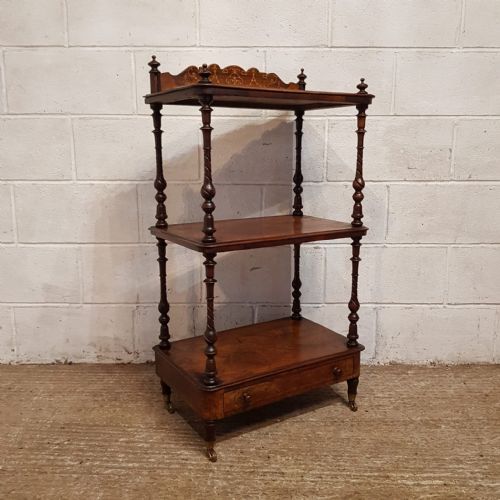


Carved Wooden Corner Unit
A carved wooden corner unit puts dead wall space to work, bringing timber warmth and historic form into a room.
Carved Wooden Corner Unit
A carved wooden corner unit takes several forms on this page, spanning corner cabinets, cupboards, shelves, and whatnots designed to fit snugly into room angles. These pieces emerge from periods including the Georgian and Victorian eras, utilising timber frames built to maximise awkward spaces.
Most items you encounter here lean towards Victorian burr walnut or mahogany designs, alongside Georgian oak and red walnut cupboards. Wall-mounted cabinets and floor-standing whatnots make up the selection, reflecting domestic storage needs across the eighteenth and nineteenth centuries.
How they were made
Cabinet makers relied on solid timbers such as oak, walnut, and mahogany, often applying burr walnut veneers or delicate marquetry and inlay work to surfaces. Brass hardware appears alongside carved details, creating textured panels and doors.
Construction methods range from wall-mounted frames to freestanding tier structures and dome-top fitted interiors. Joinery focuses on stability within ninety-degree angles, integrating shelves and cupboards to suit domestic display and storage.
Forms on this page range from enclosed dome-top cabinets to open tier whatnots and wall shelves.
What varies in quality
The refinement of timber selection and decorative detail marks the distinction between standard items and finer examples. Rich figuring in burr walnut or intricate marquetry elevates a piece well beyond plain construction.
Depth of carving and the integration of fitted interiors or mirrored panels demonstrate superior craftsmanship. The balance between structural timber and surface ornament determines the visual weight of the unit.
Liberty and Co
The Carved Wooden Corner Unit Glossary
- Burr walnut
- A timber taken from walnut tree growths, prized for its swirling, highly figured grain patterns. Cabinet makers used it for decorative veneer work on high-status furniture.
- Marquetry
- The art of applying pieces of veneer to a structure to form decorative patterns or pictures. Different coloured woods are cut and fitted together precisely.
- Whatnot
- An open set of freestanding shelves used for displaying ornaments and books. These tiered pieces gained popularity during the Victorian period.
- Chippendale Revival
- A late nineteenth-century style replicating the mid-eighteenth-century designs associated with Thomas Chippendale. It typically employs mahogany and detailed carving.
- Dome top
- A rounded upper profile seen on certain cabinets and cupboards. This architectural shape provides extra internal height.
Carved Wooden Corner Unit: Frequently Asked Questions
Where should I place a corner unit?
These units fit directly into room angles to utilise space that standard furniture leaves empty. They anchor awkward junctions in dining rooms or hallways.
Freestanding models stand independently in a corner, while wall cabinets mount securely at eye level to display smaller items.
How do I tell Georgian from Victorian pieces?
Georgian examples often feature simpler lines in oak, red walnut, or mahogany, dating through the eighteenth century. Their proportions align with the architectural standards of that period.
Victorian pieces introduce busier timbers like burr walnut, alongside applied carving, mirrors, and revival styles such as Chippendale or Anglo-Moorish.
What is the difference between a cupboard and a whatnot?
A corner cupboard provides enclosed storage behind solid doors, keeping contents hidden from view. These suit practical storage needs.
A whatnot consists of open shelves designed specifically for display. They hold decorative objects and ornaments across multiple tiers.
Are these units suitable for small rooms?
Corner furniture is specifically designed to occupy unused wall junctions, freeing up floor space in compact areas. Wall-mounted cabinets lift storage off the floor entirely.
Tall freestanding units draw the eye upward, making efficient use of vertical volume without crowding the room.