


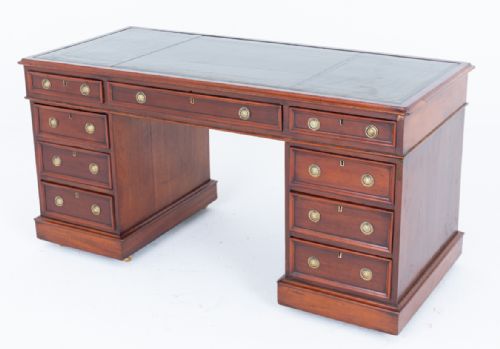
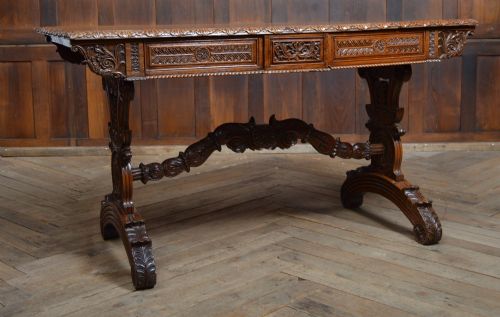


Carved Wood Partners Desk
A carved wood partners desk provides dual workspaces for shared studies and libraries, uniting fine cabinetwork with practical double-sided utility.
Carved Wood Partners Desk
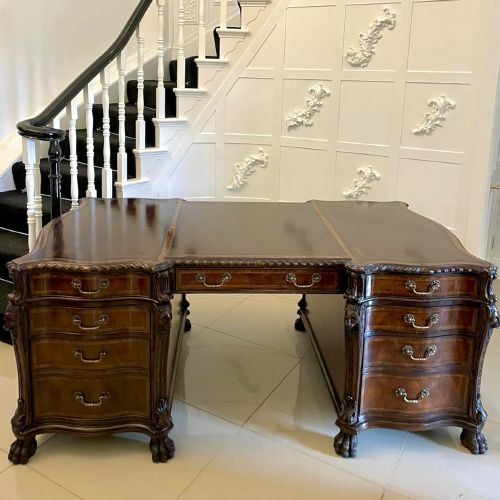
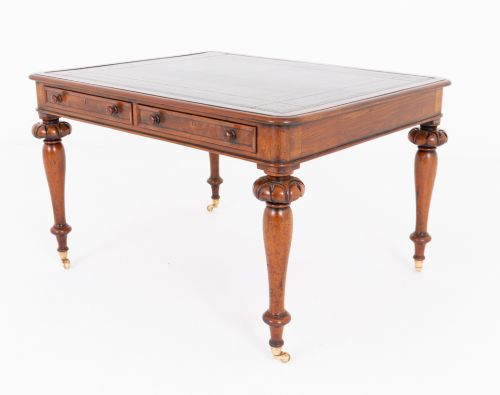
A carved wood partners desk functions as a double-sided writing station designed for two people to sit opposite one another. The form typically appears as a twin-pedestal pedestal desk or a large library table fitted with drawers and cupboards on both faces.
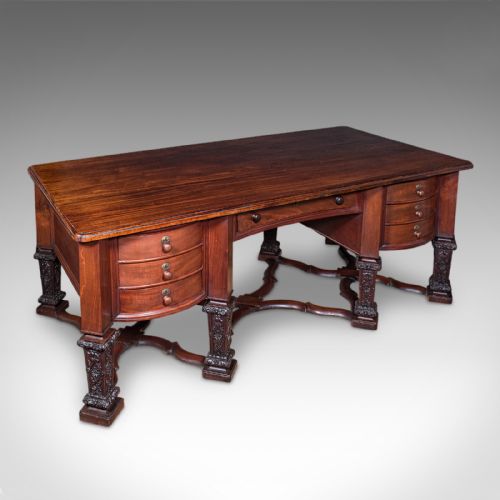
Most examples found in these listings date from the nineteenth century, spanning Victorian, Edwardian, and William IV periods. Timber choices run from dense mahogany and walnut to exotic padauk and rosewood.
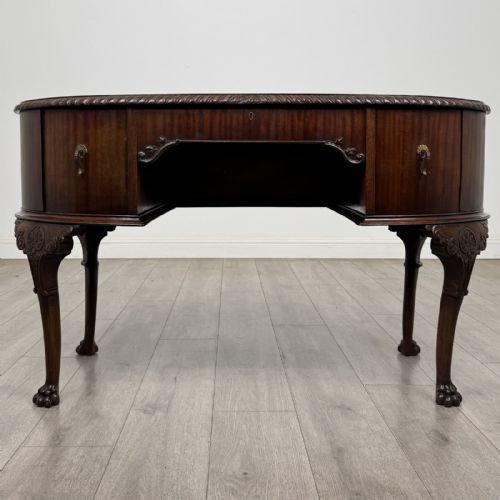
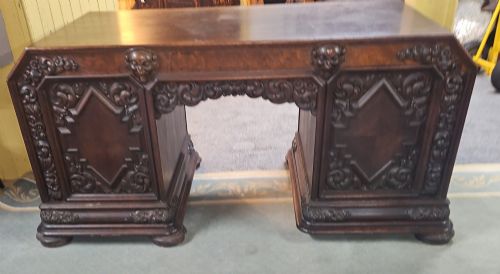
Makers often drew upon Georgian, Regency, and Louis XIV Revival styles for ornamental vocabulary. Carved pillars, lions paw feet, and panelled sides distinguish these heavier executive pieces from simpler writing tables.
Materials and construction methods
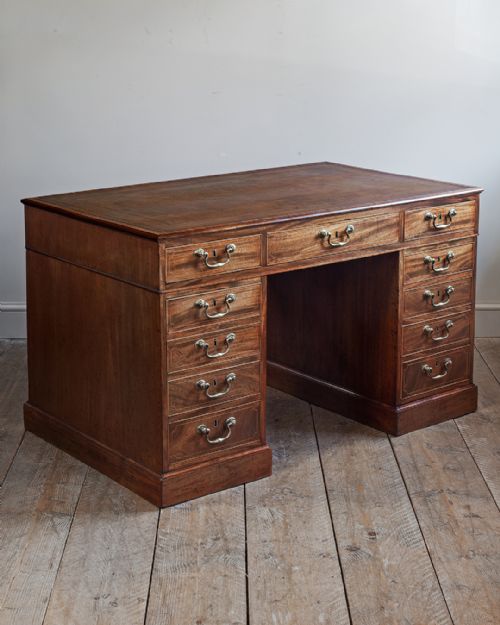
Cabinetmakers constructed the carcase and drawers primarily in solid mahogany, oak, or walnut, frequently applying fine veneers over secondary woods. Brass hardware such as drop handles and lever locks completed the functional fittings.
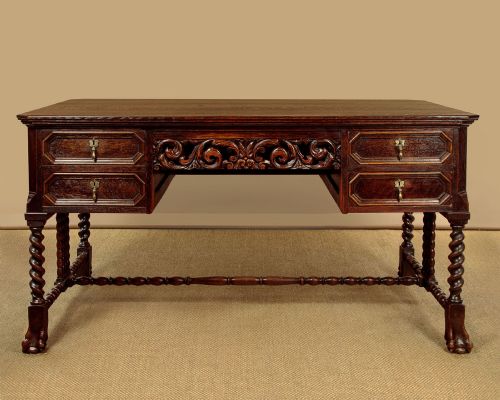
Writing surfaces were traditionally inset with tooled leather to provide a durable writing plane. Carved ornamentation on pillars, friezes, and feet was executed by hand directly into the dense timbers.
Carved Wood Partners Desk Retail Price Guide 2026
Typical asking prices for carved wood partners desk among the pieces listed under this phrase on Sellingantiques today, from the lower quarter to the upper quarter. They describe what is for sale here now, not the wider market.
Some nineteenth-century writers kept their inkwells steady while ships rolled at sea by choosing heavy padauk timber.
Assessing quality in construction and ornament
Quality rests upon the depth and crispness of the hand carving and the selection of figured timber veneers. Superior desks display well-matched grain patterns across all visible sides, including the secondary working face.
Internal construction reveals the standard of the workshop through hand-cut dovetails on drawer linings and solid timber drawer bottoms. The weight of the timber and the integration of brass locks and mounts further separate standard production from exhibition pieces.
Gillows·Hobbs and Co·Étienne Kohlmann
The Carved Wood Partners Desk Glossary
- Partners desk
- A large double-sided desk designed with drawers and cupboards accessible from both front and rear. This configuration allowed two individuals to work facing each other.
- Pedestal desk
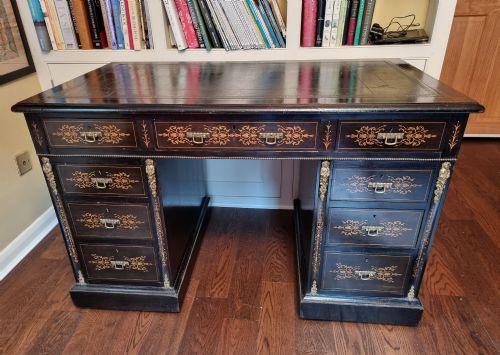
- A freestanding desk comprising two supporting pedestals or banks of drawers beneath a main writing surface. The top section typically rests on these columns for stability.
- Padauk
- A heavy, dense tropical timber displaying a rich reddish-brown colour that darkens with age. It appears frequently in Anglo-Indian furniture of the nineteenth century.
- Library table
- A large freestanding table used primarily for reading and writing, often finished on all sides with frieze drawers. These pieces frequently feature carved legs and stretcher supports.
- Dovetail
- A joint formed by interlocking wedge-shaped fingers used to secure drawer corners. Hand-cut variations indicate traditional cabinetmaking methods.
Carved Wood Partners Desk: Frequently Asked Questions
What is a partners desk?
A partners desk is a large double-sided desk featuring drawers and cupboards on both operational faces. This layout allowed two people to sit opposite one another and work simultaneously.
The form suits large studies, libraries, and open administrative spaces where freestanding placement is required.
How do I care for leather desk tops?
Leather writing surfaces require occasional treatment with specialist leather balms to prevent drying and cracking. Avoid using harsh chemical cleaners or excess moisture near the tooled borders.
Keeping the surface free of dust and using blotters protects the original hide from ink stains and wear.
Where were partners desks used?
These desks originated in grand nineteenth-century libraries, counting houses, and administrative offices. Partners, bankers, and senior officials utilised the dual-sided storage and writing space.
Today they function effectively as executive desks or central library tables in residential interiors.
How do I identify Victorian desks?
Victorian examples are identified by dense mahogany or walnut construction, heavy proportions, and elaborate carved details. Details such as lions paw feet and brass drop handles are common.
Drawer construction typically employs hand-cut dovetails and solid secondary timbers consistent with mid to late nineteenth-century manufacturing.