





Carved Wood Newspaper Rack
These carved wood newspaper rack designs bring order to daily journals and folios, combining timber construction with practical storage for the sitting room.
Carved Wood Newspaper Rack
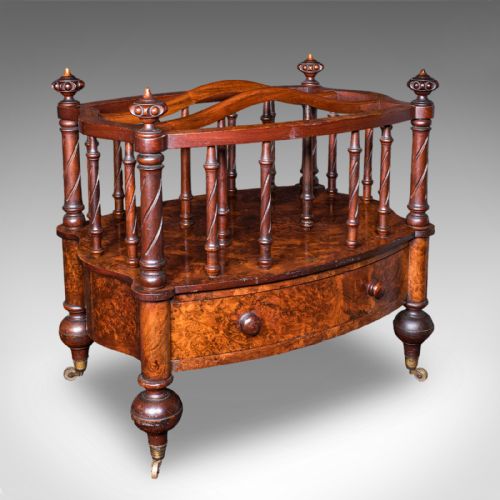
When you search for a carved wood newspaper rack, you encounter a selection of standing storage pieces designed for periodicals, journals, and sheets. The most common forms on this page include mahogany, rosewood, and walnut canterburys alongside dedicated magazine racks and folio stands.
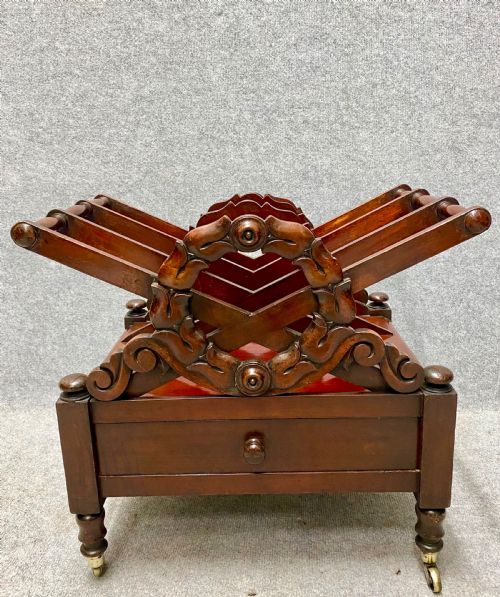
These items span periods from the 18th century through the Victorian, Regency, and Edwardian eras, reflecting changing domestic habits. Pieces often feature pierced scroll divisions, foliate designs, or wreath carvings executed in English, French, and Burmese workshops.
The layout generally incorporates vertical partitions for sorting papers, frequently supported on small turned feet or castors. Whether configured as a traditional canterbury or an open standing rack, each example serves the fundamental purpose of holding daily reading materials.
Materials and construction methods
Cabinetmakers utilised dense hardwoods such as mahogany, rosewood, walnut, and burr walnut to build these storage stands, often selecting timber with pronounced grain figures. Oak and teak also appear among the pieces, providing sturdy frames capable of supporting heavy loads of paper.
Decoration relied on hand carving, wood inlay, and pierced scrollwork to ornament the divisions and side panels. Joinery techniques ensured the upright partitions remained secure within the base structure despite regular use.
Carved Wood Newspaper Rack Retail Price Guide 2026
Typical asking prices for carved wood newspaper rack among the pieces listed under this phrase on Sellingantiques today, from the lower quarter to the upper quarter. They describe what is for sale here now, not the wider market.
Materials span mahogany, rosewood, walnut, burr walnut, oak, and teak, paired with brass fittings.
Assessing quality in construction and detail
Quality rests in the crispness of the carved details and the selection of figured timber veneers. Superior examples display refined pierced scrollwork and careful attention to secondary woods rather than plain surfaces.
The integrity of the structural joints and the proportion of the vertical divisions distinguish standard utility items from finer cabinetwork.
The Carved Wood Newspaper Rack Glossary
- Folio Stand
- An adjustable or fixed frame designed to hold large books, prints, or unbound newspapers flat or at an angle. These stands often use folding wooden X-frames.
- Foliate
- Ornamentation shaped like leaves or foliage, commonly carved into the wooden rails or panels of Victorian and Regency pieces.
- Burr Walnut
- Timber taken from the warted growths of a walnut tree, highly prized for its swirling grain patterns used in cabinet veneers.
Carved Wood Newspaper Rack: Frequently Asked Questions
What is a canterbury?
A canterbury is a low compartmentalised stand designed specifically for holding newspapers, magazines, and sheet music.
They usually feature three or four vertical divisions and often include a small drawer at the base.
How were these racks used?
These stands kept daily newspapers, journals, and folios tidy and accessible in the sitting room or library.
Readers placed their current reading material within the vertical partitions for easy retrieval throughout the day.
How do I date a wooden rack?
Dating relies on observing the timber species, carving styles, and structural forms associated with specific periods like Regency or Victorian.
Mahogany and rosewood dominate earlier 19th-century pieces, while oak and teak appear in later Arts and Crafts or Edwardian examples.
Where were these pieces made?
The listings show English, French, and Burmese origins, reflecting the international trade in furniture woods during the 19th century.
Local workshops and larger cabinet makers produced these stands using regional timbers and prevailing stylistic trends.