




Carved Wood Grandfather Clock
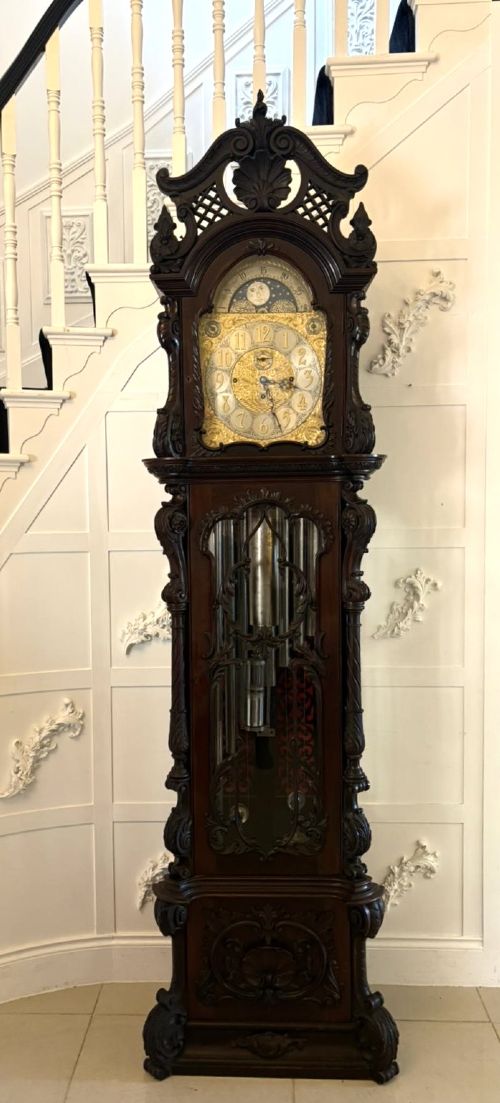
A carved wood grandfather clock stands tall in a hallway, bringing mechanical life and carved detail to a room.
Carved Wood Grandfather Clock
When you search for a carved wood grandfather clock, you encounter floor-standing timepieces spanning the eighteenth, nineteenth and early twentieth centuries. These tall case clocks combine cabinetmaking with precision horology, housing pendulum movements within timber enclosures.
The pieces appearing on this page range from early Georgian walnut and oak examples to Victorian and Edwardian mahogany and oak versions, alongside smaller grandmother clocks and specialised longcase forms. Regional British makers and revivalist styles appear frequently across the selection.
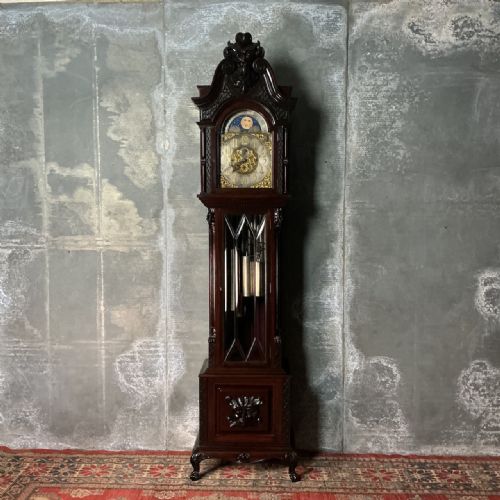
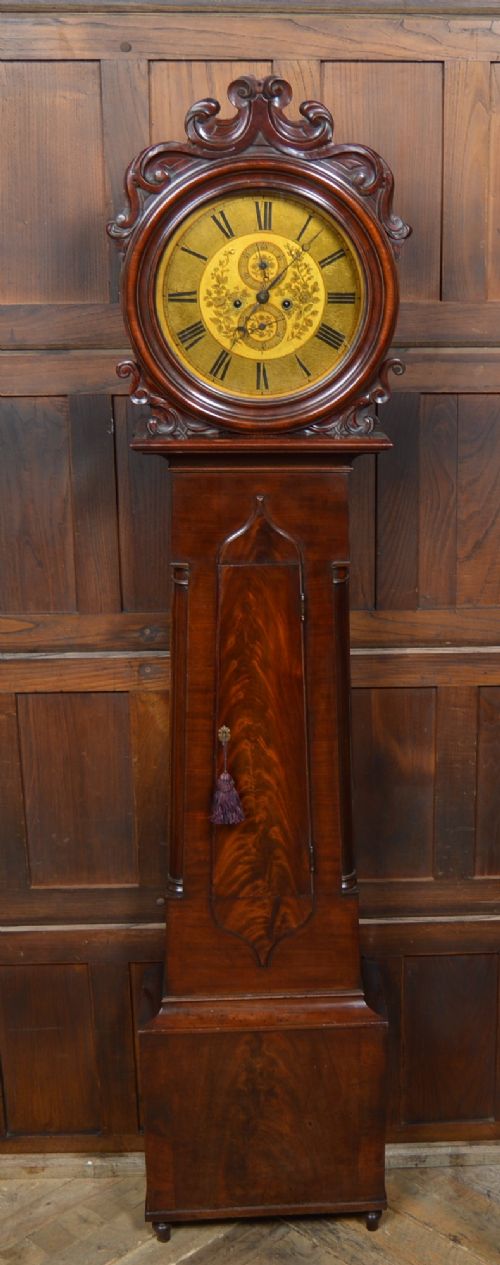
Most examples retain their original longcase proportions, with dials of brass or painted metal visible beneath glass hoods. Cabinet variations include carved panels depicting figures, simpler country designs and architectural mouldings.
Materials and construction
Cabinetmakers utilised hardwoods such as mahogany, oak, walnut and rosewood to construct the tall vertical cases. Timber was selected for grain pattern and strength, then joined using traditional cabinet joints to house the heavy weights and pendulum.
Carving was executed by hand directly into the timber of the case, producing decorative elements such as figures, foliage and geometric panels. Brass and steel were employed for the movement mechanisms, dials and face fittings, while glass protected the dial.
Listings span from the eighteenth century through the Victorian era and into the early twentieth century, utilising oak, mahogany, walnut and rosewood.
Evaluating quality and execution
Quality in these clocks rests upon the crispness of the hand carving and the selection of timber veneers or solid boards. Finer examples display deeply undercut carving and well-figured mahogany or walnut surfaces rather than plain secondary woods.
The integration of the movement with the case dictates horological merit, with complex chiming or musical mechanisms and signed brass dials representing higher standards of workshop production.
Mappin & Webb London·Price Evans of Salop
The Carved Wood Grandfather Clock Glossary
- Longcase clock
- The formal term for a tall pendulum clock housed in a wooden case resting on the floor. These tall enclosures protect the weighted movement and pendulum.
- Grandmother clock
- A smaller version of the traditional longcase clock, typically produced in the late nineteenth or early twentieth century. They occupy less floor space while retaining similar proportions.
- Three train
- A clock movement equipped with three gear trains to drive the timekeeping, striking and chiming functions separately. Such movements require additional weights or springs.
- Dial
- The visible face of the clock where the hours and minutes are displayed. Dials are constructed from brass, painted metal or silvered copper.
Carved Wood Grandfather Clock: Frequently Asked Questions
How do I wind a grandfather clock?
Winding involves using a key or crank to pull the weights back up to the top of the trunk. Care must be taken not to overwind the movement.
Most eight-day movements require winding once a week, while thirty-hour versions need daily attention. Keeping to a regular schedule maintains timekeeping accuracy.
Where should I place a longcase clock?
Select a stable interior wall away from direct sunlight, central heating vents and heavy foot traffic. Floor vibrations can interfere with the pendulum swing.
Ensure the floor is level so the clock case can be plumbed vertically, which prevents the escapement mechanism from becoming unevenly balanced.
How do I date a carved grandfather clock?
Dating relies on examining the construction methods of the timber case, the style of the dial and the complexity of the movement. Oak cases often point to earlier Georgian or revival periods, while mahogany was favoured through the nineteenth century.
Maker signatures inscribed on the brass dial provide the most direct evidence of origin and production date.
What is the difference between a grandfather and grandmother clock?
The primary distinction is overall height, with grandmother clocks standing significantly shorter than standard longcase clocks. They were designed for smaller domestic spaces.
Despite the difference in scale, both utilise similar weight-driven pendulum movements and fitted wooden cases.