
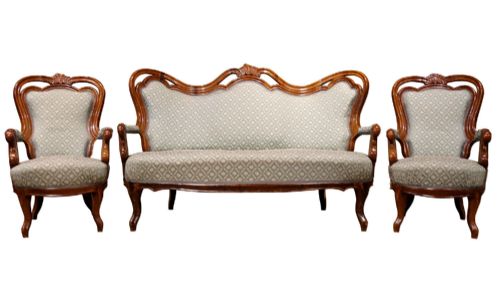


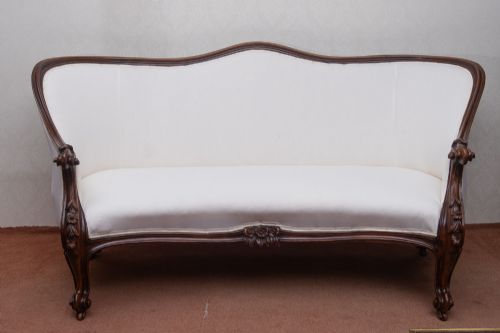
Carved Wood Frame Settee
A carved wood frame settee provides substantial seating while displaying the carved detail of period cabinetry.
Carved Wood Frame Settee
A carved wood frame settee brings together structural timber and upholstered comfort across several design traditions. Buyers searching for a carved wood frame settee will encounter pieces ranging from Regency country house models to Victorian walnut frames and French revival styles.
Origins span English, French, Italian and Continental workshops, with periods stretching from the eighteenth century through the Edwardian era. These seats function effectively in reception spaces and drawing rooms where timber framing remains visible.
Materials and construction methods
Frames rely on solid hardwoods like walnut, mahogany, rosewood and beech, chosen for their strength under carving tools. Giltwood, painted finishes, and ebonised or simulated rosewood treatments alter the surface appearance of the timber.
Upholstery materials include traditional textiles, patterned fabrics, velvet and brown leather secured over padded foundations. Brass details and inlaid elements sometimes accent the carved wooden structural members.
One notable Edwardian sofa arrives directly with a literary provenance linking to Daphne Du Maurier and Rebecca.
Judging execution and finish
Quality rests in the crispness and depth of the hand carving upon the wooden frame, whether depicting scrolling ends, herms, or floral motifs. Superior examples maintain balanced proportions between the exposed timber structure and the upholstered areas.
The choice of dense cabinet timbers like figured walnut or rich mahogany elevates a piece above standard softwood or simpler hardwood alternatives. Preservation of original surface finishes, such as period gilding or patinated polish, distinguishes finer examples from later alterations.
Chippendale·liberties retail
The Carved Wood Frame Settee Glossary
- Canapé
- A traditional French term for an upholstered sofa or settee, usually featuring an exposed carved wooden frame. These pieces often reflect Louis XV or Louis XVI design influences.
- Giltwood
- Timber that has been coated with a thin layer of gold leaf or gilt preparation. This finish appears frequently on formal French and English nineteenth-century display furniture.
- Scroll-end
- A structural arm or terminal shaped into a curving scroll reminiscent of a rolled scroll of paper. This detail provides a distinct silhouette on nineteenth-century seating.
- Camelback
- An upholstered sofa back featuring a distinctive convex curve resembling the hump of a camel. This profile gains emphasis when framed in carved mahogany or walnut.
Carved Wood Frame Settee: Frequently Asked Questions
What is a carved wood frame settee?
A carved wood frame settee is a seated furniture piece featuring an exposed timber structure adorned with carved decoration around the back, arms, or legs. These items combine soft upholstery with visible cabinetmaker craft.
They serve as principal seating furniture in formal rooms, drawing upon design vocabularies ranging from Regency elegance to Victorian ornamentation.
How do I identify the period?
Period identification relies on observing the combination of timber choices, carving styles, and structural silhouettes present in the frame. Regency pieces often exhibit classical influences or rosewood finishes, whereas Victorian examples favour heavily carved walnut and ornate upholstery.
Design indicators such as French revival styling or Edwardian proportions offer further clues to the date of manufacture.
Where should I place a settee?
These settees suit reception rooms, large hallways, and drawing rooms where the carved wooden frame remains visible from multiple angles. Placing them away from direct sunlight protects both the exposed timber and the fabric upholstery.
Ensure adequate clearance around the piece so that the carved arms and legs can be seen clearly as decorative elements.
Are these settees comfortable for daily use?
Many of these pieces were built for formal reception spaces rather than lounging, meaning seat depths and back angles vary according to the period. Some examples retain historic padding while others have undergone complete restoration for modern seating requirements.
Reviewing the upholstery description helps determine the level of padding and support a specific settee provides.