





Carved Wood Floor Clock
These carved wood floor clock examples bring architectural presence and mechanical rhythm to a room, driven by brass movements and housed in timber cases.
Carved Wood Floor Clock
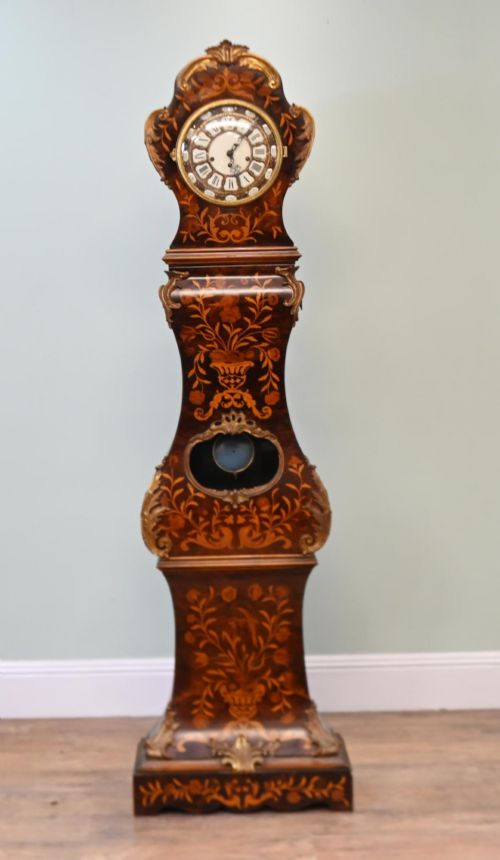
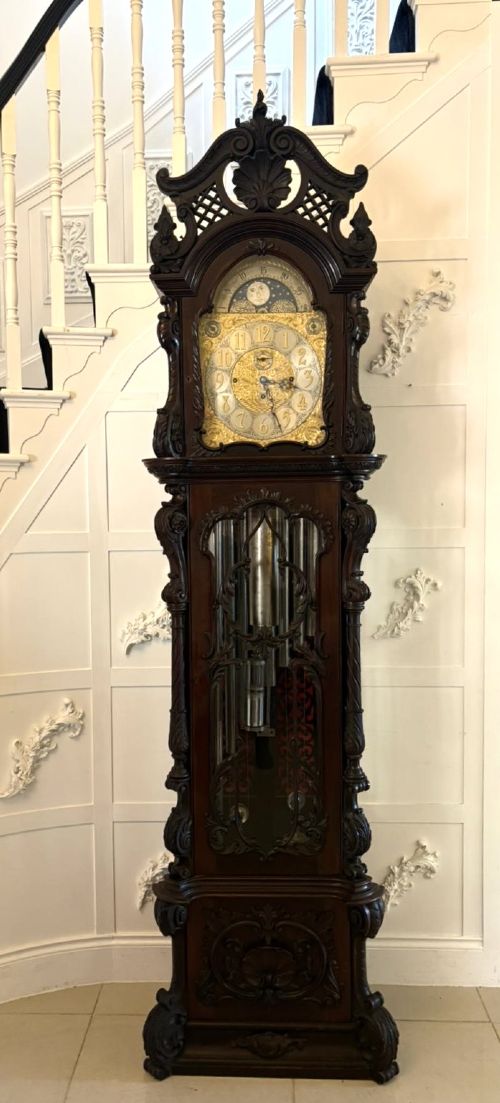
A carved wood floor clock represents tall horological forms, primarily longcase and grandfather clocks, standing upright to house weights and pendulums. These pieces emerge from periods including the eighteenth century, Georgian era, and Victorian epoch.
The versions most commonly met on this page span oak and mahogany constructions, alongside walnut and rosewood variants. Forms range from full-sized longcase clocks to smaller grandmother clocks and drum head designs.
Geographic and stylistic origins vary from traditional English workshops to Scottish makers, Jacobean revival interpretations, and Chinese craftsmanship. Cases feature glass panels for viewing dials and brass components alongside hand-carved sculptural details.
Materials and construction methods
Cabinet makers constructed these tall cases using solid hardwoods such as oak, mahogany, and walnut, frequently applying rich veneers or hand-carved figural motifs directly to the timber. The wood was selected for stability and grain figure to support heavy mechanical movements over centuries.
Interior structures incorporated brass and steel components within the dial and gear trains, whilst glass doors protected the face and pendulum swing. Joinery techniques relied on traditional framing and panel construction to house the weights safely.
Carved Wood Floor Clock Retail Price Guide 2026
Typical asking prices for carved wood floor clock among the pieces listed under this phrase on Sellingantiques today, from the lower quarter to the upper quarter. They describe what is for sale here now, not the wider market.
Distinguishing quality across examples
The refinement of the carved woodwork and the complexity of the clock movement set the standard for each piece. Deep, crisp hand-carving on the case distinguishes superior workshop output from simpler production.
Movement sophistication also dictates tier, moving from standard time-and-strike systems to multi-train chiming mechanisms or musical rotations. The integration of high-grade dial materials like brass and mother-of-pearl elevates the overall execution.
Mappin & Webb London·Price Evans of Salop
The Carved Wood Floor Clock Glossary
- Longcase clock
- A tall, weight-driven pendulum clock enclosed in a wooden case with a waist and a base. These tall pieces are often referred to as grandfather clocks.
- Grandmother clock
- A smaller, scaled-down version of the traditional longcase clock, typically produced during later periods. They occupy less vertical space whilst retaining standard mechanical functions.
- Three train
- A clock movement featuring three separate gear trains to drive the timekeeping, hour striking, and quarter-hour chimes. This complex mechanism requires multiple weights or spring barrels.
- Drum head
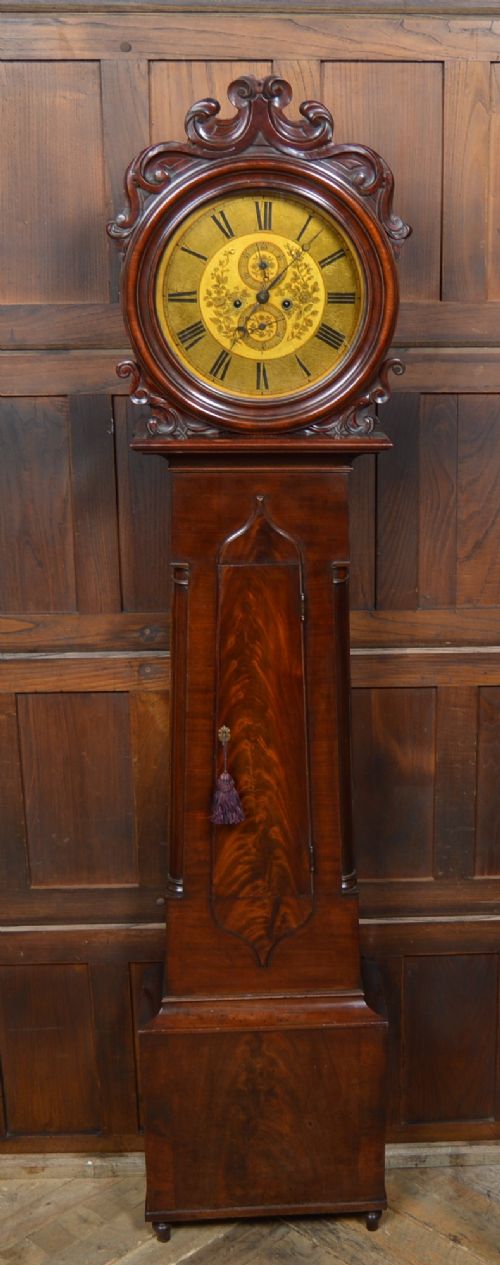
- A clock style where the dial section resembles a circular drum mounted atop a tall wooden trunk. This regional Scottish variant offers a distinct silhouette.
- Regulator
- A precision pendulum clock designed for high accuracy, often utilised as a standard for setting other timepieces. They feature simplified, highly legible dials.
Carved Wood Floor Clock: Frequently Asked Questions
Where should a carved wood floor clock stand?
These tall timepieces require a stable, dry interior wall away from direct heat sources and heavy vibrations to maintain accurate pendulum movement.
Placing them in hallways, living rooms, or studies allows the height of the case and the sound of the chime to integrate into the daily environment.
How do you wind a longcase clock?
Winding involves using a specialised crank key to pull up the internal weights or tension the springs via the dial face.
Frequency depends on the specific movement, with eight-day configurations requiring weekly attention to keep the pendulum swinging.
What is the difference between oak and mahogany cases?
Oak cases typically display prominent grain patterns and feature in earlier Jacobean revival or provincial Georgian pieces, offering a robust texture.
Mahogany provides a smoother, reddish-brown surface often chosen for finer nineteenth-century cabinet work and Chippendale styles.
How can you tell an 18th century clock from a Victorian one?
Eighteenth-century examples often exhibit simpler, robust proportions in oak or walnut with provincial maker signatures inscribed on the brass dial.
Victorian variations frequently introduce darker woods, heavier ornamental carving, or Scottish drum head configurations alongside refined mechanical trains.