




Carved Wood Fire Guard
A carved wood fire guard provides a decorative barrier in front of an unlit hearth, combining timber frames with textile or glass panels.
Carved Wood Fire Guard
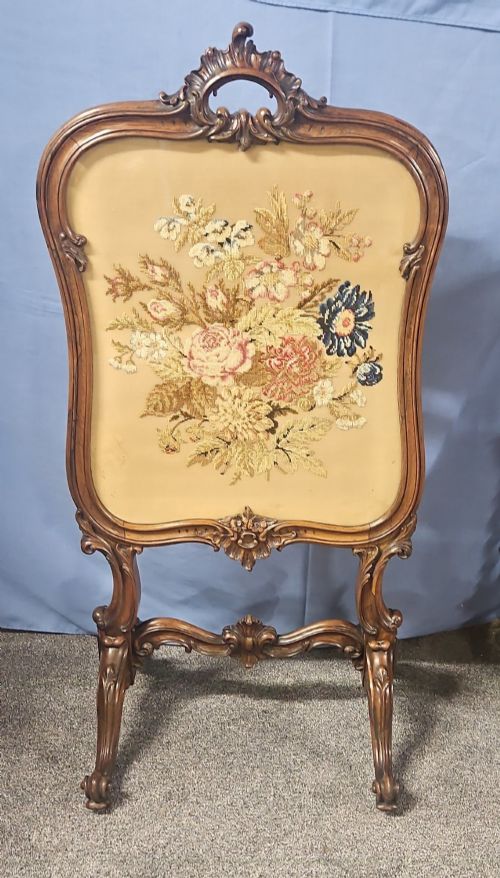
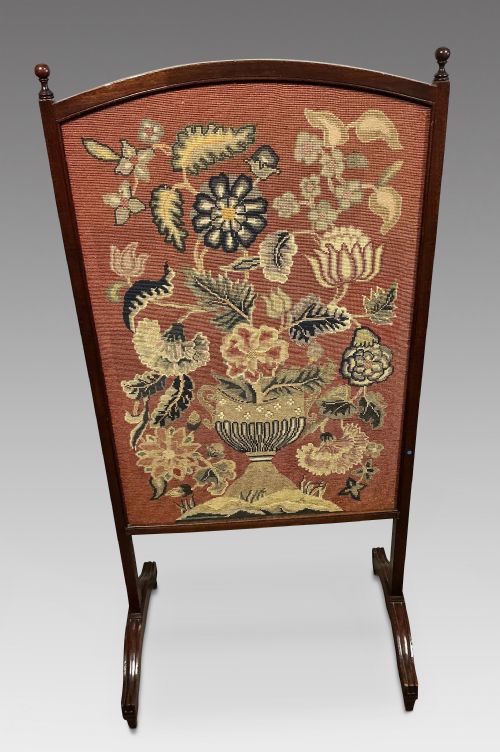
A carved wood fire guard is a domestic furnishing designed to shield occupants from the radiant heat of an empty fireplace during warmer months. These items appear in various forms, including cheval designs, standing frames, and adjustable screens. The examples on this page span the 17th century through the Victorian era and the 1900s, reflecting shifts in interior decoration over several hundred years.
Most pieces encountered here date from the 19th century and the Victorian period, constructed from timber frames holding decorative panels. Walnut, mahogany, and oak dominate the wooden elements, while the inner panels utilise tapestry, needlework, wool, canvas, silk, glass, or brass. Styles range from plain utilitarian timber to elaborate Victorian Rococo Revival, George III, Dutch Renaissance Revival, and Black Forest carvings.
Materials and Construction
Cabinetmakers shaped the structural frames from hardwoods such as mahogany, walnut, and oak, often applying detailed hand carving. Bobbin-turned elements and giltwood finishes appear on specific period examples, demonstrating distinct joinery techniques.
The central panels display considerable artisanal skill, incorporating hand-woven tapestry, needlepoint, silk embroidery, embossed and chased brass, or glass. These textiles and metals were secured within the wooden rebates of the screen to form a stable decorative surface.
Several screens depict family coats of arms and clan crests, turning household furniture into permanent heraldic declarations.
Judging Quality and Execution
The distinction between standard examples and superior pieces rests on the depth and crispness of the timber carving and the complexity of the internal panel. Finely executed figural tapestries, heraldic coats of arms, or intricate Black Forest motifs elevate a piece above simpler domestic screens.
Proportion and structural integrity also define the better items, particularly in adjustable mechanisms or substantial giltwood and mahogany frames. The integration of high-grade materials like rosewood or specialised needlework indicates a more ambitious original commission.
The Carved Wood Fire Guard Glossary
- Cheval screen
- A fire screen mounted on a frame with two supporting side pillars and feet, allowing the panel to swing or tilt.
- Needlepoint
- A type of canvas work embroidery executed with wool or silk yarn, frequently seen forming the central panel of 19th-century screens.
- Giltwood
- Timber that has been coated with a thin layer of gold leaf, characteristic of grand Georgian and Victorian decorative objects.
- Black Forest
- A style of deeply carved wooden ornamentation, often featuring naturalistic animal or botanical motifs originating from Central Europe.
- Rococo Revival
- A mid-19th-century design movement favouring asymmetrical scrolls, shell motifs, and elaborate flowing curves.
Carved Wood Fire Guard: Frequently Asked Questions
What is a carved wood fire guard used for?
These pieces served as a decorative shield placed in front of an empty fireplace during the summer months when fires were not lit. They protected rooms from soot drafts and hid the unappealing ash inside the grate.
Beyond practical duties, they functioned as substantial interior furnishings that showcased the owner's taste through elaborate woodwork and embroidered textile panels.
How do I date a carved wood fire screen?
Dating relies on identifying the prevailing stylistic cues, timber choices, and textile methods present in the object. For instance, George III pieces display distinct classical proportions, whereas Victorian examples often lean towards heavy walnut frames with floral needlework.
Hardware types, joinery methods, and the specific nature of the tapestry or brass inserts further help place the item within periods like the 17th century, the Georgian era, or the Victorian decades.
Are these screens adjustable?
Certain examples feature mechanisms that allow the wooden panel to slide or tilt within the surrounding frame. This adjustability helped direct the screen to block drafts or adjust the height of the decorative display.
Not all screens possess this feature, as many stationary models remain fixed in a rigid vertical position supported by feet or a broad base.
What panels are found inside the wood frames?
The central inserts vary widely depending on the period and origin of the piece. Common materials include hand-woven tapestries, pastoral needlepoint, silk embroidery, embossed and chased brass, and glass.
Some panels display specific heraldic designs, such as family coats of arms or clan crests, worked into wool or canvas.