


Carved Wood Cane Sofa
A carved wood cane sofa brings texture and lightness to a room, uniting open woven panels with solid timber frames.
Carved Wood Cane Sofa
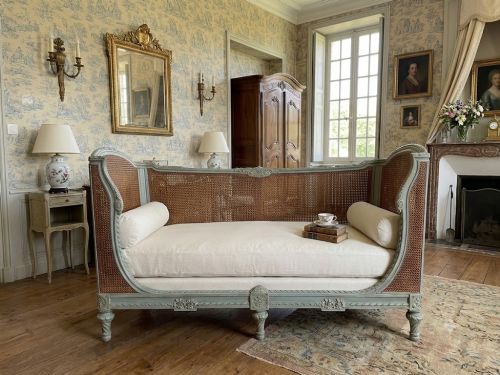
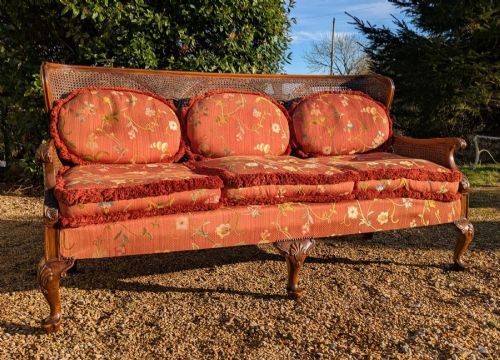
When you search for a carved wood cane sofa, you encounter seating built with woven cane panels set into wooden frames across the back and sides. These pieces span settee, daybed, and sofa forms, originating from workshops influenced by French, Swedish, and Anglo-Indian design traditions.
You are most likely to meet 19th-century examples alongside 20th-century revivals on this page. Common stylistic variants include Louis XV and Louis XVI styles, Gustavian forms, and Anglo-Indian hardwood constructions.
The objects serve as long seating or daybeds, often retaining upholstered loose cushions or feather pads. Their forms range from painted and gilded frames to bleached hardwoods and carved walnut structures.
Materials and construction methods
Makers built these frames using beech, walnut, hardwood, and giltwood, shaping the timber through carving and joinery before applying paint, gilding, or bleaching finishes. The visible wooden structure supports both the load-bearing rails and the decorative crests.
Cane panels are hand-woven directly into channels or pressed into grooves along the interior of the backrests and arm panels. This technique creates a semi-transparent screen that lightens the visual weight of the heavy timber frame.
Upholstered elements incorporate textile, linen, and fabric covers filled with feather cushions where specified by the design. These soft furnishings complement the rigid grid of the cane work and the carved details of the wood.
Listings feature pieces spanning the 18th century through to the 20th century, utilising walnut, beech, hardwood, and painted wood.
Evaluating quality and craftsmanship
The precision of the wood carving dictates the refinement of the piece, separating standard production from exceptional execution. Crisp botanical motifs, balanced proportions, and clean joints indicate higher workshop standards.
The integrity of the woven cane work influences the overall standard of the object. Tightly woven, uniform strands without breakages show careful hand-workmanship that sustains daily use.
The choice of primary timber and surface finish also defines the grade of the piece. Solid walnut, properly applied gilding, and well-preserved painted or bleached finishes represent superior material selection.
The Carved Wood Cane Sofa Glossary
- Cane
- Woven material made from the outer bark of rattan palms, utilised for flexible and breathable panel inserts in seats and backs.
- Bergere
- A closed-arm upholstered armchair or sofa style originating in France, typically featuring exposed wooden frames and cane or upholstered sides.
- Daybed
- A long seating item designed for reclining, combining the characteristics of a sofa and a bed.
- Gustavian
- The Swedish neoclassical style characterised by restrained classical carving, pale painted finishes, and functional elegance.
- Canapé
- The French term for a decorative sofa or settee, often built with an exposed carved wood frame.
Carved Wood Cane Sofa: Frequently Asked Questions
What is a carved wood cane sofa?
It is a piece of long seating featuring a timber frame combined with woven cane panels on the back or sides.
These items encompass settees, daybeds, and love seats originating from various European and colonial traditions.
How were these sofas used originally?
They served as formal seating in reception rooms or as reclining daybeds in private chambers.
Households utilised them for daytime resting and social entertaining.
How do I care for cane panels?
Keep the woven cane hydrated by wiping it occasionally with a damp cloth to prevent brittleness.
Avoid placing the seat near direct heat sources that dry out the natural rattan material.
How do I identify French style pieces?
French style pieces display characteristic carved woodwork, cabriole or tapered legs, and painted or gilded surfaces.
Details often reference Louis XV or Louis XVI design vocabularies.
Are these sofas comfortable for daily lounging?
Many examples include fitted feather cushions or upholstered pads that provide a soft seating surface.
The rigid cane back offers sturdy support while the cushions supply comfort.