



Carved Scroll Stretcher
These pieces with a carved scroll stretcher give a room solid period character through intricate woodwork beneath chairs and tables.
Carved Scroll Stretcher
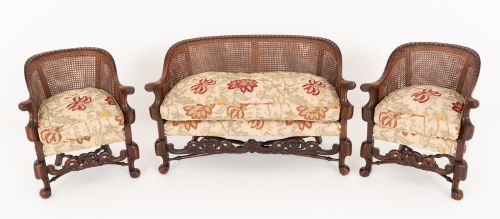
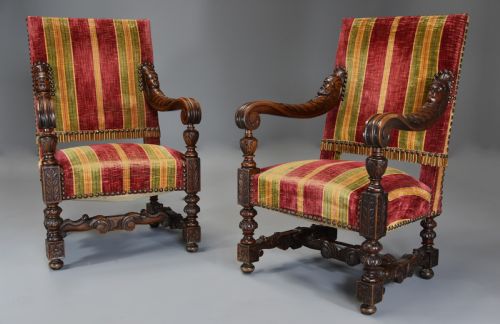
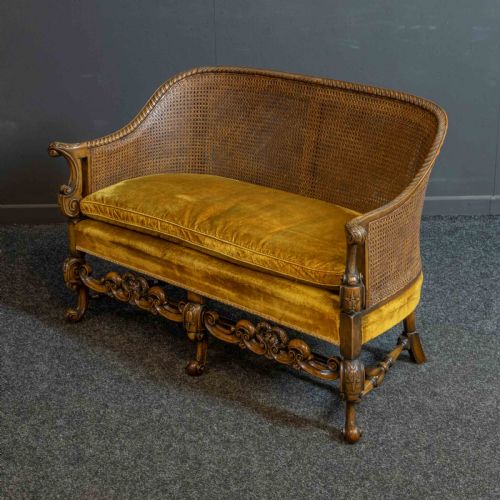
A carved scroll stretcher is an underframe connecting the legs of chairs, tables and sofas, shaped with decorative scrolls to add both stability and visual detail. When you search for this phrase, you find items spanning from the nineteenth century into the early twentieth century, reflecting various revival movements. The forms you are most likely to meet on this page include walnut open armchairs, centre tables, and seating suites.
The styles range widely across historical revivals, featuring Carolean, French Baroque, William and Mary, and Jacobean designs. These pieces often serve as statement furniture in halls, libraries and drawing rooms, where the decorative underframe remains visible beneath seating or tabletops.
How they were made
Cabinet makers and joiners worked with dense timbers such as walnut, oak, burr oak, mahogany and rosewood to construct these frames. The stretchers were shaped by hand, carving the characteristic scrolls and curves that brace the legs together while bearing structural weight.
Seating items were frequently finished with upholstery in fabric and velvet, or fitted with woven cane inserts. Additional detailing often included brass hardware to complement the dark, polished woodwork.
Listings show walnut and oak as the predominant timbers used across nineteenth-century revival seating and tables.
What varies in quality
The crispness and depth of the carving on the scroll stretcher determine the refinement of the piece, as sharper, more deeply undercut details show superior craftsmanship. Plain or softly rounded scrollwork often indicates a more utilitarian production from later revival periods.
The choice of timber grain also separates standard examples from exceptional ones, particularly when highly figured burr oak or richly toned walnut is utilised. Original upholstery materials and intact cane weaving further distinguish pieces that retain their authentic finish.
The Carved Scroll Stretcher Glossary
- Stretcher
- A horizontal wooden brace connecting the legs of a table, chair or sofa to provide structural rigidity. In these pieces, it is elevated and carved into decorative scroll shapes.
- Carolean style
- A seventeenth-century aesthetic revived strongly in the nineteenth century, characterised by rich walnut framing, deep carving and scrolling woodwork. It draws inspiration from the reign of Charles II.
- Burr oak
- A timber taken from the gnarled growths on oak trees, highly prized for its swirling, mottled grain patterns. It provides a striking decorative surface on tabletops.
- Cane weaving
- A technique of luted plant material woven into open patterns for chair seats and backs. It adds a lighter texture to heavy wooden frames.
Carved Scroll Stretcher: Frequently Asked Questions
What is a carved scroll stretcher?
A carved scroll stretcher is a shaped wooden brace running between the lower legs of a chair or table for stability. The woodwork is formed into ornamental curls and sweeps rather than simple straight bars.
This structural element sits low down between the legs, catching the eye beneath the seat or tabletop and defining the revival period of the furniture.
How do I date these pieces?
Dating relies on examining the timber species, joinery methods, and the specific revival style of the carving. Items listed here span the nineteenth century up to the nineteen-twenties, often mimicking seventeenth-century designs.
Walnut and oak framing combined with distinct baroque or carolean motifs typically point toward nineteenth-century revival craftsmanship rather than original seventeenth-century construction.
Where should I place a scroll stretcher table?
Centre tables and stretcher tables work best where people can walk around them and view the detailed underframe from multiple angles. Libraries, large hallways and open drawing rooms suit these substantial pieces.
Keeping the table away from walls allows the carved scroll stretcher to remain fully visible as a central design feature of the room.
Are these pieces comfortable for daily use?
Seating items like bergere suites, armchairs and upholstered elbow chairs offer substantial support and deep seating. Many feature padded arms and upholstered backs designed for long periods of sitting.
The sturdy wooden frames and braced legs ensure the chairs withstand regular daily use while maintaining their decorative integrity.