

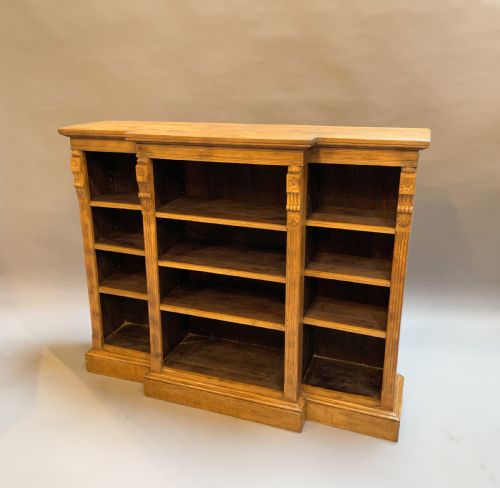


Carved Pilaster Shelving
Carved pilaster shelving brings architectural dignity to a room, offering sturdy support for volumes while displaying rich timber grain and period detail.
Carved Pilaster Shelving
When you search for carved pilaster shelving, you are looking at substantial library bookcases and open bookcases designed to anchor a room. These pieces range from Georgian and Regency forms through to late Victorian and 1920s revivals, built to house serious collections of books.
You are most likely to meet Victorian and 19th-century oak, walnut, and mahogany examples on this page. Many feature adjustable shelving and architectural uprights, uniting utility with formal ornament.
How they were made
Cabinet makers utilised dense hardwoods such as oak, walnut, mahogany, and rosewood, often applying veneers to achieve striking surface patterns. Some pieces incorporate specialist elements like patinated marble tops and leather trim.
Structural framing relied on robust joinery to support heavy library volumes, while decorative emphasis concentrated on carved pilasters and classical column details flanking the open bays.
Listings span the Georgian, Regency, and Victorian periods, showcasing bookcases constructed from oak, walnut, mahogany, rosewood, and satinwood.
What varies in quality
Quality rests upon the selection of timber and the crispness of the architectural carving on the pilasters. Finer pieces demonstrate superior proportion, choice figured veneers, and integrated adjustable shelf mechanisms that operate smoothly.
Lower tiers of production rely on simpler softwood construction or repetitive, shallow ornamentation lacking the depth and sharpness found in better nineteenth-century examples.
The Carved Pilaster Shelving Glossary
- Pilaster
- A rectangular column projecting slightly from a wall or bookcase frame, typically treated with classical architectural capitals and bases. This structural element provides both physical support and visual rhythm to the front of a bookcase.
- Breakfront
- A piece of furniture whose central section projects forward from the flanking wings. This configuration creates depth and shadow across the facade.
- Adjustable bookcase
- A shelving unit equipped with tracks, pegs, or ratchet systems to alter shelf heights. This practical adaptation accommodates books of varying sizes.
Carved Pilaster Shelving: Frequently Asked Questions
What periods do these bookcases span?
The listings on this page span from the Georgian and Regency eras through the Victorian period up to the early twentieth century. This encompasses a broad timeline of cabinet making.
Maker styles shift across these decades from formal neoclassical proportions to heavier revivalist forms with deep architectural carving.
Are the shelves adjustable?
Many of the library bookcases listed feature adjustable shelving systems to accommodate varying book sizes. This makes them practical for actual library use.
Original adjustable mechanisms often employ wooden ratchets or brass pins set into the interior uprights.
What timbers were commonly used?
Cabinet makers relied primarily on hardwoods including oak, walnut, mahogany, and rosewood. Some examples incorporate rosewood veneer or satinwood.
Softer woods like pine appear occasionally as secondary timbers or in simpler softwood bookcases.
How do I identify a Victorian bookcase?
Victorian examples often display heavier proportions, rich walnut or oak grain, and prominent carved pilasters. They frequently take the form of open library bookcases.
Construction details such as machine-sawn backing boards or robust adjustable brackets help pinpoint this mid-to-late nineteenth-century era.