
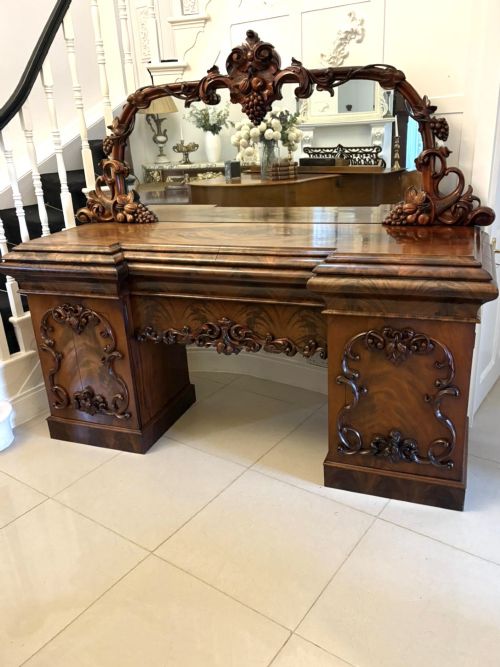
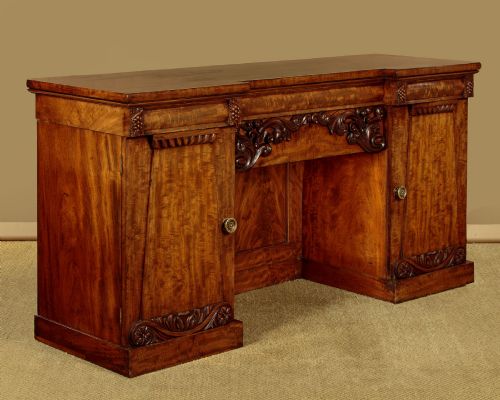

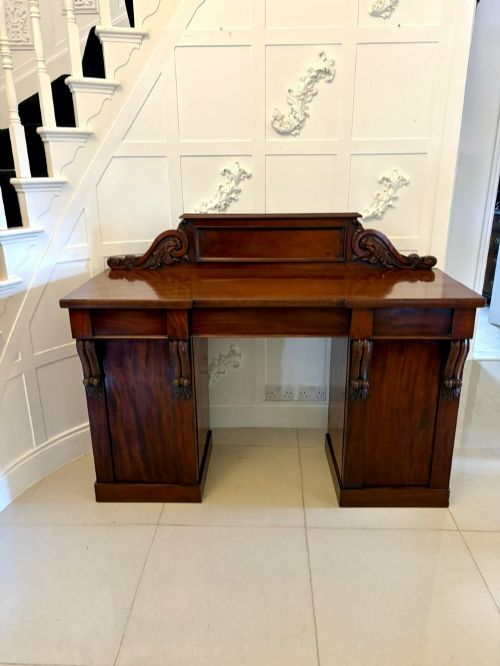
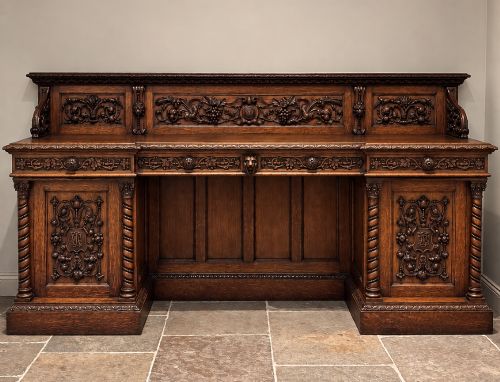
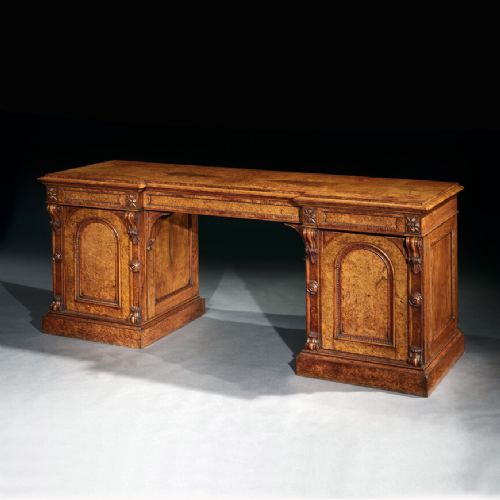


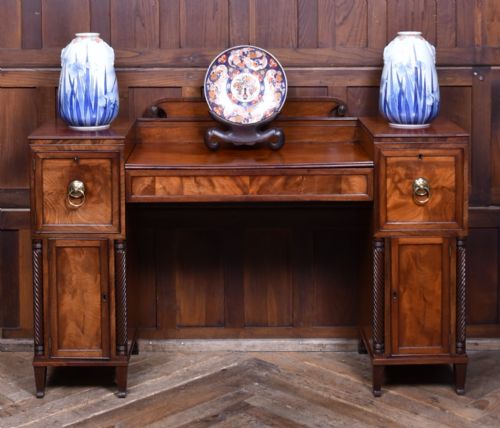
Carved Pedestal Buffet Cabinet
A carved pedestal buffet cabinet brings substantial presence to a room, offering deep storage through matched pedestals and heavy timber construction.
Carved Pedestal Buffet Cabinet
A carved pedestal buffet cabinet combines deep storage pedestals with a central board, appearing widely across the nineteenth century in various regional interpretations. Buyers encounter these forms most frequently under Victorian, William IV, and Regency periods, where substantial timber construction defines the category.
The pieces on this page span several stylistic evolutions, from late Georgian and Regency formats through heavy Victorian Renaissance Revival examples to mid-twentieth-century Art Deco interpretations. Sideboards and chiffoniers dominate the selection, often incorporating mirror backs, breakfront layouts, and twin pedestals for formal dining rooms.
Design and execution
The depth of carving and the selection of timber veneers dictate the distinction between standard production and exceptional examples. Figured grains and mirror-matched flame mahogany require skilled selection from the cabinet maker, lifting the visual weight of large pedestals.
Coherence of the chosen style governs the success of the piece, whether executing Gothic Revival details, classical William IV scrolls, or clean Art Deco lines. Integrated mirrors and complex breakfront configurations demand precision joinery to maintain structural integrity across heavy sideboards.
Listings span multiple decades of the nineteenth century, with Victorian and William IV examples forming the bulk of available pedestal sideboards.
Epstein
The Carved Pedestal Buffet Cabinet Glossary
- Pedestal
- A foundational cabinet block supporting the main sideboard surface, typically housing cupboards or cellarette drawers.
- Chiffonier
- A compact sideboard variant, often fitted with lower cupboards and upper shelving or a mirror back.
- Breakfront
- A cabinet facade where the central section projects forward from the flanking pedestals or cupboards.
- Flame mahogany
- Timber veneer cut to display a flickering, symmetrical flame pattern across wide drawer fronts and doors.
- Pollard oak
- Oak timber taken from trees pollarded to produce a dense, clustered grain pattern filled with knots.
Carved Pedestal Buffet Cabinet: Frequently Asked Questions
What is a pedestal sideboard?
A pedestal sideboard is a large dining room cabinet featuring two substantial cupboards or column supports flanking a lower central board.
These pieces provide substantial storage for dining linen and silver, anchoring formal dining spaces with heavy timber construction.
How do I date a Victorian sideboard?
Dating relies on identifying stylistic shifts between early revival pieces, mid-century proportions, and late century mirror backs.
Examining the timber veneers, hardware types, and carving depth helps narrow the decade of manufacture within the nineteenth century.
Where were these cabinets used?
These cabinets served primarily in formal dining rooms for serving food and storing glassware.
Today, they adapt well into living rooms or wide hallways as statement storage furniture.
What timber is most common?
Mahogany remains the predominant timber found across these listings, appearing in solid form or as figured veneer.
Alternative woods like oak, pollard oak, and burr walnut appear in specific regional or later Art Deco pieces.