

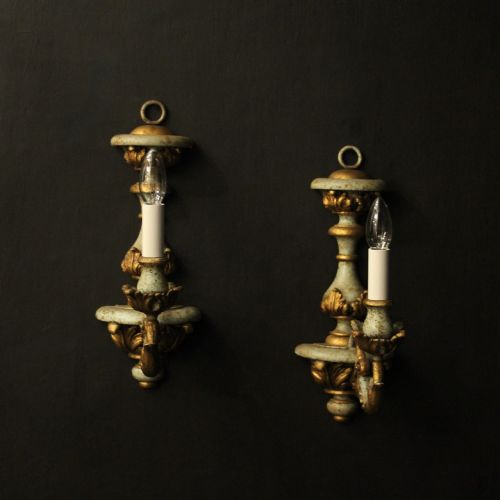


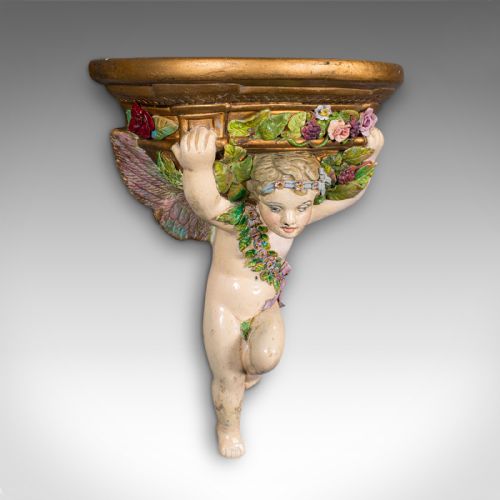


Carved Painted Wall Bracket
These carved painted wall bracket pieces bring instant architectural depth and historical character to a room, offering a decorative stage for urns, timepieces, or candles.
Carved Painted Wall Bracket
When you search for a carved painted wall bracket, you encounter timber, plaster, and gesso fixtures designed to project from a vertical surface. These range from substantial eighteenth century architectural supports and large corbels to smaller French Rococo revival étagères and Victorian Italianate consoles.
The selection here encompasses single and multi-branch wall lights, sconces, and decorative clock mounts alongside traditional wall shelves. French and Italian influences dominate the designs, frequently executed in antique white or polychrome finishes with giltwood accents.
Buyers most commonly meet decorative pairs dating from the nineteenth and early twentieth centuries, alongside earlier eighteenth century woodwork and plaster elements. These objects function equally as standalone wall ornament and as functional ledges or lighting supports.
How they were made
Artisans formed these objects primarily from carved wood, plaster, and gesso, applying layers of paint, polychrome pigments, and occasionally giltwood to the surfaces. Hand-carving methods shaped the timber substrates of the brackets, corbels, and consoles before the application of decorative finishes.
Plaster elements relied on moulding and casting techniques to achieve elaborate architectural relief work, such as corbels and clock mounts. Surface treatments combined white or coloured paint with metallic leaf to accentuate the carved scrollwork and neoclassical details.
Carved Painted Wall Bracket Retail Price Guide 2026
Typical asking prices for carved painted wall bracket among the pieces listed under this phrase on Sellingantiques today, from the lower quarter to the upper quarter. They describe what is for sale here now, not the wider market.
Some wall brackets started life as architectural salvage, rescued from historic buildings to spend retirement holding a small clock.
What varies in quality
Depth of hand-carving and crispness of moulded detail set the finer examples apart from simpler production. The handling of the paint and gilt layers, particularly where polychrome colour is applied over wood or gesso, determines the visual richness of the surface.
Proportion and structural integrity define the higher tiers of these fixtures, ensuring that architectural brackets and console tables project cleanly from the wall with balanced weight distribution.
The Carved Painted Wall Bracket Glossary
- Corbel
- A structural bracket projecting from a wall to support a weight, often carved in stone, wood, or plaster. Eighteenth century examples show substantial architectural moulding.
- Giltwood
- Wood that has been coated with gold leaf or a gold-coloured metallic finish. This technique highlights carved details on brackets and frames.
- Polychrome
- Decorated in a variety of colours. Many Italian and French wall lights utilise this finish to create depth across carved wooden surfaces.
- Étagère
- A piece of furniture with a set of open shelves for displaying small objects. Wall-mounted versions provide tiered display surfaces for decorative items.
- Rococo Revival
- A nineteenth century style that revived the asymmetry, scrollwork, and natural motifs of the eighteenth century French movement. It appears frequently on decorative wall brackets and consoles.
Carved Painted Wall Bracket: Frequently Asked Questions
How were wall brackets historically used?
These pieces served practical and decorative roles in historic interiors, supporting heavy clocks, porcelain urns, and lighting fixtures. They elevated objects to eye level and reflected candle or natural light within a room.
Larger architectural corbels functioned as structural supports for mantelpieces, cornices, or heavy ceiling beams. Smaller carved brackets created dedicated display spaces along panelled walls.
Where should I place a wall bracket?
Mount these pieces at eye level or above furniture groupings to create focal points in hallways, living rooms, or dining spaces. Pairs work effectively flanking a mirror, doorway, or fireplace mantel.
Ensure the wall construction can support the weight of wooden or plaster brackets, particularly when placing heavy items such as clocks or vases on the shelf.
How do I distinguish eighteenth century pieces?
Early pieces display hand-carved timber construction with dense grain and patinated surfaces beneath historic paint layers. The carving shows deep relief work characteristic of period architectural salvage.
Later revival pieces often employ standardised mouldings or machine-assisted shaping alongside nineteenth and twentieth century paint formulations.
What is the difference between a bracket and a sconce?
A bracket primarily functions as a shelf or structural support projecting from the wall for display purposes. Sconces incorporate integrated arms designed specifically to hold candles or electric lighting.
Many surviving examples combine both functions, featuring a shelf bracket fitted with wooden or metal arms for illumination.