



Carved Oak Desk Organiser
A carved oak desk organiser brings solid presence and practical stationery storage to any workspace.
Carved Oak Desk Organiser
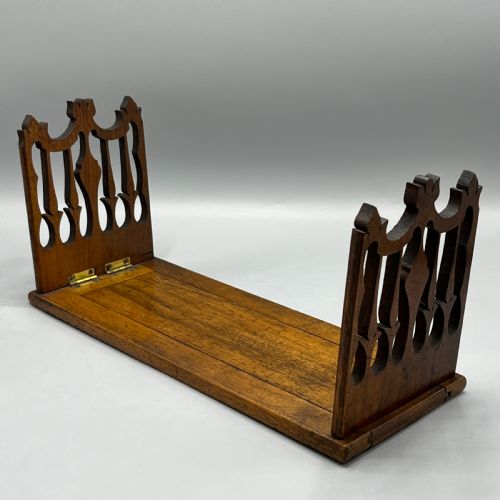
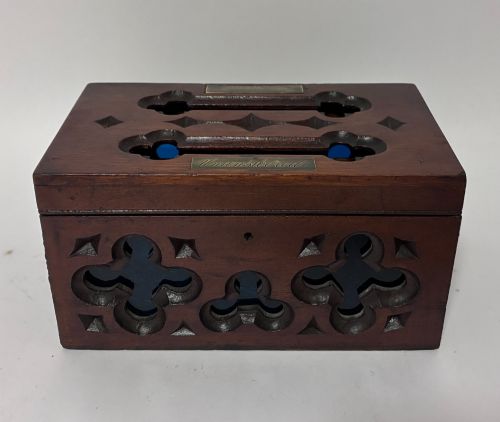
When you search for a carved oak desk organiser, you are looking at nineteenth and early twentieth-century desktop pieces designed to keep correspondence, books, and writing equipment in order. The examples listed on this page encompass various forms such as correspondence boxes, inkstands, letter racks, tabletop cabinets, and revolving bookcases.
The versions you are most likely to meet span the Victorian and Edwardian eras, often showing distinct historicising or reform styles like Gothic Revival, Scottish Baronial, and Arts and Crafts. These items served a functional purpose in the home library or office, combining compartmentalised storage with decorative carving.
The periods represented stretch from the mid-nineteenth century through to the nineteen-twenties, reflecting changing tastes in desktop utility and woodwork. Materials range from solid timber to mounted horn, brass, and silver details, grounding each piece in its specific era of manufacture.
Materials and construction
Construction relies primarily on solid oak, frequently paired with contrasting elements such as brass hinges, iron fittings, or fabric linings. Artisans shaped these pieces using traditional joinery methods suited to desktop items that required sturdy compartments for books, inkwells, and papers.
Carved Oak Desk Organiser Retail Price Guide 2026
Typical asking prices for carved oak desk organiser among the pieces listed under this phrase on Sellingantiques today, from the lower quarter to the upper quarter. They describe what is for sale here now, not the wider market.
Listings span the nineteenth and early twentieth centuries, featuring periods from eighteen-fifty to nineteen-twenty.
Judging the work
Quality in a carved oak desk organiser lies in the crispness and depth of the hand carving, alongside the harmony of its proportions. Pieces with well-defined motifs and integrated hardware show superior workshop execution compared to simpler, more utilitarian counterparts.
The integration of secondary materials such as mounted horn, silver, or brass elevates a piece from a standard utility box to a finer decorative item. The integrity of the original construction and the condition of interior fittings also dictate the standing of individual examples.
The Carved Oak Desk Organiser Glossary
- Correspondence box
- A lidded box with internal dividers designed for holding letters and stationery. These containers often feature sloping lids and secure locks.
- Book slide
- An extending desktop rack intended to hold a small row of volumes upright between two ends. The sliding mechanism allows the overall length to adjust as books are added or removed.
- Inkstand
- A tray or stand incorporating one or more inkwells alongside pen rests and sometimes a sander. They sit directly on the desktop to provide writing materials.
- Gothic Revival
- An architectural and decorative style drawing on medieval ecclesiastical forms. In woodwork, this manifests in pointed arches, trefoils, and heavy carved mouldings.
- Arts and Crafts
- A design movement valuing honest construction and hand craftsmanship over industrial mass production. Pieces from this tradition typically display simplified structural lines and naturalistic surface decoration.
Carved Oak Desk Organiser: Frequently Asked Questions
What was a desk organiser used for?
These items were essential desktop accessories used to sort incoming correspondence, store writing paper, and keep reference volumes close at hand. They helped maintain order in the Victorian and Edwardian study or library before the widespread use of modern filing systems.
Different configurations suited different tasks, from letter racks for daily post to inkstands that kept dipping pens and wet ink ready for use.
How do I date an oak desk piece?
Dating relies on stylistic clues, construction methods, and materials that align with specific nineteenth and early twentieth-century movements. Pieces showing heavy Gothic Revival or Scottish Baronial motifs often point to the Victorian era, while flowing floral lines suggest an Edwardian Art Nouveau influence.
Hardware such as brass hinges and locks can also offer chronological markers, though makers often reused traditional designs across several decades.
Are these pieces suitable for daily use?
Most of these organisers function well on modern desks for holding mail, notebooks, or pens much as they did in the past. Solid oak construction gives them the durability needed for everyday handling.
Care should be taken with antique finishes and delicate mounted elements like horn or silver to preserve their condition over time.
What styles are common in these items?
The listings feature a range of nineteenth and early twentieth-century aesthetics, predominantly Gothic Revival, Arts and Crafts, and Art Nouveau. These reflect the prevailing taste for historicism and handcrafted design during the Victorian and Edwardian periods.
Some examples also incorporate regional motifs, such as Scottish Baronial detailing on horn and silver-mounted stands.