
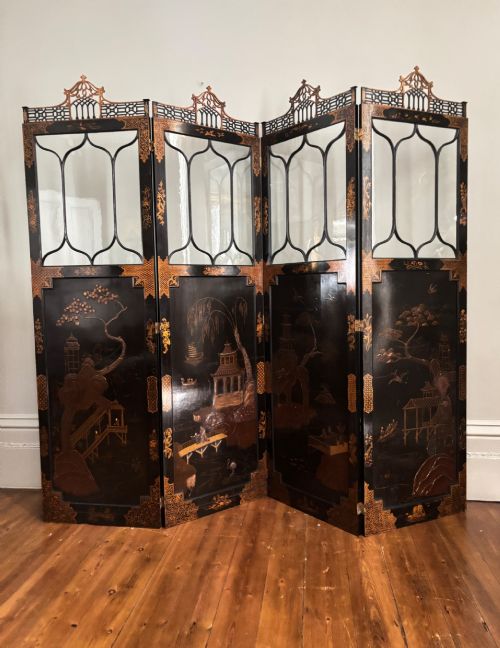




Carved Lacquered Room Divider
A carved lacquered room divider brings architectural depth and rich surface texture to a tall corner.
Carved Lacquered Room Divider
A carved lacquered room divider partitions a larger interior or frames an empty wall with folding panels of wood finished in dark or polychrome lacquer. These pieces range from towering eight-fold folding screens to more compact dressing and fire screens.
The versions most frequently met on this page span the nineteenth and early twentieth centuries, reflecting Chinese and Japanese export traditions alongside domestic Chinoiserie interpretations. They arrive in various panel counts, from three-fold setups to expansive multi-panel room dividers.
How they were made
Construction relies upon solid hardwood frames built into hinged panels, providing a sturdy substrate for layers of lacquer. Artisans built up these surfaces before applying deep incision, paint, or applied relief elements.
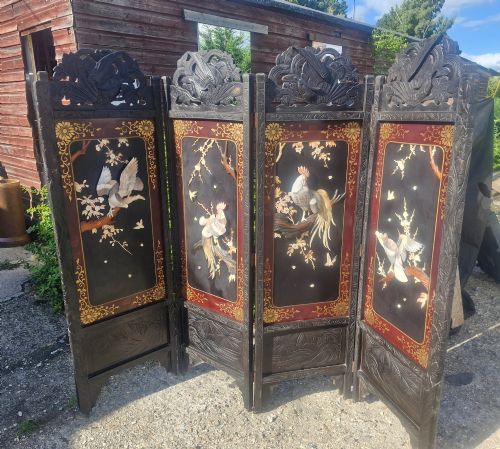
Decoration incorporates intricate details carved directly into the lacquer ground alongside inlaid hardstone, bone figures, and occasional touches of gold leaf. Brass hardware frequently joins the folding panels together to allow smooth articulation.
Several panels feature deep carved bone figures that appear to peer out quietly from behind the lacquer foliage.
What varies in quality
Quality rests upon the depth of the carving and the complexity of the surface ornamentation across the panels. Pieces featuring meticulous bone or hardstone inlays and extensive multi-layer lacquer stand apart from simpler painted versions.
The architectural scale and structural integrity of the folding frame also dictate the calibre of the piece. Larger multi-fold screens demand superior joinery to support their weight over numerous hinged sections.
The Carved Lacquered Room Divider Glossary
- Coromandel lacquer
- A Chinese incised lacquer technique where the surface is carved through layers of dark lacquer to reveal a contrasting ground underneath, which is then often painted.
- Chinoiserie
- A European artistic style reflecting Chinese motifs and decorative techniques, popularised during various historical periods.
- Hardstone
- Naturally occurring semi-precious stones such as jade, agate, or soapstone utilised for inlay work on panels.
- Folding screen
- A piece of furniture consisting of two or more panels that are connected by hinges and can be folded relative to each other.
Carved Lacquered Room Divider: Frequently Asked Questions
How do I place a room divider?
Position your screen against a flat wall to act as large-scale art, or angle it across an open corner to create a distinct spatial zone.
Ensure the panels have enough clearance to articulate safely without pressing against delicate architectural mouldings or furniture.
How do I tell Chinese from Japanese screens?
Look closely at the decorative motifs and the specific layering techniques used in the lacquer surface.
Chinese pieces often utilise deep incised Coromandel work, whereas Japanese examples frequently showcase applied bone figures and distinct export painting styles.
How many panels should I buy?
Choose your panel count according to the scale of the room and the intended visual weight.
Smaller three or four-fold versions suit modest spaces, while grander six or eight-fold screens require larger walls or open floor plans to breathe.
How do I care for lacquer surfaces?
Dust the panels regularly with a soft, dry cloth to prevent abrasive particle accumulation on the delicate finish.
Keep the screen away from direct sunlight and strong heat sources that might cause the wood substrate or lacquer layers to dry out.