
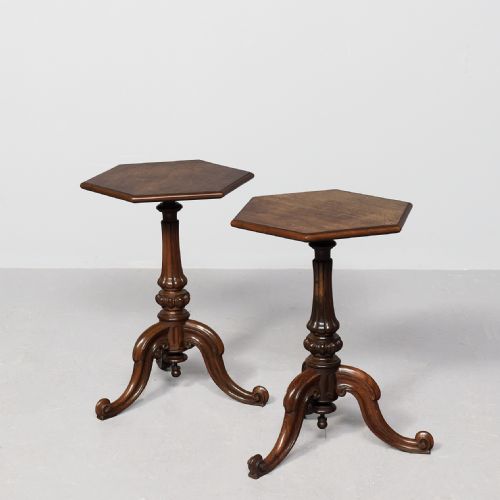
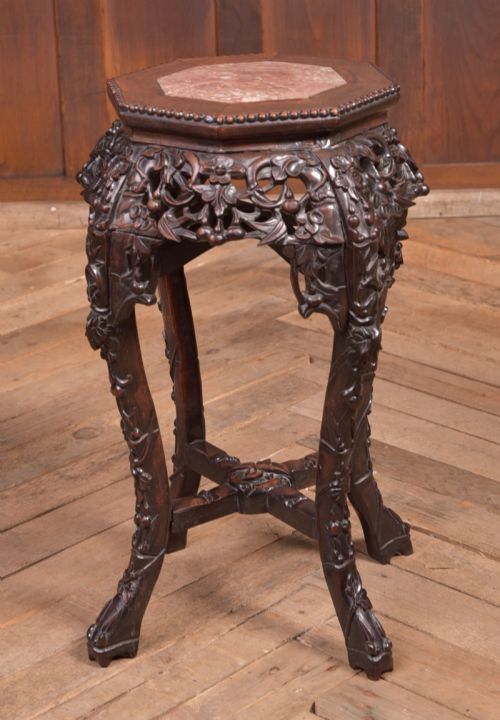
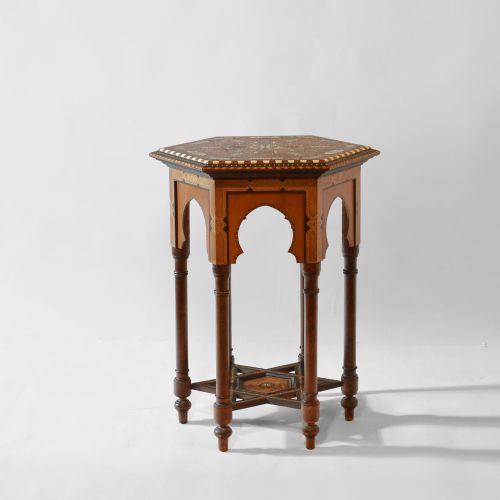


Carved Hexagonal Side Table
A carved hexagonal side table brings complex geometry and rich timber grain to a corner, offering a compact surface with strong Moorish or Victorian character.
Carved Hexagonal Side Table
A carved hexagonal side table provides a six-sided surface supported by turned legs or heavily ornamented folding bases, turning awkward corners into functional display areas. When people search for a carved hexagonal side table, they generally encounter low occasional tables, plant stands, and occasional tables originating from the nineteenth century up to the early twentieth century.
The aesthetic reaches across distinct traditions, incorporating Victorian craftsmanship, Moorish Revival geometry, and Anglo-Indian carving alongside Chinese padouk stands. Walnut, mahogany, and oak form the structural backbone of these pieces, frequently paired with exotic hardwoods.
Makers and workshops often utilised intricate surface work, resulting in items that function as miniature architectural statements. These small tables adapt easily beside seating, holding a lamp or a single ceramic vessel without dominating a room.
Assessing quality and detail
Quality rests primarily on the depth and precision of the carving, alongside the tightness of the joinery where the six sides meet. Superior examples maintain crisp edges on the relief work and show no shrinkage in the inlaid bone or mother-of-pearl.
The choice of timber dictates the baseline of refinement, with dense rosewood and pollard oak demanding greater skill from the cabinetmaker than softer secondary woods. Original surfaces without heavy modern refinishing retain the crispness intended by the maker.
Some tables feature secret folding actions built for nomadic Ottoman life, proving that even a side table needs a travel plan.
Liberty and Co
The Carved Hexagonal Side Table Glossary
- Hexagonal
- Having six straight sides and six angles. This geometry creates the distinctive six-sided top characteristic of these tables.
- Inlay
- A technique where pieces of a contrasting material are embedded into depressions in the wood base. Mother-of-pearl and bone are frequently used for this decorative effect.
- Specimen wood
- Timber collected for its contrasting colours and grain patterns. Makers arranged these varied woods in geometric mosaics across the tabletop.
- Moorish Revival
- An architectural and decorative style popular in the nineteenth century. It draws inspiration from Islamic art, featuring intricate lattice and geometric carving.
- Padouk
- A heavy tropical hardwood valued for its strength and rich colour. It appears in export pieces from Chinese workshops.
Carved Hexagonal Side Table: Frequently Asked Questions
Where should I place a hexagonal table?
These tables fit naturally into corners or beside low armchairs where a round table might feel too soft. Their six-sided top allows them to sit flush against two walls in tighter spaces.
Because the footprint is compact, they serve well as lamp tables or plant stands without blocking pathway movement through a room.
How do I clean inlaid surfaces?
Dust the carved recesses regularly with a soft, dry brush to prevent dirt accumulation in the delicate channels. Avoid liquid polishes that can seep under mother-of-pearl or bone inlays and weaken the adhesive.
A dry microfiber cloth applied gently along the grain keeps the wood nourished without risking moisture damage to the decorative panels.
Are these tables sturdy enough for daily use?
Most examples are built from dense hardwoods like mahogany, walnut, or oak, providing solid structural integrity. However, heavily pierced fretwork and folding bases require careful handling when moving the furniture.
They comfortably support lamps, books, and small decorative objects, though heavy foot traffic or sitting on them should be avoided.
How do I distinguish regional styles?
Moorish and Islamic pieces often feature dense geometric fretwork and mother-of-pearl inlay, while Anglo-Indian tables display deep floral relief carving in dark hardwoods. Chinese export pieces frequently utilise padouk and distinct joinery without visible metal fasteners.
Examining the underside and the nature of the wood reveals the workshop origin and the period of manufacture.