
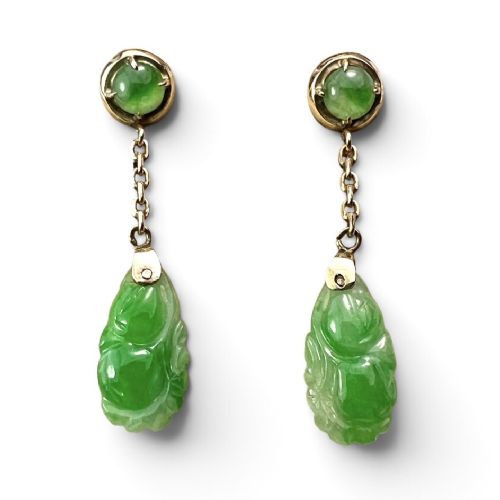


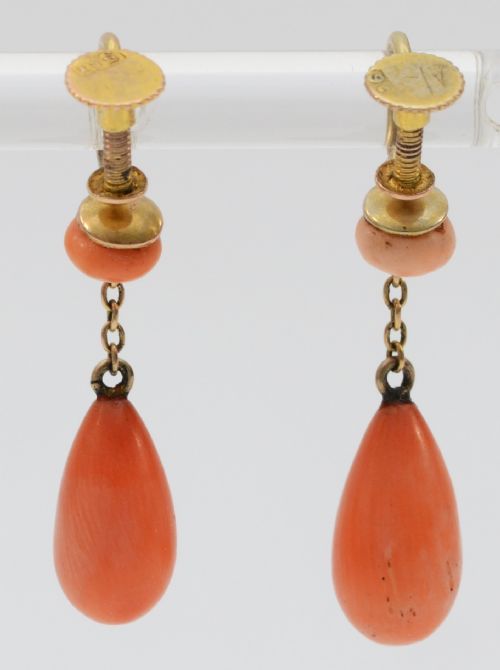


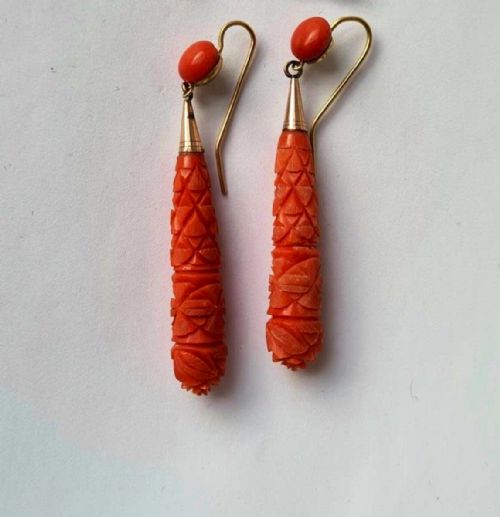

Carved Gold Earrings
These carved gold earrings bring tactile detail to the ear, spanning the Victorians through to the mid-century modernists.
Carved Gold Earrings
Carved gold earrings encompass drop, stud, and long drop forms fashioned across periods from the Regency era to the 1960s. You will frequently meet Victorian and Edwardian examples alongside Art Deco and mid-century pieces.
The materials paired with the metal define the genre, drawing heavily on carved natural coral, jadeite, shell, and Whitby jet. These organic mediums are shaped into motifs ranging from classical cameos and acorns to Chinese blessing symbols.
Origins stretch from British workshops to Italian studios and Chinese export houses. The selection relies on mounted stones and shells where the carver's hand dictates the character of the piece.
Materials and Techniques
Makers utilised nine-carat, fourteen-carat, and eighteen-carat yellow and rose gold to form settings, wires, and screwbacks. These metals provide the structural framework for the intricate carvings mounted upon them.
Carving techniques were applied directly to natural materials such as shell, agate, jade, and coral. Artisans also worked with Whitby jet, carving deep botanical and avian forms directly into the dark fossilised wood.
Materials range from traditional shell and yellow gold to natural coral, jadeite, amethyst, and Whitby jet.
Assessing Quality and Execution
Depth and precision of the carving separate the finer items from simpler production. Master carvers achieved clean lines in hard materials like jadeite and agate, whereas lesser pieces show softer, less defined contours in shell or coral.
The integration between the carved element and the gold mount reveals the maker's skill. Secure bezel settings and balanced drop mechanisms ensure the carved portions hang correctly without undue stress on the gold wires.
Deakin and Francis·Andrew Grima
The Carved Gold Earrings Glossary
- Cameo
- A method of carving where a raised relief image stands out from a contrasting background. Shell and agate are the primary materials used in this selection.
- Drop Earrings
- Earrings designed to hang below the earlobe rather than sit directly against it. They often incorporate articulated joints to allow movement.
- Whitby Jet
- A dense, black fossilised wood utilised extensively during the Victorian period. It accepts a high polish and deep carving.
- Jadeite
- A tough, mineral silicate valued for its translucent green qualities. Carved examples often originate from Chinese export pieces.
- Pinchbeck
- An alloy of copper and zinc developed to imitate gold. It appears in period settings alongside genuine gold components.
Carved Gold Earrings: Frequently Asked Questions
How do I date carved gold earrings?
Dating relies on the fastening mechanisms, the geological materials used, and the stylistic traits of the carving. Regency and early Victorian items frequently feature pinchbeck or early wire fixings, while mid-century examples show distinct modernist or Italian influences.
Examining the reverse of the setting and the nature of the gold hallmark, where present, helps narrow the decade of production. Stylistic motifs like Art Deco geometry or Victorian botanical themes further anchor the piece in its era.
Are these earrings comfortable for daily wear?
Comfort depends largely on the weight of the carved medium and the style of the fitting. Lighter shell cameos on wire hooks wear easily throughout the day, whereas dense jadeite or large Whitby jet drops carry more weight on the lobe.
Buyers should consider whether the piece uses standard wires, screwbacks, or post fittings. Selecting designs that match personal preference for weight ensures an enjoyable experience when wearing antique jewellery.
How should I clean carved natural coral and shell?
Organic materials like coral and shell require gentle treatment to preserve their surface lustre. A soft, dry cloth is usually sufficient for removing dust, avoiding harsh chemical dips or ultrasonic cleaners entirely.
Submerging these porous materials in water can damage the mounting adhesives and alter the surface over time. Store them separately in lined boxes to prevent abrasion from other metallic items.
What is the difference between jade and jadeite?
Jade is a broad term that encompasses two distinct metamorphic minerals: jadeite and nephrite. Jadeite is the denser and rarer of the two, often displaying bright translucent green shades seen in Chinese export carvings.
Nephrite tends to be tougher with a more fibrous structure. Both were utilised by period carvers, but jadeite frequently commands attention for its vibrant colour variation.