


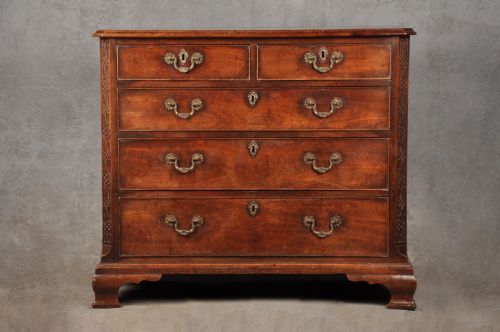


Carved Foot Mahogany Commode
These carved foot mahogany commode pieces are timber chests of drawers holding centuries of domestic history, built for practical storage and formal rooms.
Carved Foot Mahogany Commode
A carved foot mahogany commode represents substantial timber storage, appearing primarily as chests of drawers across Georgian, Victorian, and Edwardian periods. Buyers encounter varied forms here, including serpentine fronts, large Chippendale style chests, and smaller Dutch bombe interpretations.
The timber vocabulary spans solid mahogany, flame mahogany, and mahogany veneer, often supported by oak and pine internal carcases. Regional variations also surface on this page through Swedish and Dutch pieces alongside English iterations.
Materials and construction
Cabinet makers utilised dense timber foundations like mahogany, flame mahogany, and oak, frequently applying boxwood inlay for decorative contrast. Secondary woods such as pine appear within internal drawer linings and carcase backs.
Structural embellishments rely on traditional joinery methods combined with carved foot details, such as paw feet on nineteenth-century examples. Brass hardware finishes the drawer fronts across Georgian and later revival periods.
Carved Foot Mahogany Commode Retail Price Guide 2026
Typical asking prices for carved foot mahogany commode among the pieces listed under this phrase on Sellingantiques today, from the lower quarter to the upper quarter. They describe what is for sale here now, not the wider market.
Paw feet give solid mahogany chests the quiet dignity of resting beasts.
Assessing quality
Quality rests in the crispness of the timber carving, particularly around the feet and applied mouldings, where superior pieces retain sharp detail. The selection of figured mahogany veneer or flame mahogany also dictates visual depth across the drawer fronts.
Internal construction integrity separates standard utility items from finer examples, evident in the choice of secondary woods like oak versus pine and the precision of the drawer dovetailing.
The Carved Foot Mahogany Commode Glossary
- Flame mahogany
- A wood veneer figure showing a distinctive flame-like pattern created by slicing through diverging grain branches. This desirable cut enhances the visual movement on drawer fronts.
- Serpentine front
- A furniture facade shaped with a convex centre flanked by concave curves. This undulating profile requires skilled carpentry to execute correctly.
- Bombe
- A swollen or bulging convex shape characteristic of continental furniture styles. It creates a volumetric silhouette on chests and cabinets.
- Boxwood inlay
- Contrasting pale wood inserted into recesses on the mahogany surface to form decorative lines. It provides subtle geometric framing.
Carved Foot Mahogany Commode: Frequently Asked Questions
What is a carved foot mahogany commode?
A carved foot mahogany commode is a timber chest of drawers featuring carved supports and mahogany construction. These pieces served as primary storage furniture in domestic interiors across multiple centuries.
Examples on this page span Georgian, Victorian, and Edwardian eras, displaying styles from plain Regency lines to elaborate Chippendale and Dutch revival forms.
How do I date a mahogany chest?
Dating relies on observing construction methods, timber selection, and stylistic details visible in the hardware and feet. Georgian and 18th-century pieces often display hand-cut dovetails and solid timber carcases.
Later Victorian and Edwardian examples incorporate machine-sawn elements, mahogany veneers, and specific revival motifs like Dutch bombe curves or paw feet.
Where were these chests made?
These chests originate from English workshops as well as continental sources including Sweden and the Netherlands. Regional preferences dictate whether a piece takes a serpentine profile or a bombe silhouette.
Local timber availability and prevailing European design trends heavily influenced the distinct appearance of each geographic group.
How should I care for mahogany furniture?
Maintain mahogany furniture by keeping it away from direct heat sources and fluctuating humidity levels to prevent timber splitting. Regular dusting with a dry cloth preserves the finish without requiring heavy polishes.
Avoid placing damp items directly on the polished top surface to protect the timber grain and veneer.