

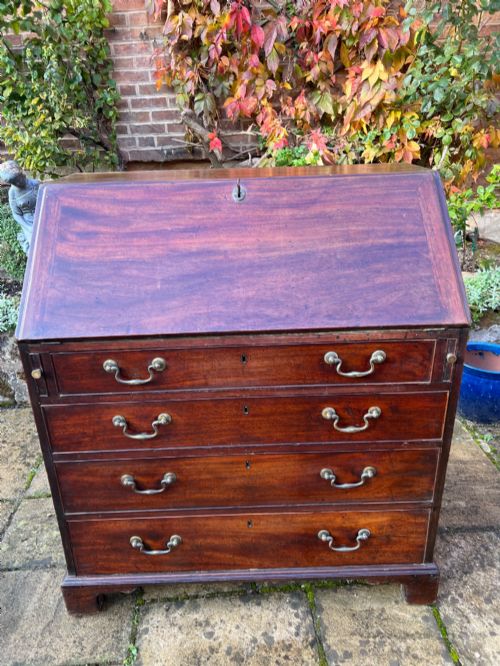
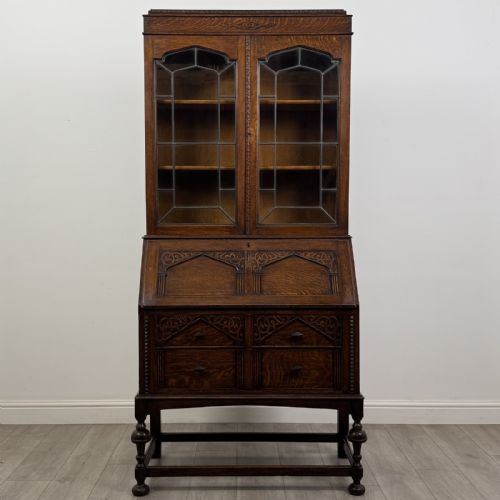
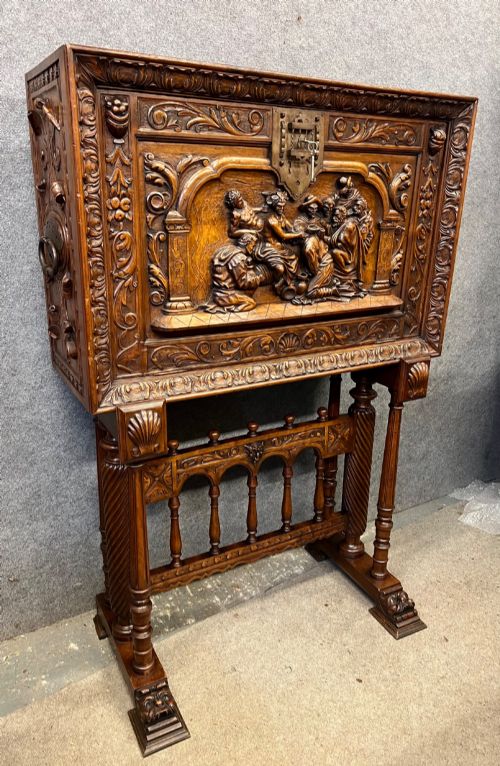
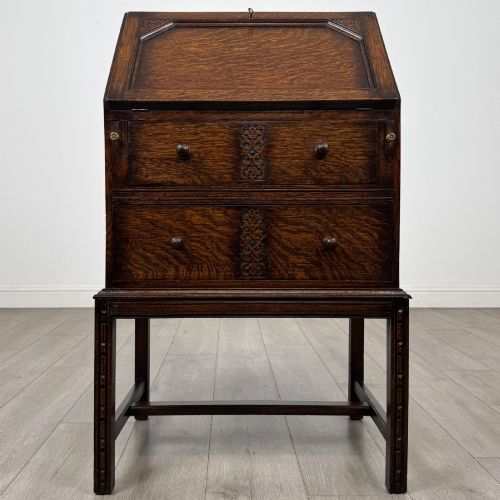
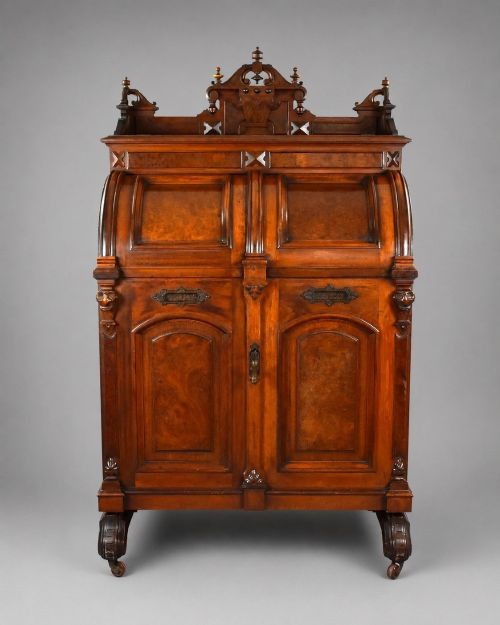
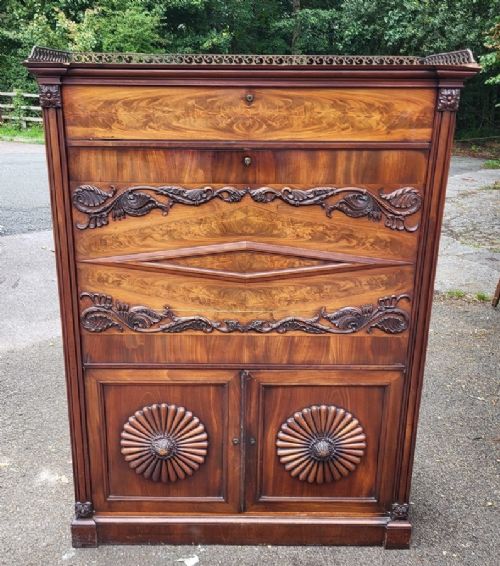
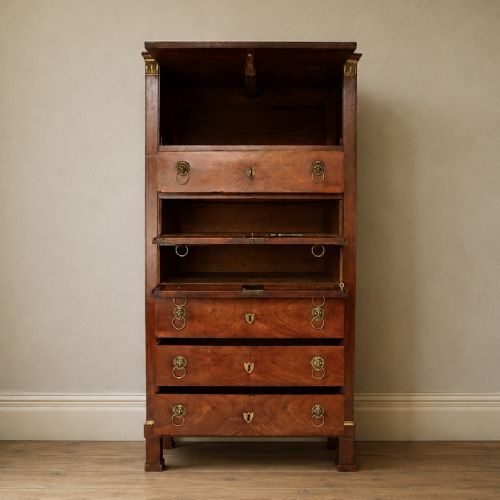
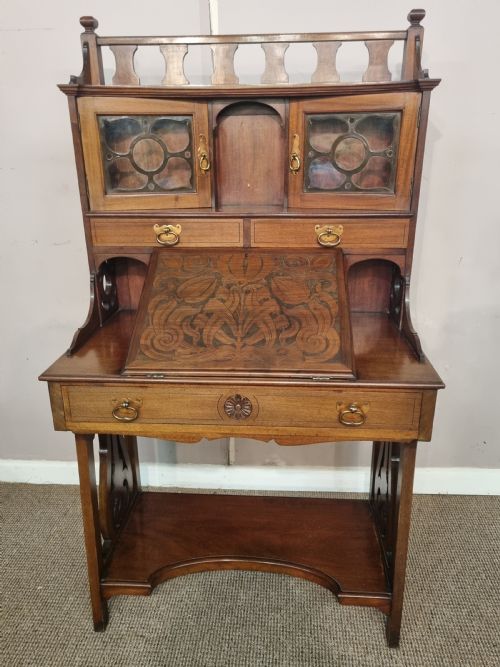
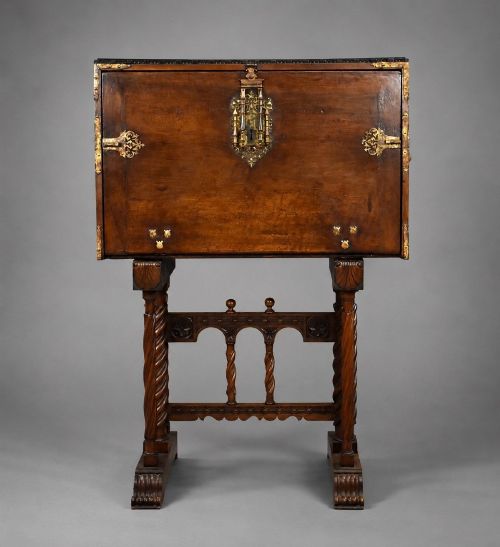


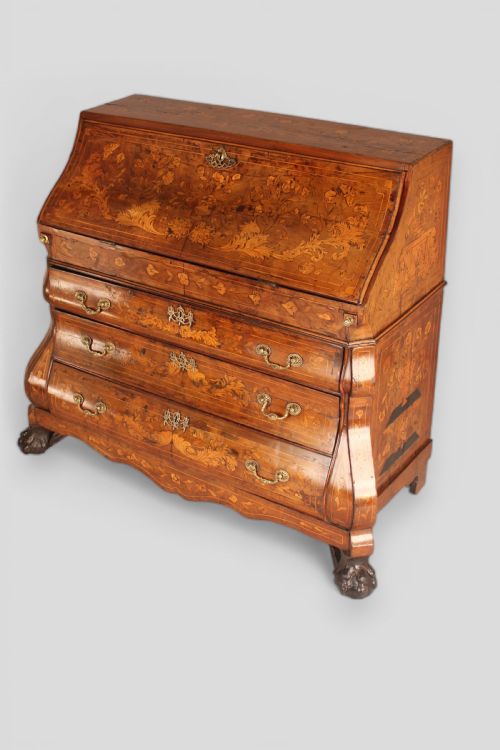
Carved Fall Front Desk
A carved fall front desk provides a sloping writing flap that opens to reveal internal compartments, combining workspace with concealed storage.
Carved Fall Front Desk
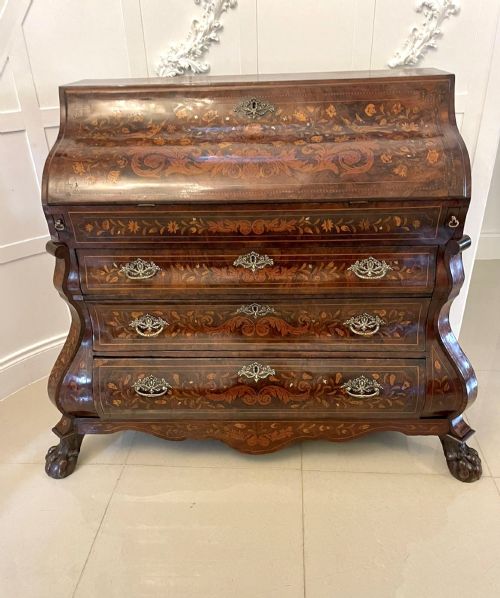
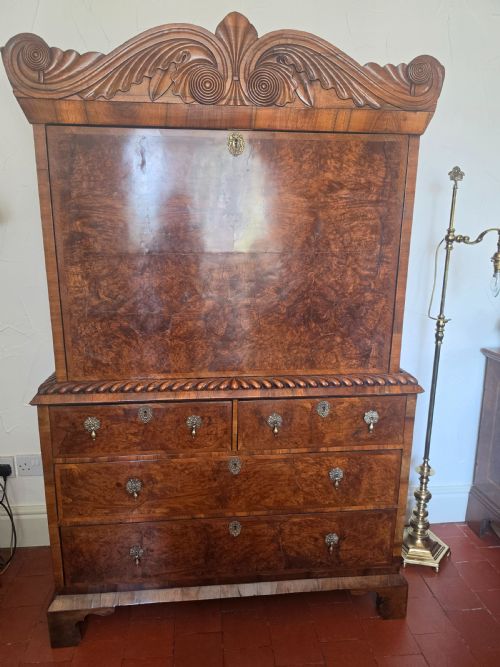
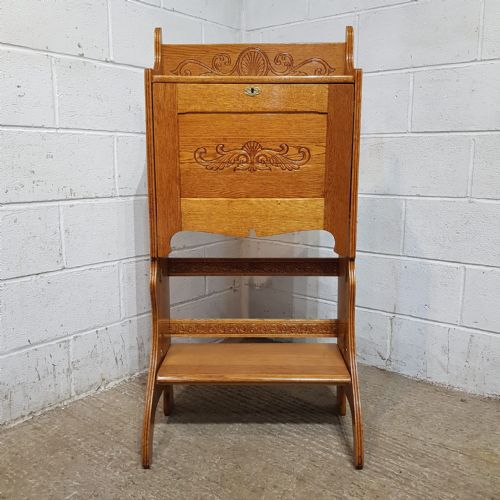
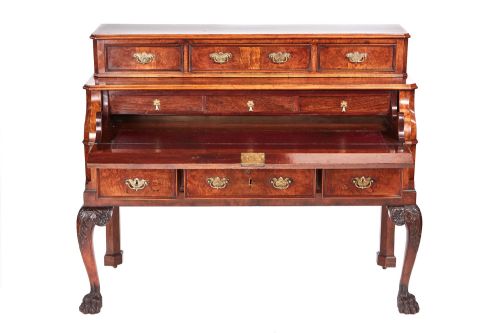
A carved fall front desk, commonly encountered as a bureau or escritoire, brings together a sloping writing lid and a chest of drawers or cabinet stand. These pieces emerge across periods from the seventeenth century through to the twentieth century, taking forms such as standard oak bureaux, bombé shaped walnut writing desks, and tall cabinets.
The materials span solid oak, mahogany, and walnut, alongside decorative veneers like burr walnut and amboyna. Makers apply carving, marquetry inlay, and figural details including linenfold panels and Green Man motifs to the exterior surfaces.
Regional variations appear in Dutch marquetry pieces, Spanish bargueño cabinets, and Anglo-Indian hardwood desks. Buyers select these items for domestic study spaces or principal rooms where concealed compartments and writing surfaces serve daily use.
Materials and Construction Methods
Cabinetmakers construct the primary carcase of a carved fall front desk using timbers such as oak, mahogany, and walnut, often applying burr walnut or flame mahogany veneers to principal surfaces. These woods provide structural stability while displaying natural grain patterns.
Decoration relies on techniques including floral marquetry inlay, deep relief carving, and applied mouldings. Brass hardware such as escutcheons, handles, and hinges secure the fall front flap and internal drawer elements.
Carved Fall Front Desk Retail Price Guide 2026
Typical asking prices for carved fall front desk among the pieces listed under this phrase on Sellingantiques today, from the lower quarter to the upper quarter. They describe what is for sale here now, not the wider market.
A carved Green Man peers out from Victorian oak, keeping watch over the internal pigeonholes and secret letters.
Distinctions in Execution
Quality within a carved fall front desk depends on the depth and crispness of the hand carving, the alignment of veneered grain patterns across drawer fronts, and the integrity of internal pigeonholes and secret compartments. Superior examples demonstrate precise joinery in the drawer linings and smooth operation of the fall front support brackets.
The choice of secondary timbers and the complexity of marquetry inlay separate standard production from master craftsmanship. Secondary details, such as original brass fittings and intact leather writing inserts, influence the overall cohesion of the piece.
Robert Mouseman Thompson·Liberty & Co·Gregory & Co. of London
The Carved Fall Front Desk Glossary
- Fall front
- The hinged writing flap of a bureau that lowers to a horizontal position for writing. It conceals internal drawers and compartments when closed.
- Bureau
- A writing desk featuring a sloping lid that opens to reveal pigeonholes and small drawers. It often sits atop a chest of drawers.
- Escritoire
- A tall writing cabinet with a fall-down writing surface enclosed by a door or flap. These units originate in seventeenth- and eighteenth-century European workshops.
- Marquetry
- The art of applying pieces of veneer to a structure to form decorative patterns and pictorial designs. Craftsmen use varied wood tints to achieve shading.
- Bombe
- A bulging or outward-curving profile characteristic of eighteenth-century Dutch and continental furniture. This contour requires specialised shaping of the wood veneers.
Carved Fall Front Desk: Frequently Asked Questions
How do I use a fall front desk?
Lower the hinged wooden flap until it rests horizontally, supported by internal wooden arms or pull-out lopers. This creates a flat surface for writing while granting access to the stationary compartments inside.
Close the flap upward when finished to conceal correspondence and keep the room tidy. The internal compartments remain locked behind the closed lid if a key is fitted to the escutcheon.
What is the difference between a bureau and an escritoire?
A bureau typically pairs a sloping writing flap with a chest of drawers beneath. It focuses on domestic storage combined with a dedicated writing surface.
An escritoire is often a taller cabinet where the writing flap or drop-down desk is enclosed within a vertical framework. These tall pieces frequently incorporate upper bookcase sections or panelled doors.
How do I date a wooden writing desk?
Examine the timber species, construction joints, and decorative style to determine the period. Oak and walnut predominate in seventeenth- and eighteenth-century examples, while mahogany gains favour later.
Stylistic markers such as Jacobean linenfold panels, Dutch marquetry inlay, or Arts and Crafts simplicity provide further chronological clues. Secondary woods inside the drawers help confirm the manufacturing era.
Where should I place this desk at home?
Position the desk against a sturdy wall in a study, library, or living room with stable humidity levels. Ensure adequate natural or task lighting falls across the open writing flap.
Keep the piece away from direct heat sources and strong sunlight to protect vulnerable wood veneers and antique finishes. Leave sufficient clearance behind the chair for comfortable seating when the flap is open.