

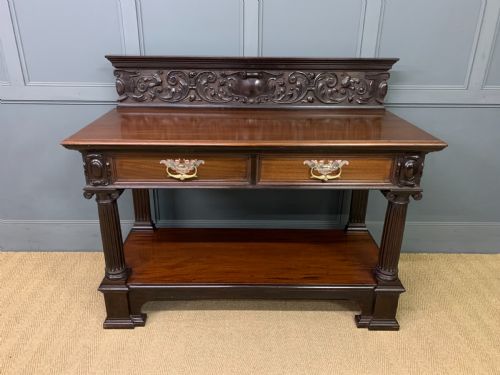


Carved Backboard Table
These carved backboard table examples are sturdy mahogany serving pieces and sideboards from the nineteenth century that anchor a dining room.
Carved Backboard Table
When you search for a carved backboard table, you are looking at nineteenth-century serving tables, consoles, and sideboards built for dining spaces. These forms provide sturdy surfaces for service alongside decorative timber work at the rear.
The pieces listed on this page span the Regency, William IV, George IV, and Victorian periods, including specific years like eighteen-sixty and eighteen-eighty. Mahogany forms dominate the selection, appearing alongside padouk wood and flame mahogany veneer.
You will most commonly meet Victorian and William IV sideboards and buffets featuring prominent carved details. Alongside these standard sideboards, the selection includes three-tier display stands and bow front serving tables.
How they were made
Cabinet makers utilised solid mahogany and padouk wood, often applying flame mahogany veneer to large flat surfaces to highlight the grain. Brass fittings occasionally appear on these heavy dining pieces.
Carving defines the style, executed by hand directly into the dense timbers along the backboards and fascias. Joinery traditions of the period relied on heavy framing to support the weight of timber tops and tiered shelving.
Carved Backboard Table Retail Price Guide 2026
Typical asking prices for carved backboard table among the pieces listed under this phrase on Sellingantiques today, from the lower quarter to the upper quarter. They describe what is for sale here now, not the wider market.
The page spans the Regency, William IV, George IV, and Victorian eras, alongside specific dates from eighteen-sixty and eighteen-eighty.
What varies in quality
The depth and sharpness of the timber carving separate standard production from superior examples. Crisp, deeply undercut foliage and scrollwork demonstrate greater artisan skill than shallow, machine-cut patterns.
Selection of the wood grain dictates the visual appeal, particularly where flame mahogany veneer is matched symmetrically across doors and drawers. Heavier construction and intact original timber tiers also lift a piece above simpler utilitarian forms.
The Carved Backboard Table Glossary
- Backboard
- The upright timber panel mounted at the rear of a serving table or sideboard, frequently decorated with carving. It prevents items from sliding off the back.
- Sideboard
- A large dining room furniture form used for storing tableware and serving food. Examples often feature cupboards, drawers, and tiered surfaces.
- Buffet
- A serving piece distinct from a sideboard, sometimes constructed with multiple open tiers for display. These pieces served a practical function in nineteenth-century dining rooms.
- Padouk
- A dense tropical hardwood with a reddish hue used in cabinet making. Anglo-Indian pieces frequently utilise this timber for its rich colour.
- Veneer
- A thin layer of figured wood applied to a secondary timber base. Flame mahogany veneer provides decorative grain patterns on large surfaces.
Carved Backboard Table: Frequently Asked Questions
What is a carved backboard table?
A carved backboard table is a nineteenth-century dining room serving piece, sideboard, or buffet featuring an upright decorated timber panel at the rear.
These heavy mahogany and padouk tables provide surface space for food service and display while showcasing period carving techniques.
How do I identify a Regency sideboard?
Regency sideboards display classical restraint through clean architectural lines and selected mahogany timbers. Look for symmetry and restrained ornamentation typical of the early nineteenth century.
Later Victorian interpretations often introduce heavier proportions and more elaborate, deep-relief carving along the backboards and front edges.
Where were these serving tables used?
These pieces belonged in the dining rooms of substantial nineteenth-century homes. Servants used the surfaces to plate meals and hold silverware during large dinners.
Today, they function well in modern dining spaces or large hallways as serving surfaces and display areas for lamps or pottery.
What is the difference between a buffet and a sideboard?
A sideboard traditionally combines enclosed cupboards and drawers for storing dining linen and cutlery. It offers a broad top surface for serving.
A buffet often includes open tiers or serving shelves, historically intended for displaying silver and serving dishes during a meal.