




Carriage Clock with Handle
A carriage clock with handle is a portable timepiece designed for travel, combining precision mechanics with a sturdy carrying grip.
Carriage Clock with Handle
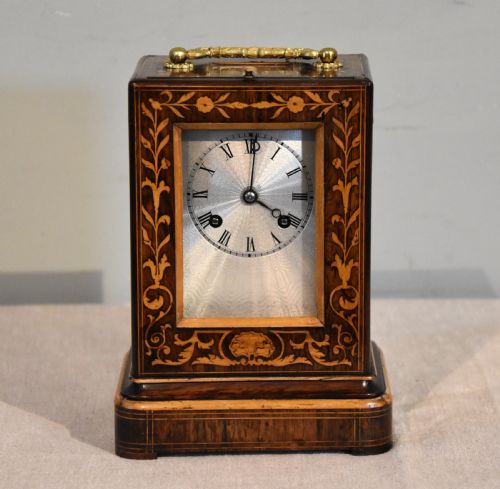
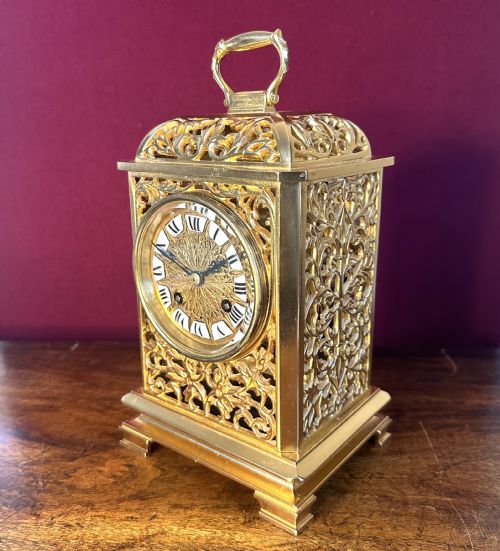
A carriage clock with handle is a portable timepiece developed for travel by Victorian and Edwardian travellers. These pieces are housed in metal cases with glass panels that reveal the internal movement.
You will most commonly meet brass and gilt brass examples on this page, often dating from the nineteenth and early twentieth centuries. Forms range from standard mantel proportions down to miniature sizes.
Origin and styling split broadly between British makers and French workshops. Pieces frequently incorporate decorative elements such as frets, columns, and distinctive handle designs.
How they were made
Makers constructed these cases primarily from brass, gilt brass, and bronze, frequently casting handles and framing in solid metal. Silver and sterling silver also appear, alongside specialised mounts in gold.
Panels of bevelled glass protect the dial and expose the escapement mechanism to view. Dials themselves are typically executed in white enamel with painted numerals, while select panels feature cast bronze or floral detailing.
Listings feature brass, silver, and bronze materials across Victorian and Edwardian periods.
What varies in quality
Quality rests heavily on the sophistication of the movement and the crispness of the cast metal case. Repeat striking mechanisms and multi-train movements sit at the upper end of the scale.
Pickford of London·Paul Garnier
The Carriage Clock with Handle Glossary
- Carriage clock
- A portable spring-driven timepiece originally built for travel. These clocks feature protective glass panels and a top-mounted handle.
- Escapement
- The mechanism within a clock that controls the release of power from the train. It ensures the motion remains even and accurate.
- Gilt brass
- Base brass treated with a thin layer of gold or gold-coloured wash. It provides a bright, reflective finish similar to solid gold.
- Enamel
- A glassy substance fused to a metal substrate under high heat. Used principally for the chapter rings and dials of these clocks.
- Fret
- Ornamental pierced metalwork applied to the case. This technique allows sound and light to pass through decorative panels.
Carriage Clock with Handle: Frequently Asked Questions
What is a carriage clock with handle?
A carriage clock with handle is a portable mechanical timepiece designed to be carried easily. They originated in the nineteenth century for travellers who required accurate timekeeping on the move.
These clocks are typically housed in brass or gilt metal frames with glass viewing panels. The handle sits firmly on top of the case for transport.
How do I wind a carriage clock?
Winding requires a dedicated key inserted into the arbours located on the backplate or underneath the movement. Turn the key gently until you feel resistance.
Care must be taken not to overwind the mainspring. Most examples require winding at regular intervals depending on the duration of the movement.
How do I tell Victorian from Edwardian pieces?
Victorian clocks often display heavier brass castings, architectural columns, and Gothic or traditional detailing. They date from the nineteenth century up to nineteen hundred.
Edwardian pieces tend toward lighter proportions, sometimes including miniature formats or refined silver mounts. These date from the early twentieth century.
Where should I place my clock?
Select a stable, level surface away from direct sunlight, moisture, and extreme temperature fluctuations. Mantelpieces and tabletops provide ideal environments for display.
Ensure the clock rests on a solid foundation so the balance wheel operates evenly. Avoid high-traffic areas where the handle or case might be accidentally knocked.