






Captain Desk with Drawers
These compact writing tables known as captain desk with drawers offer a clever arrangement of storage and writing space tailored for tighter interiors.
Captain Desk with Drawers
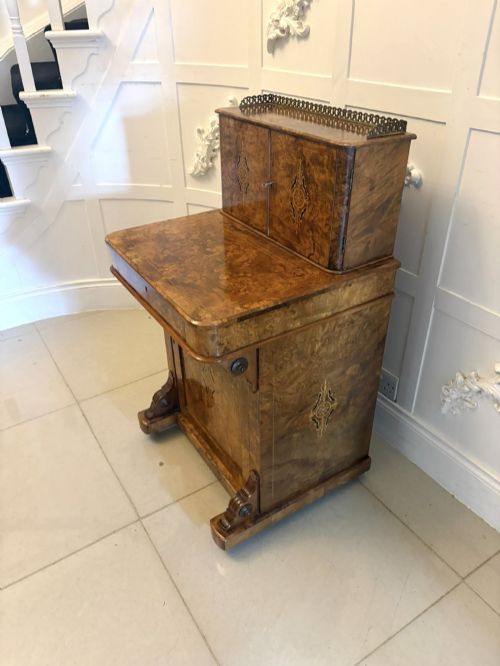
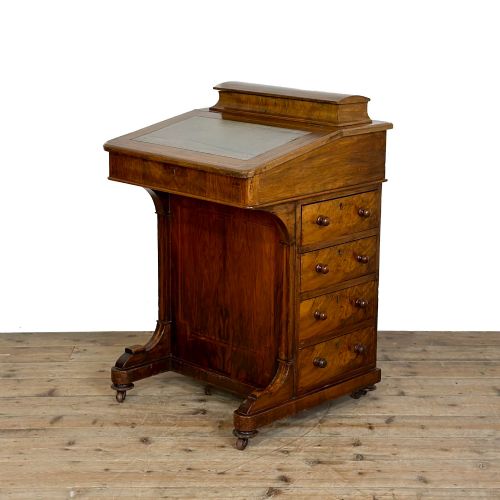
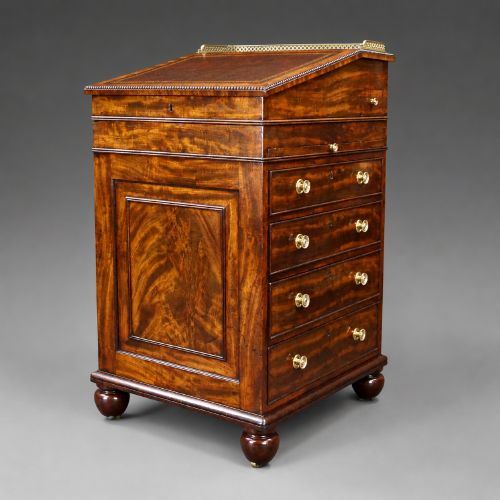
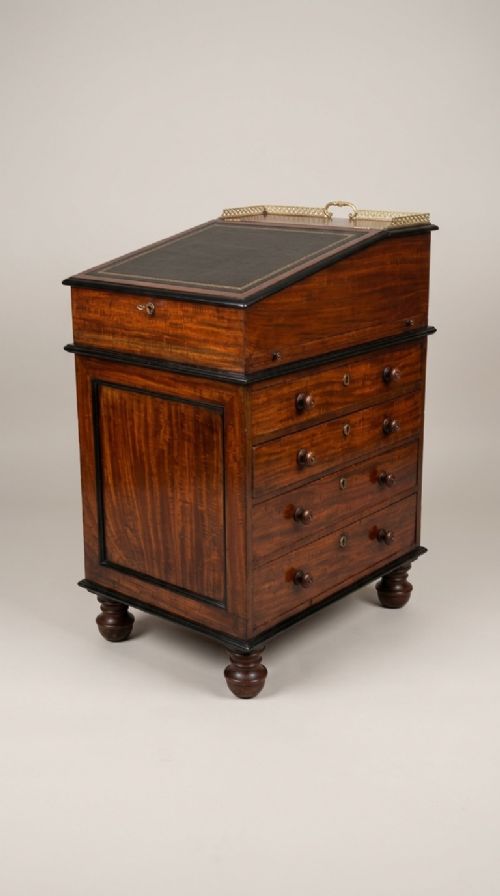
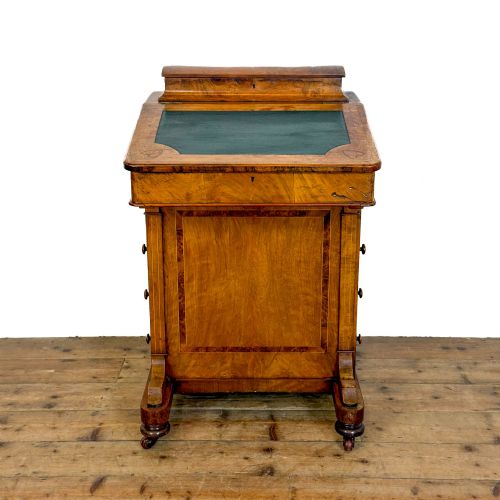
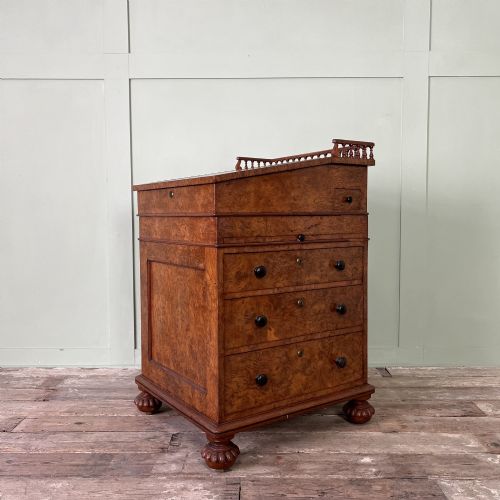
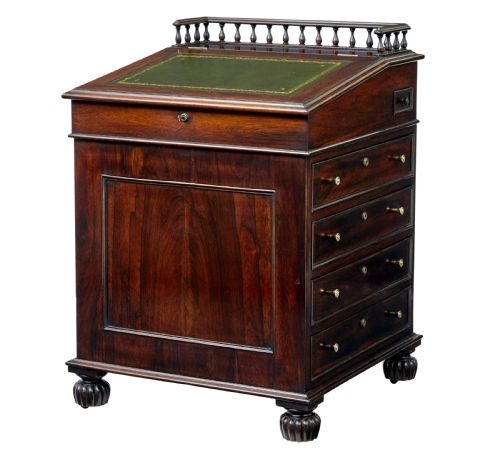
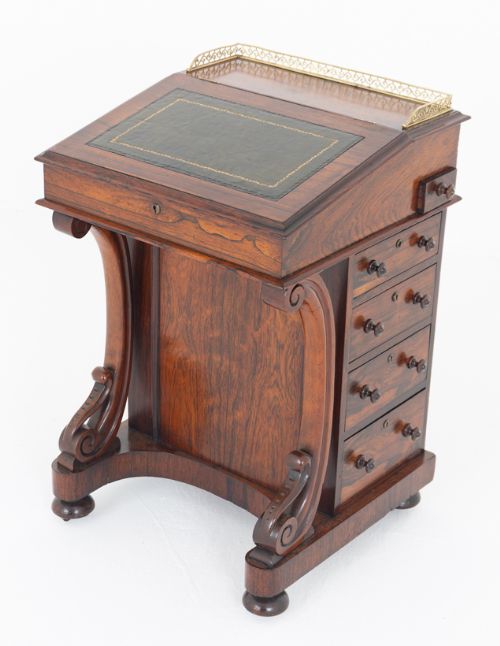
A captain desk with drawers is a compact, sloping-topped writing cabinet built with banks of side drawers, appearing frequently in Victorian and Regency forms across these listings.
Most examples you encounter take the form of Davenports, constructed in mahogany, burr walnut, rosewood, and pollard oak, often featuring sliding tops and side nests of drawers.
The layout typically combines a slanted writing surface lined with leather above a pedestal base containing functional drawers on one side and false drawers opposite.
How they were made
Cabinet makers utilised dense hardwoods such as flame mahogany, rosewood, and burr walnut, laying timber veneers over robust foundational carcases.
Fitted interiors incorporate secondary woods like maple, whilst brass handles, hinges, and sliding mechanisms provide structural and decorative hardware.
Surfaces frequently showcase decorative techniques including marquetry inlay, book-matched veneers, and tooled leather writing inserts.
The listings show desk forms spanning the Regency, William IV, Victorian, and Edwardian periods, executed in rosewood, walnut, oak, and mahogany.
What varies in quality
The standard of timber selection marks the divergence between ordinary pieces and superior examples, particularly in the figuring of burr walnut, flame mahogany, and amboyna veneers.
Intricacy of internal fittings, such as maple-lined stationary compartments and secret drawers, distinguishes more ambitious workshop production.
The precision of cabinet joinery, including dovetailed drawer construction and the smooth operation of sliding tops, dictates the overall grade.
Gillows·Gillow and Co·James Shoolbred
The Captain Desk with Drawers Glossary
- Davenport
- A small compact writing desk featuring a sloping lid and pedestal drawers. This form dominates the selection seen here.
- Burr walnut
- Timber taken from the warted excrescences of walnut trees, prized for its swirling grain patterns. It forms the primary decorative surface on numerous Victorian pieces.
- Marquetry
- The art of applying decorative pieces of veneer to a structure to form intricate designs. Examples include floral and geometric inlay across walnut carcases.
- Flame mahogany
- Mahogany veneer cut to reveal a distinctive flickering grain pattern resembling flames. This material appears on Regency and Victorian desks.
- Pedestal base
- The supporting structure beneath the writing surface containing vertical stacks of drawers. These often feature locking mechanisms operated by keys.
Captain Desk with Drawers: Frequently Asked Questions
What is a captain desk with drawers?
A captain desk with drawers is a traditional compact writing cabinet that combines a sloping desktop with built-in pedestal drawers.
These pieces were originally designed for use in confined spaces on ships or in small domestic studies, offering efficient storage for papers and writing implements.
How do I use a sliding top desk?
The sliding top mechanism allows the upper writing slope to push forward, extending the kneehole space and providing a more comfortable sitting position.
When not in use, the top slides back to reduce the footprint of the desk in a room.
How do I tell Regency from Victorian desks?
Regency desks typically display cleaner architectural lines, classical rosewood or mahogany surfaces, and simpler brass mounts.
Victorian examples frequently introduce heavier burr walnut veneers, decorative marquetry inlay, and more ornate structural variations such as piano tops.
Where were side drawers placed?
The drawers are traditionally built into one side of the pedestal base, with the opposite side usually fitted with matching dummy drawers for symmetry.
Some variants feature drawers accessing both sides of the pedestal for increased storage capacity.