
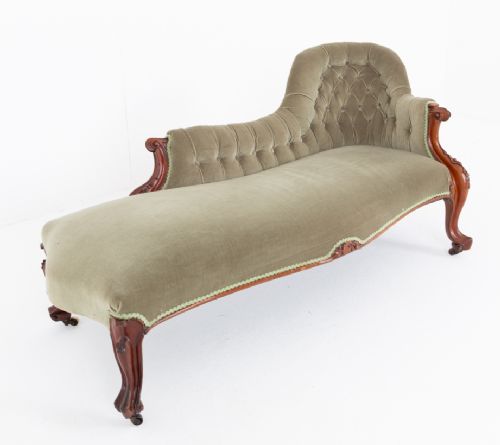


Button Back Fainting Couch
A button back fainting couch offers a reclining seat for Victorian parlours, combining deep upholstery with an elevated backrest.

Button Back Fainting Couch
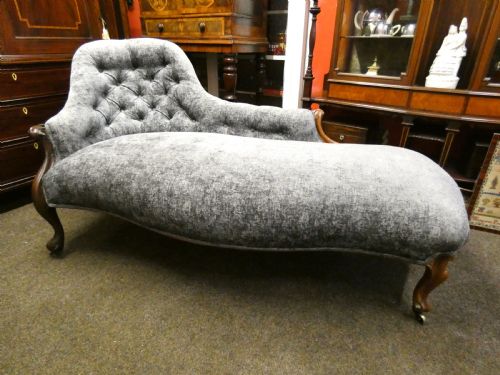
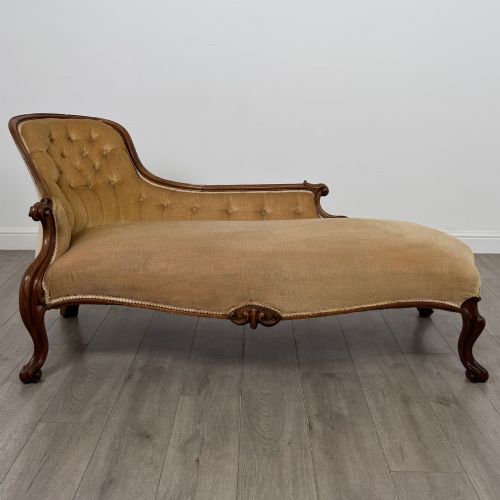
A button back fainting couch typically appears as a chaise longue or daybed originating from the nineteenth century, including Victorian and Regency periods. These seating forms combine a raised, curved headrest with an extended seat designed for reclining.
Makers shaped these pieces from woods such as mahogany, rosewood, walnut, and ebonised timber, styled in Victorian, Regency, Louis XVI Revival, and William IV designs. Variations include kidney sofas, double spoonback designs, and miniature furniture.
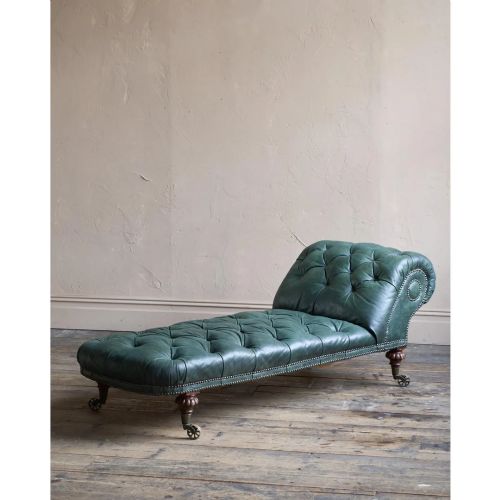
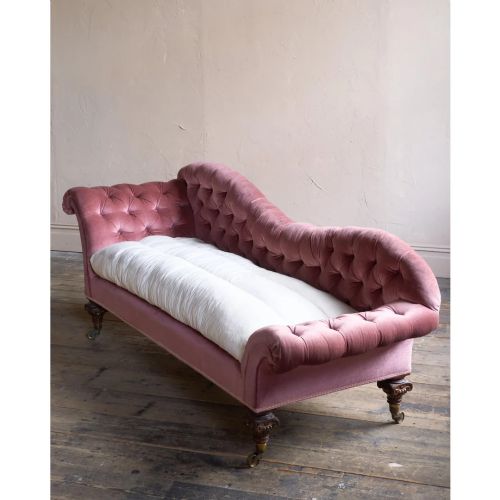
Most examples found here date to the Victorian era, often featuring carved wooden frames and upholstered surfaces in fabric, velvet, leather, or satin. Architectural details like Ionic column legs occasionally support the wooden structure.
How they were made
Cabinet makers constructed the foundational frames using solid hardwoods like mahogany, rosewood, walnut, and occasional brass accents, applying hand-carved ornamentation to the exposed wooden rails and legs. Gilt decoration appears on specific day beds.
Upholsterers secured the padding and stretched fabric, velvet, leather, or satin across the seat and backrest, creating the characteristic tufted buttoning by pulling ties deep into the stuffing. Frames often incorporated exposed polished wood alongside the upholstered areas.
Object forms vary across the selection, encompassing standard chaise longues, daybeds, kidney sofas, double spoonbacks, and miniature furniture models.
What varies in quality
The sophistication of the timber carving and the choice of dense hardwoods like rosewood or figured mahogany separate standard examples from finer works. Elaborate frame details such as double spoonbacks or carved Ionic column legs indicate greater maker effort.
The execution of the deep buttoning and the choice of covering material, whether supple leather, plush velvet, or woven fabric, dictate the finish. Well-preserved frames retain crisp joinery and balanced proportions across the elongated seat and curved back.
Holland & Sons·Miles & Edwards·Howard and Sons
The Button Back Fainting Couch Glossary
- Chaise longue
- An upholstered long chair designed for reclining, featuring a backrest at one end. It served as a daybed and social seat in nineteenth-century rooms.
- Buttoned
- Upholstery secured with deep-set buttons arranged in a geometric grid pattern. This technique pulls the fabric tight and creates padded indentations.
- Rosewood
- A dense, dark timber with distinct grain patterns used frequently for high-end nineteenth-century furniture frames. It takes a high polish.
- Spoonback
- A chair or couch back shaped like the bowl of a spoon, curved to fit the human form. Victorian makers often doubled this shape on larger settees.
- Daybed
- A long seat intended for daytime resting or lounging, functioning similarly to a chaise longue. Early twentieth-century versions also appear in this form.
Button Back Fainting Couch: Frequently Asked Questions
What is a button back fainting couch?
A button back fainting couch is a nineteenth-century daybed or chaise longue featuring an upholstered backrest and deep button tufting. These pieces provided a semi-reclined seating option in Victorian parlours.
They combine the functions of a sofa and a bed, allowing the sitter to recline without lying completely flat. The raised end supported the head during rest.
How were fainting couches used historically?
Victorians used these pieces for daytime resting, reading, and receiving close visitors in private sitting rooms. The reclining position suited the fitted corsetry worn at the time.
They stood against drawing room walls rather than in bedrooms, acting as formal statement furniture. The long seat accommodated a person stretched out in comfort.
How do I identify a Victorian fainting couch?
Victorian examples display characteristic dark timber frames made of rosewood, mahogany, or walnut, often with visible hand-carving. The upholstery frequently incorporates velvet, leather, or patterned fabric with tufted buttoning.
Design styles range from plain mahogany frames to ornate double spoonbacks or pieces supported by Ionic column legs. Most date between the middle and late nineteenth century.
How do I live with a fainting couch?
Place the couch against a main wall where its asymmetrical backrest can be viewed properly without blocking room traffic. It works well in large living spaces, dressing rooms, or studies as a primary reading seat.
Protect the exposed wooden frame from direct sunlight and care for the upholstery material according to its specific fabric or leather type. Keep heavy foot traffic away from the extended seating platform.