


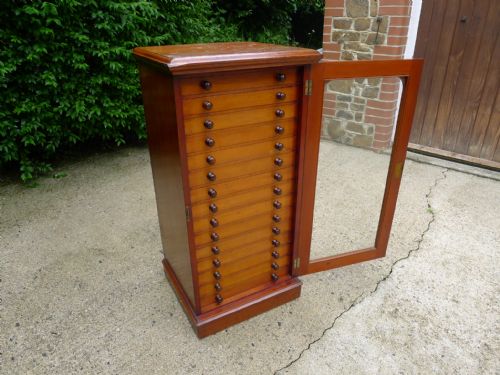


Butterfly Specimen Cabinet
A butterfly specimen cabinet houses delicate lepidoptera collections within disciplined rows of glazed drawers.
Butterfly Specimen Cabinet
A butterfly specimen cabinet provides secure housing for natural history collections through multiple shallow drawers fitted with glass panels. These pieces emerge predominantly from Victorian and Edwardian workshops, reflecting a period of intense amateur and professional entomological study.
The format ranges from compact five-drawer chests to grand forty-drawer upright cases designed to preserve fragile specimens from light and pests. Mahogany and walnut form the primary structures, paired with internal pine framing for stability and straightforward drawer movement.
Materials and Construction
Cabinet makers utilised dense timbers such as solid mahogany, walnut, and figured pitch pine to build carcasses capable of supporting heavy banks of drawers. Brass handles, label holders, and locking mechanisms provide secure hardware enclosure for each compartment.
Internal drawer construction relies on precision joinery and glass tops to seal specimens while maintaining visibility. Card linings and specialised pinning bottoms inside the drawers keep individual specimens secure.
Butterfly Specimen Cabinet Retail Price Guide 2026
Typical asking prices for butterfly specimen cabinet among the pieces listed under this phrase on Sellingantiques today, from the lower quarter to the upper quarter. They describe what is for sale here now, not the wider market.
Listings feature Victorian, Edwardian, and Regency periods alongside Georgian Revival pieces constructed from mahogany, walnut, oak, and pitch pine.
Assessing Cabinet Construction
Drawer capacity and timber selection dictate the standing of a piece, with thirty-two or forty-drawer mahogany examples representing significant workshop output. The presence of named maker signatures or specific regional workshop stamps elevates the status of the furniture.
Secondary woods, drawer action smoothness, and the survival of original glass panes determine structural integrity. Uniformity in grain matching across multiple drawers indicates higher levels of cabinet-making skill.
Watkins and Doncaster·Brady of Edmonton·Charles William Schofield·J.T. Crockett·Standish
The Butterfly Specimen Cabinet Glossary
- Specimen cabinet
- A piece of furniture containing shallow drawers built specifically for storing natural history items. These units protect fragile contents from dust and handling.
- Lepidoptera
- The order of insects comprising butterflies and moths. Specimens are mounted on pins inside glazed drawers for study and display.
- Pitch pine
- A resinous softwood utilised in late nineteenth-century cabinet interiors. It offers robust structural support for heavy banks of drawers.
- Burr walnut
- Timber featuring intricate swirling grain patterns sourced from tree growths. Cabinet makers employed this material for decorative exterior veneer panels.
- Glazed door
- A timber-framed door fitted with glass panels. This allows inspection of drawer labels and contents without exposing specimens to the room environment.
Butterfly Specimen Cabinet: Frequently Asked Questions
What periods do these cabinets date from?
The available selection spans the nineteenth and early twentieth centuries, encompassing Victorian, Edwardian, and Regency eras.
Workshop production methods during these decades focused on dense hardwoods and modular drawer systems designed for scientific study.
How were these cabinets originally used?
Naturalists and collectors utilised the shallow drawers to organise classified species of butterflies and moths.
Glass-fronted doors and tightly fitted drawers protected fragile specimens from dust, light degradation, and insect pests.
What timbers appear most frequently?
Mahogany and walnut form the predominant exterior materials, often finished with polished surfaces.
Internal drawer construction frequently incorporates secondary softwoods and card components to accommodate specimen pins.
How do I distinguish cabinet sizes?
Dimensions range from compact chests containing five or six drawers to substantial upright units holding up to forty drawers.
Tabletop display formats and paired chests also occur within the recorded nineteenth-century material.