




Brown Wooden Jewellery Cupboard
A brown wooden jewellery cupboard brings tabletop storage into domestic spaces, offering scaled-down drawers and cabinets for precious trinkets.
Brown Wooden Jewellery Cupboard
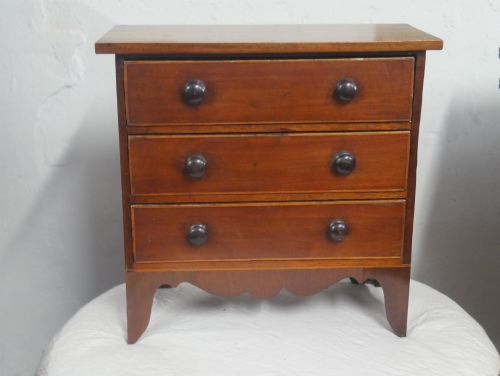
A brown wooden jewellery cupboard encompasses miniature chests of drawers, table cabinets, and small wall cabinets designed for personal storage. These pieces take various historical forms, from Georgian and Victorian apprentice pieces to French commodes and tabletop collectors cabinets.
Buyers meet examples fashioned from mahogany, walnut, burr walnut, oak, and pine, often reflecting distinct regional styles like 19th Century Scottish or George II style. The selection ranges from plain pine table cabinets to finely detailed walnut and mahogany miniature chests with mother of pearl inlay.
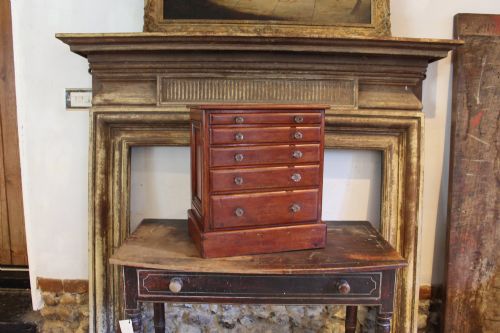
Many items function as jewellery chests or watch and clock repairer's chests, providing compact compartments scaled down from full-size furniture. Their utility lies in offering organised tabletop storage whilst retaining the character of larger period cabinets.
Materials and construction
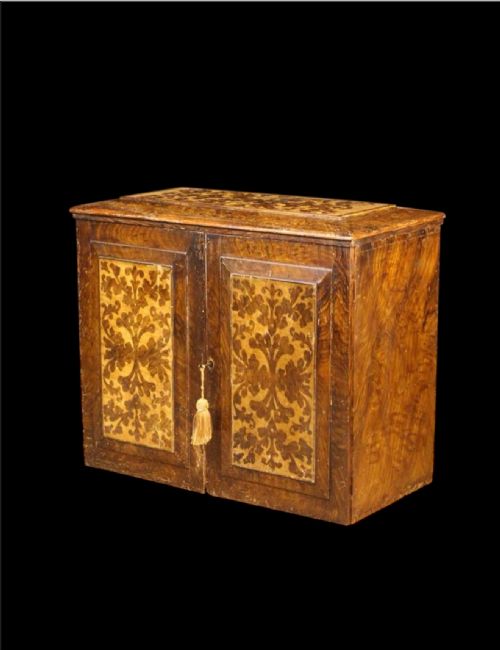
Cabinet makers utilised dense hardwoods such as mahogany, walnut, and oak alongside softer pine and fruitwoods to construct these miniature pieces. Burr walnut and figured walnut veneers added decorative grain patterns to drawer fronts and top surfaces.
Joinery methods mirror those of full-scale period furniture, incorporating fitted drawers, brass hardware, and occasional mother of pearl inlay. Carved details and glass elements appear on specific table top and wall cabinets from the Victorian and Edwardian eras.
The available selection spans the eighteenth century through to 1920, featuring mahogany, walnut, oak, and pine across various miniature furniture forms.
Assessing quality and finish
Superior examples display careful selection of timber veneers, such as burr walnut or figured walnut, matched evenly across drawer fronts. Finer pieces incorporate refined brass handles, tight dovetail joinery, and precise miniature proportions that mimic full-size cabinetry.
Simpler pine or soft wood cabinets rely on straightforward construction methods and plain timber surfaces. The presence of specialised interiors, such as those in watch repairer chests or velvet-lined jewellery compartments, distinguishes more elaborate historical forms.
The Brown Wooden Jewellery Cupboard Glossary
- Apprentice piece
- A small-scale item created by a trainee craftsman to demonstrate mastery of joinery and woodworking skills before admission to a guild.
- Miniature chest of drawers
- A scaled-down version of a standard chest, retaining functional drawers and period proportions for tabletop use.
- Burr walnut
- A highly prized timber veneer obtained from walnut tree growths, characterised by swirling, intricate grain patterns.
- Collectors cabinet
- A small cabinet fitted with multiple shallow drawers designed for storing geological specimens, coins, or jewellery.
Brown Wooden Jewellery Cupboard: Frequently Asked Questions
What is an apprentice piece?
An apprentice piece is a small-scale item created by a trainee woodworker to prove their skill to master craftsmen.
These pieces replicate full-size furniture with exact proportions and miniature joinery.
How were these small cabinets used?
These small cabinets served multiple domestic and specialist purposes, including holding jewellery, trinkets, and small valuables.
Some specialised examples functioned as watch and clock repairer chests or storage for natural history collections.
Are all miniature chests from the Victorian era?
Miniature chests span several periods, with examples originating in the eighteenth, nineteenth, and early twentieth centuries.
Georgian, Victorian, Edwardian, and Regency periods all produced various forms of small wooden cabinets.
What woods were commonly used?
Makers utilised a variety of timbers including mahogany, walnut, burr walnut, oak, pine, and soft woods.
Finer examples frequently featured decorative veneers or inlaid mother of pearl details.