

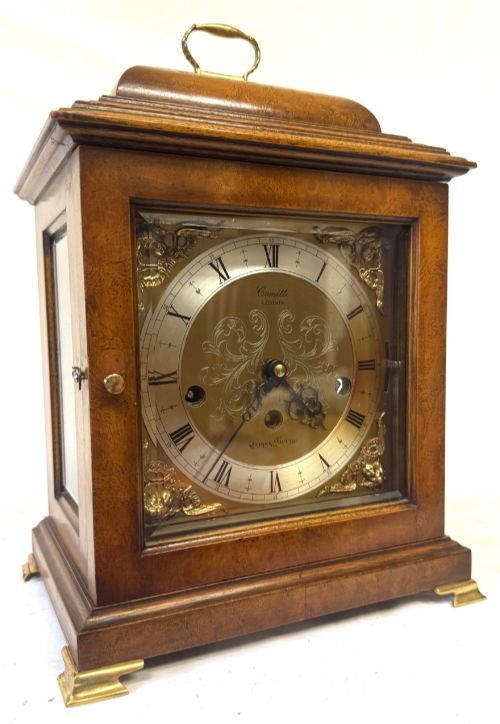
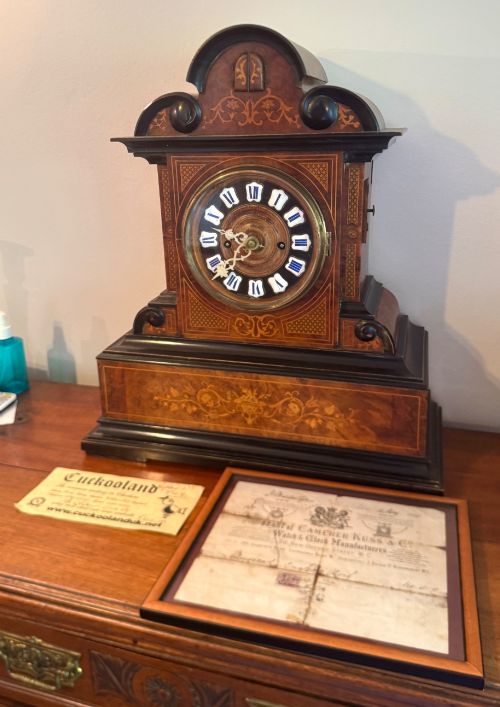

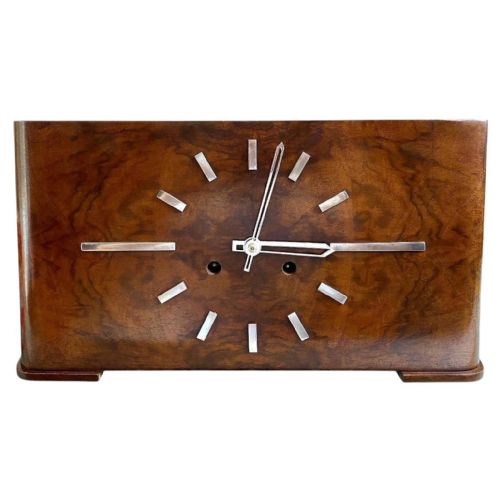


Brown Walnut Mantel Clock
These brown walnut mantel clock selections offer the traditional desk and bracket timepieces collectors seek for period interiors.
Brown Walnut Mantel Clock
A brown walnut mantel clock is a domestic timepiece designed for placement on a shelf, mantelpiece or desk, appearing in forms ranging from traditional Victorian bracket clocks to geometric Art Deco designs. Buyers searching for a brown walnut mantel clock will encounter pieces spanning several eras, including 18th century bell top models, Victorian marquetry examples, and mid-century walnut veneer executions.
Materials and construction methods
Cabinet makers utilised solid walnut, burr walnut, and figured walnut veneers over secondary timbers to construct the architectural cases. Glass panels protect the dials, whilst brass, chrome, and enamel feature prominently in the bezels, chapter rings, and movement components.
Carved wooden details appear on Black Forest iterations, and ebonised highlights accent certain Victorian marquetry models. Mechanical movements govern the timekeeping, encompassing fusee mechanisms, striking trains, and multi-tune musical cylinders.
Some clocks play multiple tunes while others merely tick steadily, proving that domestic timekeeping has long catered to both musical ears and quiet rooms.
Evaluating craftsmanship and detail
The sophistication of the timber selection largely determines the visual hierarchy, distinguishing plain walnut housings from highly figured burr veneers and intricate marquetry patterns. Case construction complexity ranges from simple architectural boxes to deeply carved Black Forest sculptural forms or streamlined Art Deco geometric curves.
Movement sophistication also dictates distinction within the range, separating standard time-only mechanisms from complex 14-day striking trains, multi-tune movements, and refined tic-tac escapements by notable makers.
H.A.C.·Comitti Of London·Mappin & Webb·Haller·Elliott·Connell of London·Bravingtons Ltd of London·John Taylor Of London
The Brown Walnut Mantel Clock Glossary
- Bracket clock
- A portable table clock originally designed to sit upon a wall bracket to aid room illumination and sound propagation. Later examples function as substantial freestanding mantel clocks.
- Fusee
- A conical pulley connected to the mainspring by a chain or cord, designed to equalise the declining power of the spring as it unwinds. This mechanism ensures more consistent timekeeping throughout the power reserve.
- Escapement
- The mechanical linkage that regulates the release of power from the gear train to the pendulum or balance wheel. It delivers periodic impulses to maintain the motion.
- Marquetry
- The art of applying decorative veneer pieces in wood to form geometric or pictorial designs on a carcase. It requires precise cutting and fitting of contrasting timbers.
- Burr walnut
- Timber obtained from walnut tree growths that produce swirling, highly ornamental grain patterns. Cabinet makers prize this material for prominent visible surfaces.
Brown Walnut Mantel Clock: Frequently Asked Questions
How do I wind a mechanical mantel clock?
Most mechanical clocks utilise a key inserted into winding holes on the dial face to tension the internal springs or weights.
Care must be taken not to over-wind the movement, stopping as soon as resistance is felt.
Where should I place a walnut mantel clock?
These clocks sit securely upon level surfaces such as mantelpieces, sideboards, desks, or designated wall brackets.
Stability and protection from direct sunlight and damp conditions help preserve the timber and movement.
What is the difference between a mantel clock and a bracket clock?
Bracket clocks historically required a wall shelf to allow space for pull-repeat strings and sound resonance, though the term later encompassed large table clocks.
Mantel clocks were designed specifically to stand directly on shelf surfaces without additional wall supports.
How can I identify an Art Deco walnut clock?
Art Deco models typically display geometric symmetry, streamlined waterfall curves, and contrasting materials like chrome alongside walnut veneer.
Dial faces often feature stylised Arabic numerals and minimalist chapter rings characteristic of the 1920s and 1930s.