

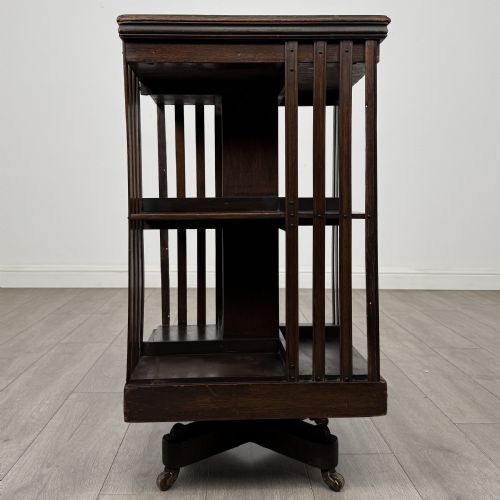
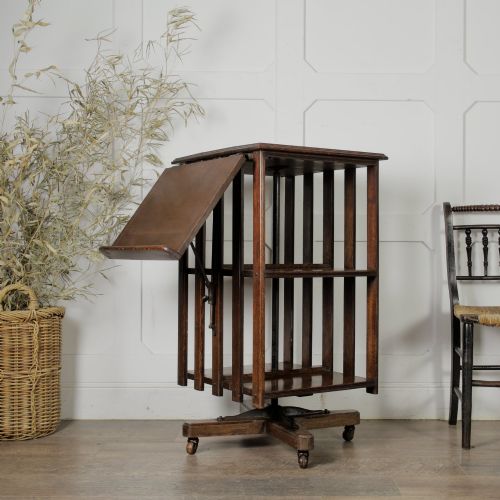

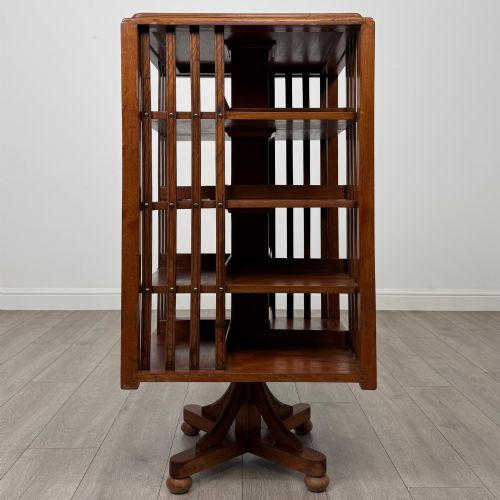
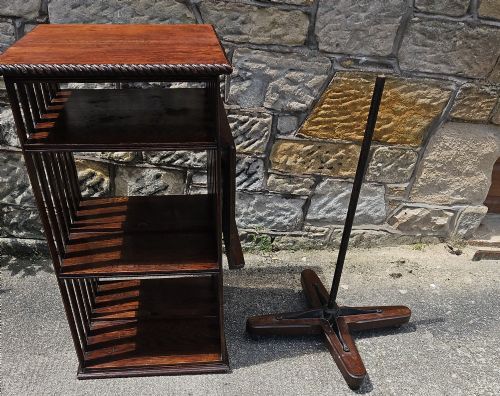
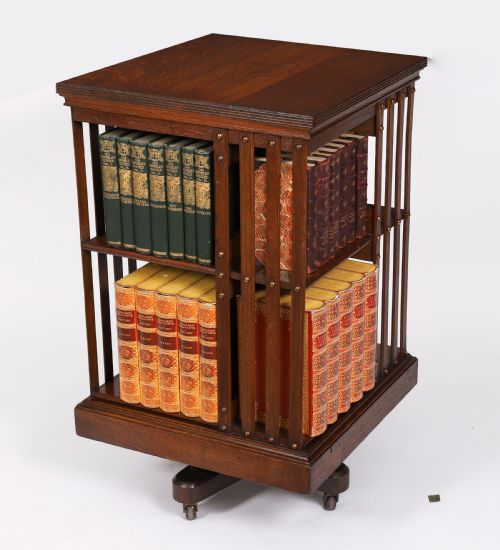


Brown Oak Revolving Bookcase
A brown oak revolving bookcase offers ingenious tabletop or floor storage that turns smoothly at a touch, bringing every volume within reach.
Brown Oak Revolving Bookcase
A brown oak revolving bookcase is a rotating shelving unit designed to hold books upright while occupying minimal floor or table space. These pieces serve studies, libraries, and sitting rooms by turning on a central mechanism to display titles from all sides.
Most examples found on this page date from the Edwardian period or around nineteen hundred, alongside Victorian pieces from eighteen ninety and later examples from nineteen thirty. Makers constructed both floor-standing tall designs and smaller table top variants.
The prevailing material across these listings is oak, occasionally accompanied by mahogany, supported by internal cast iron, iron, or brass turning mechanisms and sometimes ceramic components. Styles range from plain Edwardian forms to Arts and Crafts and Art Nouveau interpretations.
How they were made
Cabinet makers utilised solid oak and mahogany to build the frames, housing books across tiered compartments that connect to a central spindle. Woodworkers joined the timber using traditional methods suited to bearing the weight of heavy volumes.
Internal motion relies on cast iron, iron, and brass mechanisms that allow the bookcase to spin smoothly without binding. Some variations incorporate ceramic elements within the revolving pivot or decorative fittings.
Brown Oak Revolving Bookcase Retail Price Guide 2026
Typical asking prices for brown oak revolving bookcase among the pieces listed under this phrase on Sellingantiques today, from the lower quarter to the upper quarter. They describe what is for sale here now, not the wider market.
These spinning bookcases turn reading rooms into indoor carousels for literature, letting heavy volumes take a dizzy turn.
What varies in quality
The refinement of the timber selection and the complexity of the cabinet work define the tier of a piece, with figured oak and considered joinery standing above plain construction. Scale also dictates quality, distinguishing imposing tall structures from compact table top versions.
The smoothness of the revolving mechanism indicates the standard of engineering within the base, where robust brass and iron components ensure effortless rotation. Stylistic details such as Arts and Crafts or Art Nouveau flourishes elevate the character of individual pieces.
The Brown Oak Revolving Bookcase Glossary
- Edwardian
- Dating from the reign of King Edward VII, typically spanning the early twentieth century up to nineteen ten. This era favoured lighter furniture forms than the preceding Victorian period.
- Art Nouveau
- An international style characterised by organic, flowing lines and natural motifs. It appears on select revolving bookcases through decorative woodwork or metalwork.
- Revolving mechanism
- The internal pivot system, usually comprising iron, cast iron, or brass, that permits the bookcase to turn through three hundred and sixty degrees.
Brown Oak Revolving Bookcase: Frequently Asked Questions
What is a brown oak revolving bookcase?
A brown oak revolving bookcase is a rotating piece of furniture designed to hold books on multiple sides. It turns on a central pivot to give easy access to titles in a study or library.
Most pieces available date from the Edwardian era, with Victorian and later examples also appearing. They range from compact table top versions to tall floor-standing units.
Where were revolving bookcases used?
These bookcases suited studies, offices, and drawing rooms where books needed to be close at hand. Their rotating design meant they could sit beside a desk or chair.
Table top variants functioned on top of desks or tables to hold reference books. Floor-standing versions sat beside reading chairs or near bookshelves.
How do you date a revolving bookcase?
Dating relies on the style of the timber, the period characteristics, and the materials used in the revolving mechanism. Edwardian and Victorian pieces exhibit specific cabinet-making traits and design motifs.
Arts and Crafts and Art Nouveau examples point to specific late nineteenth and early twentieth-century aesthetic movements. Oak remains the primary wood across these eras.
What materials are used in these bookcases?
Oak is the dominant wood, accompanied occasionally by mahogany. The internal turning mechanisms utilise cast iron, iron, and brass.
Some pieces incorporate ceramic parts within the pivot assembly. Styles encompass plain Edwardian designs as well as decorative Arts and Crafts and Art Nouveau pieces.