

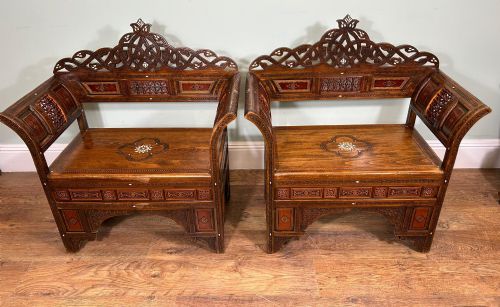
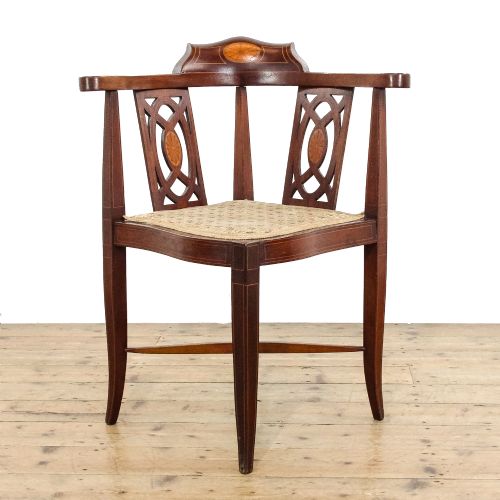


Brown Marquetry Corner Chair
These brown marquetry corner chairs combine clever timberwork and distinctive geometry, offering a compact seat that fits neatly into a room.
Brown Marquetry Corner Chair
A brown marquetry corner chair is designed specifically to occupy the junction of two walls, utilising a diagonal plan that turns an awkward void into a practical seat. The evidence shows these pieces emerging primarily from the Edwardian period, alongside examples dating around nineteen hundred and nineteen twenty.
Most pieces encountered on this page belong to the Edwardian era, taking the form of armchairs, occasional chairs, accent chairs, or salon low armchairs. Makers often constructed them as single items, though sets of four and pairs also appear in the records.
Stylistic influences range from classic Edwardian lines to Art Nouveau curves and Moorish Revival motifs. This variety gives buyers distinct visual options while retaining the characteristic footprint of a corner seat.
Materials and construction
Makers relied principally upon mahogany as the primary structural timber, shaping the curved rails and corner posts to support an angled frame. This dense wood provides the necessary strength for a seat that must endure weight without heavy, bulky legs.
Surface decoration frequently incorporates satinwood inlay and detailed marquetry inlay, creating contrasting patterns across the crest rails and back splats. Upholstery fabric adds a soft element to the seat pad, completing the combination of polished wood and textile.
Brown Marquetry Corner Chair Retail Price Guide 2026
Typical asking prices for brown marquetry corner chair among the pieces listed under this phrase on Sellingantiques today, from the lower quarter to the upper quarter. They describe what is for sale here now, not the wider market.
The documented examples span the Edwardian era alongside pieces specifically dated to nineteen hundred and nineteen twenty.
Judging the work
The distinction between ordinary and superior pieces lies in the crispness of the timber inlay and the tightness of the joinery where the diagonal members meet. Artisans who invested greater time in cutting the satinwood and marquetry achieved sharper edges and more harmonious patterns.
Proportion and stance dictate how successfully a seat integrates into a room, separating well-balanced examples from heavier or clumsier interpretations. The refinement of the turned spindles and the execution of carved details further indicate the skill level of the original workshop.
The Brown Marquetry Corner Chair Glossary
- Corner chair
- A seating form featuring a diagonal plan with the backrest positioned across the corner, allowing it to fit snugly into a room angle. These pieces typically include a curved top rail supported by turned or shaped spindles.
- Marquetry inlay
- Decorative woodwork where small pieces of contrasting veneer are fitted into a prepared ground to form pictorial or geometric designs. This technique adds colour variation and texture to flat wooden surfaces.
- Satinwood
- A yellowish exotic timber valued for its lustrous sheen, frequently utilised for contrasting stringing and detailed inlay work on darker woods like mahogany. It catches the light differently depending on the grain direction.
- Salon chair
- A light, decorative seat designed for reception rooms rather than heavy daily use, often exhibiting more delicate carving and fabric upholstery. They prioritised elegance and portability over robust lounging comfort.
Brown Marquetry Corner Chair: Frequently Asked Questions
What is a corner chair?
A corner chair is an armchair built on a diagonal plan with its backrest wrapping around two adjacent sides. This specific geometry allows the piece to nestle into the corner of a room without wasting floor space.
Historically, these seats served various domestic functions, acting as desk chairs, card table seats, or decorative accents in sitting rooms and hallways.
How do I date these chairs?
Dating relies primarily on stylistic clues such as the presence of Edwardian proportions, Art Nouveau whiplash curves, or Moorish Revival geometric patterns. The recorded pieces here span the early twentieth century, specifically around nineteen hundred to nineteen twenty.
Examining the construction methods, secondary timbers, and type of upholstery padding also helps narrow down the era of manufacture.
Where should I place one?
These pieces find their natural home in empty room corners, entrance halls, or bedrooms where standard rectangular furniture creates an awkward obstruction. Their angled footprint lets them turn unused junctions into functional focal points.
They pair well with small side tables or beneath wall-hung art, adding architectural interest to neglected areas of an interior.
Are they comfortable to sit in?
Most Edwardian examples feature upholstered drop-in or fixed fabric pads designed for upright sitting rather than deep lounging. Their compact proportions and low backs make them better suited for reading or brief conversations than all-day relaxation.
The sturdy mahogany frames provide solid support, though the open arm design encourages an upright posture.