
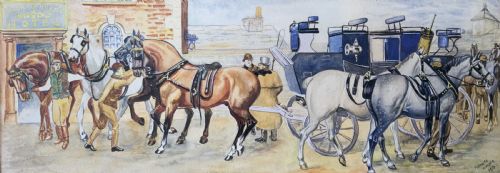


Brown Horse Watercolour Artwork
Brown horse watercolour artwork captures equine subjects in traditional pigment on paper, prized by collectors for spirited character and historic charm.
Brown Horse Watercolour Artwork
A brown horse watercolour artwork depicts equine subjects rendered in delicate pigments upon paper supports, capturing horses at work, at rest, or in motion. These paintings range from pastoral scenes of plough teams and logging carts to dynamic racing and hunting depictions, reflecting daily rural life and sporting pursuits across past centuries.
The pieces available span several distinct periods, most notably the nineteenth and early twentieth centuries, alongside Edwardian, Victorian, and mid-century examples. Works originate from British and continental artists, utilising traditional water-soluble pigments to record the power and form of horses in varied settings.
Buyers encounter subjects such as coach horses, stable studies, and rural fairs, often preserved behind glass within period wooden frames like oak. The selections demonstrate the enduring appeal of equine artistry, moving from early nineteenth-century studies to mid-century gouache and watercolour compositions.
Materials and execution
Artists apply watercolour pigment and gouache onto paper supports, sometimes combining ink details to define the musculature and harness equipment of the horses. The water-based media allows for transparent washes of colour that render the characteristic tones of brown coats and atmospheric landscapes.
Works are typically protected beneath glass and housed within wooden surrounds, notably oak frames, which preserve the delicate paper from environmental moisture and handling damage.
Listings feature works executed on paper using watercolour, gouache, and ink, preserved in wooden and oak frames.
Distinctions in quality
Quality rests upon the artist's ability to capture the anatomy and movement of the horse convincingly through assured brushwork and proportion. Superior pieces display dynamic composition and atmospheric depth rather than stiff or static equine forms.
The preservation of the paper support and the vibrancy of the watercolour pigments dictate the visual strength of the piece, alongside the harmony of original framing materials.
Herman S Melville·John Rattenbury Skeaping·James William Booth·John Augustus Atkinson·Helena Maguire·John Atkinson·Robert Hollands Walker·Charles Clifford Turner·George Hamilton Constantine·William Manners·Snaffles·Frank Saltfleet·Fred Lawson·Charles James Adams
The Brown Horse Watercolour Artwork Glossary
- Watercolour
- A painting method in which the paints are made of pigments suspended in a water-based solution. This technique allows for translucent washes that capture light effectively.
- Gouache
- An opaque water-based paint that includes a white pigment binder. Artists utilise it to add solid highlights and opaque detail to paper works.
- Equestrian
- Relating to horse riding or horseback representation. The term describes artworks focused primarily on horses and riders.
- Victorian
- Pertaining to the reign of Queen Victoria, spanning the nineteenth century. This era produced detailed genre and rural art.
- Edwardian
- Referring to the period from nineteen hundred to nineteen ten. Works from this time often exhibit refined pastoral charm.
Brown Horse Watercolour Artwork: Frequently Asked Questions
How old are these watercolours?
The pieces span from the early nineteenth century through to the mid-twentieth century, encompassing Georgian, Victorian, Edwardian, and later modernist periods.
Most examples date from the Victorian and Edwardian eras, reflecting the heavy reliance on horses in daily transport and rural labour.
How should I frame and hang them?
Watercolours require protection behind glass and conservation framing to prevent fading from direct sunlight and atmospheric damage.
Keep them away from damp environments and strong heat sources to preserve the integrity of the paper and pigments.
What subjects are most common?
Common subjects include working horses hauling carts, plough teams, hunting scenes, horse fairs, and stable portraits.
Artists frequently documented the vital economic and transport role of horses in agricultural and town settings.
How do I spot a signed piece?
Signatures typically appear in ink or pencil within the lower corners of the painted composition, sometimes accompanied by dates.
Researching the recorded working dates of the artist helps confirm the period of creation.