

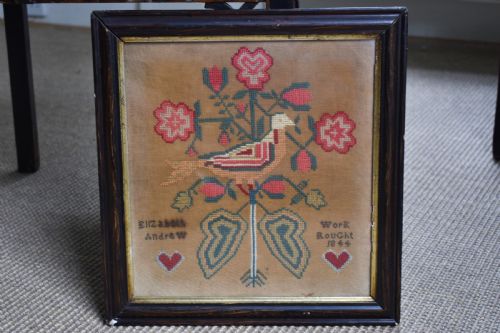
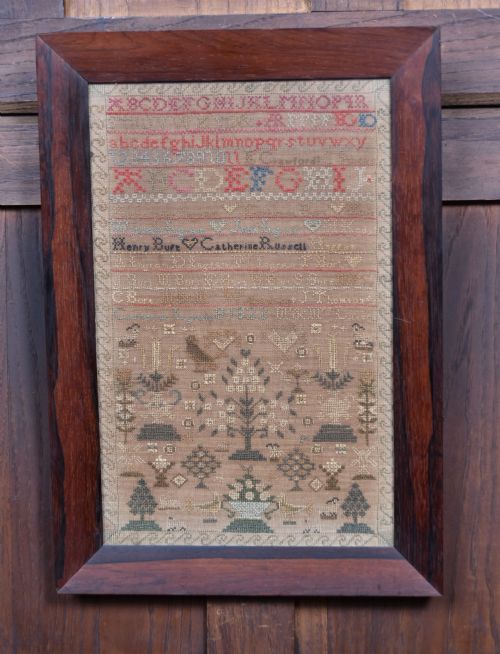


Brown Framed Sampler
These brown framed sampler pieces are textile works spanning the 17th century to the Victorian era, offering collectors tangible fragments of domestic needlework history.
Brown Framed Sampler
A brown framed sampler represents historic textile art, needlework samplers, and framed wall art originating from periods including the 17th century, Georgian, Regency, and Victorian eras. These works take the form of needlework samplers, needlework pictures, firescreens, and framed textiles.
The most common examples you will encounter on this page are 19th century and Victorian needlework samplers. These often record names, dates, or school origins alongside wool work and tapestry techniques.
Earlier examples span Stuart and 17th century periods, offering rarer variations in needlework art. Pieces range from simple alphabet and verse exercises to pictorial works depicting subjects like horses and the commandments.
How they were made
Maker execution relies on wool, silk, and thread stitched onto a linen or canvas foundation. These textiles are then housed within wood frames, frequently protected behind glass with occasional gilt accents.
Techniques range from standard needlework stitches to gros and petit point wool work. Makers utilised diverse materials to create both instructional stitch samplers and pictorial compositions.
Brown Framed Sampler Retail Price Guide 2026
Typical asking prices for brown framed sampler among the pieces listed under this phrase on Sellingantiques today, from the lower quarter to the upper quarter. They describe what is for sale here now, not the wider market.
Listings feature periods from the 17th century to the Victorian era, utilising wool, silk, linen, canvas, wood, and glass.
What varies in quality
Quality differences stem from the complexity of the stitchwork, the condition of the linen or canvas, and the fineness of the wool, silk, or thread. Pictorial detail and the inclusion of legible maker signatures or dates elevate the standing of a piece.
The framing material also contributes, with rosewood or period wooden surrounds adding distinct character compared to standard mouldings. The preservation of the glass and the underlying textile determines the overall integrity of the work.
The Brown Framed Sampler Glossary
- Sampler
- A piece of needlework produced as a demonstration or test of skill in various stitches. These often feature alphabets, numbers, and pious verses.
- Gros point
- A coarse counted-thread embroidery stitch worked on canvas. It provides a durable and textured surface for wool work.
- Petit point
- A fine needlepoint stitch worked on single-thread canvas, allowing for intricate pictorial detail. It frequently appears alongside gros point in complex textile panels.
- Firescreen
- A decorative panel placed in front of a fireplace when not in use. Many examples incorporate framed needlework samplers or tapestries.
- Linen
- A strong, durable fabric woven from flax fibres, commonly utilised as the foundation ground for historic needlework.
Brown Framed Sampler: Frequently Asked Questions
What is a brown framed sampler?
A brown framed sampler is a historic textile work, typically featuring needlework stitched onto linen or canvas, housed within a wooden frame. These pieces range from simple stitch exercises to detailed pictorial works.
They reflect domestic needlecraft traditions across several centuries, capturing personal names, dates, and educational milestones.
How old are these samplers?
The pieces span multiple historical eras, with examples originating from the 17th century through the Georgian, Regency, and Victorian periods. Dates are often stitched directly into the textile by the maker.
Specific years like 1827, 1831, and 1847 frequently appear alongside named makers.
What materials were used?
Makers stitched with wool, silk, and thread onto foundations of linen or canvas. Finished works were placed into wood frames, sometimes incorporating rosewood, and protected behind glass with gilt details.
The combination of these materials dictates the visual character and preservation state of each item.
How were they displayed?
These textiles were framed as wall art to decorate domestic interiors, preserving delicate needlework from damage. Some functional forms, such as firescreens, integrated the needlework directly into household furniture.
Displaying them behind glass helped shield the historic threads from dust and light exposure.