

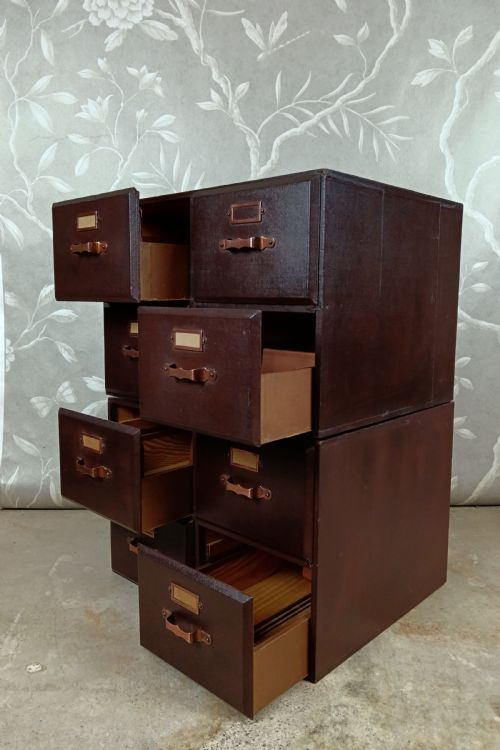


Brown Card Index
These brown card index pieces are sturdy office storage solutions that bring practical sorting power to any modern workspace.
Brown Card Index
A brown card index covers practical filing cabinets, banks of drawers, and desktop filing drawers designed for systematic organisation. These functional items originate from periods spanning the late nineteenth century through to the nineteen-thirties.
The versions most frequently met on this page include Edwardian walnut and oak filing cabinets alongside industrial commercial sets of drawers. Pieces take forms such as library card filing sets, office chests of drawers, and letter files.
Origins stretch across the Edwardian era, early twentieth-century office periods, and nineteen-twenties industrial styles. Each piece reflects the heavy-duty clerical requirements of past commercial environments.
Materials and construction
Construction relies on solid hardwoods including oak, walnut, mahogany, beech, and general wood. These sturdy timbers provide the structural backbone required for heavy, repeated daily use in busy offices.
Metal and brass components appear as functional hardware, drawer pulls, and patented mechanisms like those by Amberg or Shannon. The combination of dense timber and metal fittings ensures robust longevity.
Brown Card Index Retail Price Guide 2026
Typical asking prices for brown card index among the pieces listed under this phrase on Sellingantiques today, from the lower quarter to the upper quarter. They describe what is for sale here now, not the wider market.
A sixty-six drawer office cabinet provides endless tiny compartments for the fiercely organised collector.
Judging quality
Quality rests upon the selection of timber and the complexity of the drawer configuration, such as multi-drawer banks versus simple desktop units. Better examples display careful joinery and intact patent mechanisms.
The presence of recognised makers' systems and the integrity of the original brass and metal hardware distinguish finer filing cabinets from standard commercial utility pieces.
Amberg·Shannon
The Brown Card Index Glossary
- Bank of drawers
- A large assembly of numerous small drawers arranged in a grid, built for sorting cards, letters, or small documents. These units formed the backbone of early office administration.
- Patent cabinet
- A specialised filing enclosure featuring proprietary mechanical sorting or locking systems, such as those designed by Amberg or Shannon. These innovations improved retrieval speed in Edwardian offices.
- Edwardian
- The period spanning the reign of King Edward VII, characterised in furniture by refined proportions and the use of walnut and mahogany. Pieces from this era often balance utility with domestic elegance.
- Industrial commercial
- A style category representing rugged, utilitarian furniture built strictly for workplace efficiency rather than decoration. These items utilise exposed woods and robust metal fittings.
Brown Card Index: Frequently Asked Questions
What are brown card index cabinets used for?
These cabinets were originally designed to organise index cards, letters, and reference documents in offices and libraries. Today, they serve a similar role in modern homes and workspaces for small-item storage.
Their numerous drawers make them ideal for sorting craft supplies, stationery, or collection items while adding vintage character to a room.
How do I date a brown card index?
Dating relies on observing the prevailing wood types, hardware styles, and construction techniques visible on the piece. Edwardian examples often feature walnut or mahogany, whilst later nineteen-twenties pieces lean toward industrial oak.
Patented locking systems and manufacturer stamps also provide specific chronological markers that link pieces to turn-of-the-century manufacturing patents.
Are these cabinets suitable for modern paper sizes?
Many card index and desktop filing drawers were built for specific historical card sizes or folded letters rather than modern A4 sheets. Collectors should check internal drawer dimensions carefully before planning contemporary document storage.
Despite size variations, smaller drawers remain exceptionally useful for modern desktop organisation and sundry storage.
How should I care for wooden office drawers?
Maintain the timber by keeping the cabinet away from direct heat sources and sudden humidity changes to prevent wood movement. Regular dusting and occasional application of appropriate furniture wax will preserve the finish.
Avoid overloading deep banks of drawers to protect the original nineteenth or twentieth-century runners and internal partitions.