


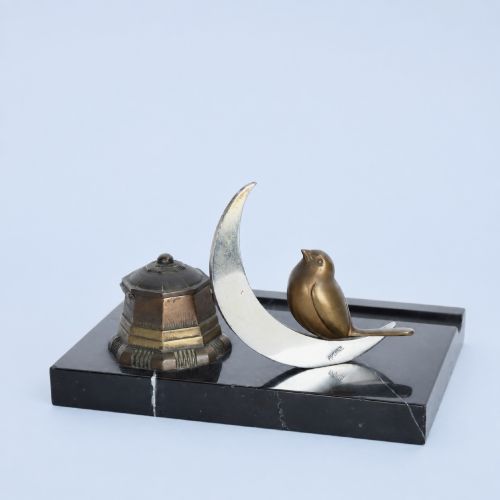




Bronze Marble Inkwell
A bronze marble inkwell sits heavy and bright upon the mahogany, holding the weight of nineteenth-century correspondence.
Bronze Marble Inkwell
A bronze marble inkwell combines cast metalwork with carved stone bases, creating substantial desk accessories designed to anchor a workspace. These pieces serve as functional inkstands and desk sets, often incorporating hinged lids and internal glass liners for daily writing.
The versions met most frequently on this page originate from nineteenth-century France, spanning periods from the Empire style through to Art Deco. Buyers encounter desk tidies, architectural models, and figural stands featuring animals, birds, or classical busts.
Origins trace across French workshops, Grand Tour souvenirs from Rome, and Austrian foundries, reflecting diverse European tastes in desk ornamentation. Materials range from Sienna and green marble to black and onyx varieties, paired with patinated or gilded bronze.
Materials and construction methods
Foundries cast the metal components in bronze, ormolu, or gilded bronze, occasionally utilising cold painting techniques for decorative detail. These metal elements include patinated figures, lions, birds, and architectural mounts.
Masons shaped the heavy stone foundations from various forms of marble, drilling recesses to receive the metal collars and ink reservoirs. Gilt bronze mounts and feet were then secured to the marble bases with threaded pins or screws.
Bronze Marble Inkwell Retail Price Guide 2026
Typical asking prices for bronze marble inkwell among the pieces listed under this phrase on Sellingantiques today, from the lower quarter to the upper quarter. They describe what is for sale here now, not the wider market.
Quality factors in desk stands
The refinement of the bronze casting dictates the visual success of the piece, separating crisp chisel work and detailed chasing from softer, simpler forms. Finer examples display expressive modeling in figural elements such as lions, dogs, or human busts.
The choice and preparation of the marble base also define the tier of the piece, with rich veining in Sienna or vert marble elevating the overall presence. Integration between the heavy stone and the metal mounts demonstrates the maker's precision.
Franz Bergmann·Lefebvre of Belgium·Albert Marionnet·Jules Dalou
The Bronze Marble Inkwell Glossary
- Encrier
- A French term for an inkstand or inkwell designed to hold writing materials on a desk. These often incorporate pen trays alongside the ink reservoirs.
- Ormolu
- Gilt bronze produced by applying a finely ground high-carat gold mercury amalgam to a bronze object. This technique imparts a durable, rich golden finish characteristic of French decorative arts.
- Grand Tour
- A cultural journey undertaken by wealthy young Europeans in the eighteenth and nineteenth centuries to study classical antiquities. Souvenirs from these travels frequently included architectural models in bronze and marble.
- Cold painted
- A method of painting bronze figures without firing the pigment in a kiln, often associated with Austrian foundries. The paint adheres to the prepared metal surface rather than fusing through heat.
- Patinated bronze
- Bronze that has been treated with chemical solutions to produce a specific surface colour or dark tone. This finish protects the metal and accentuates sculptural details.
Bronze Marble Inkwell: Frequently Asked Questions
What is a bronze marble inkwell?
A bronze marble inkwell is a desk accessory featuring a metal ink reservoir mounted upon a heavy stone base. These items were essential writing tools for nineteenth-century correspondence.
They combine sculptural metalwork, such as figures or classical motifs, with polished marble trays that catch stray drops of ink.
How do I date an inkstand?
Dating relies upon stylistic markers, such as the symmetrical restraint of Empire design or the flowing lines of Art Nouveau and Art Deco. Material choices and manufacturing techniques also indicate the period of production.
Evidence from nineteenth-century French workshops shows distinct shifts from Neoclassical severity to ornate Second Empire and exotic Orientalist themes.
Were these inkwells used daily?
These pieces functioned as practical desk items for dipping quill and steel nib pens into liquid ink. The heavy marble bases kept the inkstands stable during vigorous writing.
Many retain glass or ceramic inserts within the metal collars to hold the ink safely without damaging the surrounding bronze.
How do I clean the marble base?
Marble surfaces require gentle wiping with a soft, damp cloth to remove dust without harming the polished finish. Avoid harsh chemical cleaners or acidic substances that etch the stone.
The bronze elements should remain untreated to preserve their historic patina and gilt surfaces.