


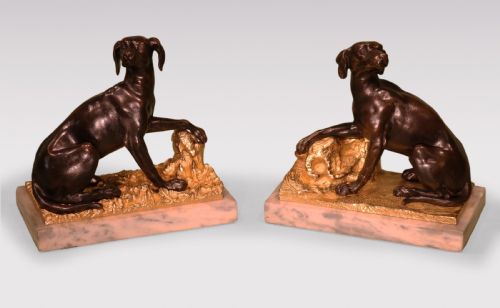


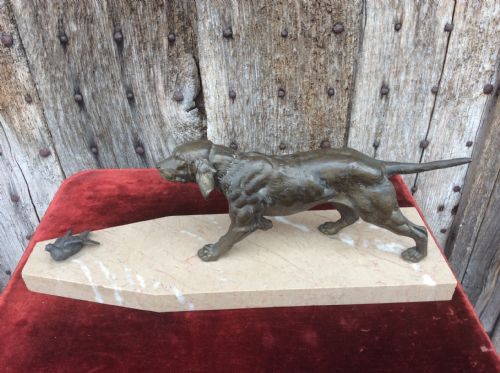

Bronze Hunting Dog Figures
These bronze hunting dog figures capture the sharp focus and energy of hounds and gundogs in metal.
Bronze Hunting Dog Figures
Bronze hunting dog figures represent sporting hounds, gundogs, and sight-hounds such as setters, pointers, borzois, and greyhounds in sculptural form. These pieces primarily date from the nineteenth century and the art deco period of the early twentieth century.
The objects take the form of freestanding sculptures and figural groups, frequently mounted upon heavy marble or onyx bases. Many works show dogs interacting with game, including pheasants, rabbits, and birds.
Makers from the French animalier school dominate the selection, producing works that emphasise muscular realism and naturalistic movement. Buyers will also encounter alternative metal castings such as spelter alongside genuine bronze.
Materials and construction
Foundries cast these figures in bronze or spelter, applying patinated finishes to create dark or metallic surface tones, with occasional cold painted detailing. Ormolu elements and mixed media accents appear alongside the primary metalwork.
Sculptures are frequently secured to bespoke bases fashioned from polished marble or onyx, anchoring the heavier metal figures.
Listings span the nineteenth century and the art deco era, incorporating materials such as bronze, spelter, marble, onyx, and ormolu.
Assessing quality and execution
The crispness of the chasing and the precision in rendering musculature, fur texture, and anatomical detail separate standard castings from finer works. Master modellers achieve a lifelike tension in the animals that lesser copies miss.
The quality of the base material and the integration between the metal sculpture and its marble or onyx plinth influence the overall presence of the piece.
Delabrierre·C Masson·Jules Moigniez·Christophe Fratin·Pierre-Jules Mêne·Dubucand
The Bronze Hunting Dog Figures Glossary
- Animalier
- A nineteenth century artistic movement focused on the realistic depiction of animals, particularly in sculpture. Practitioners captured beasts in motion or repose with anatomical accuracy.
- Spelter
- A zinc alloy commonly utilised as a less expensive alternative to bronze for decorative figures. It accepts patination and metallic finishes to simulate heavier bronze work.
- Ormolu
- Gilded bronze ornamentation applied to furniture, bases, or sculptural compositions. The technique involves fusing a gold-mercury amalgam to a base metal.
- Patinated bronze
- Bronze treated with chemical solutions to produce a specific surface colour or aged finish. This process protects the metal while enhancing visual depth.
Bronze Hunting Dog Figures: Frequently Asked Questions
What is the difference between bronze and spelter?
Bronze is a durable copper alloy that takes fine detail and develops a rich patina over time. Spelter is a softer, zinc-based metal that is lighter in weight and generally less valuable.
Inspection of the underside or areas of wear often reveals the underlying greyish metal of spelter compared to the warm reddish tone of bronze.
Why are these dogs mounted on marble bases?
Heavy marble and onyx plinths provide essential stability for dense metal sculptures, particularly larger hound figures. These stone bases also offer a clean architectural contrast to the textured animal forms.
Such mountings became standard practice during the nineteenth century and carried through into art deco design.
How can I tell nineteenth century pieces from art deco?
Nineteenth century animalier works focus on anatomical realism, dramatic movement, and detailed textures like fur and feathers. Art deco pieces from the nineteen twenties and thirties tend towards stylised, streamlined geometry and smooth surfaces.
Base materials and signature styles also help assign figures to their respective periods.