



Bronze Dressing Table Mirror
A bronze dressing table mirror brings unmistakable weight and continental polish to a room, catching the light across cast metal and bevelled glass.
Bronze Dressing Table Mirror
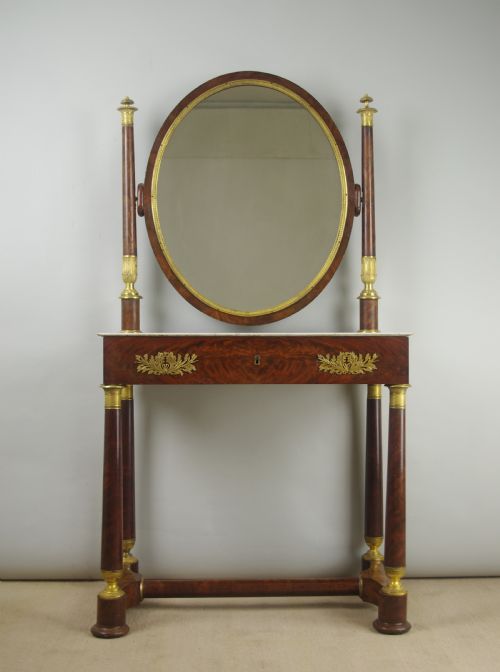
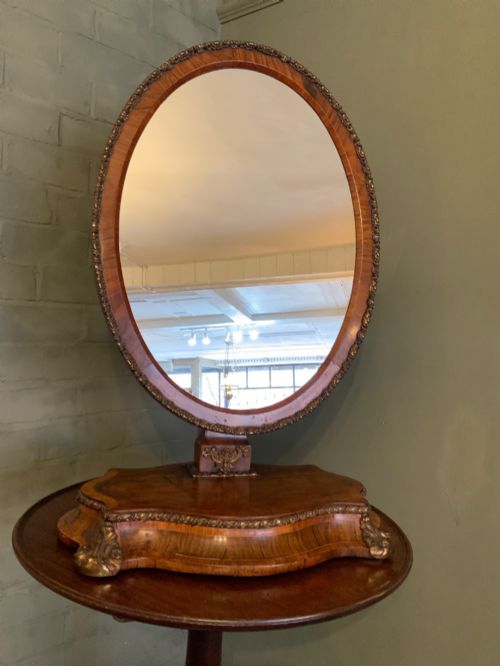
A bronze dressing table mirror is a vanity accessory designed to sit upon a chest or dressing chest, providing a reflective surface framed in cast metal. The pieces found here span the nineteenth century into the early twentieth century, showing strong French and Victorian influences across various forms.
You are most likely to meet French Empire and Rococo revival styles on this page, alongside Victorian and Edwardian examples. These objects utilise bronze, ormolu, and gilt bronze, often incorporating glass, marble, and enamel.
The selection includes table mirrors, pedestal mirrors, and toilet mirrors, as well as associated vanity items like hand mirrors and dressing tables. Forms range from simple pivoting ovals to elaborate cast frames adorned with decorative mounts.
How they were made
Maker's workshops cast bronze and brass into intricate frames and adjustable stands, frequently applying a gilt or ormolu finish to the metal surface. Enamel work, such as champleve, and porcelain plaques from factories like Sevres and Limoges were then inset into the heavy metal structures.
Mirrors were fitted with thick glass plates, sometimes held by walnut or mahogany backing frames and supported by marble bases for added stability. Hinges and pedestals allowed the glass to tilt, requiring precise mechanical joints that remain functional today.
Bronze Dressing Table Mirror Retail Price Guide 2026
Typical asking prices for bronze dressing table mirror among the pieces listed under this phrase on Sellingantiques today, from the lower quarter to the upper quarter. They describe what is for sale here now, not the wider market.
Listings feature periods from the early nineteenth century up to the Art Deco era, predominantly showcasing French and Victorian craftsmanship.
What varies in quality
Quality in a bronze dressing table mirror rests on the crispness of the metal chasing and the depth of the gilding or ormolu. Finer examples display sharp, hand-finished detail in the cast foliage or figurative mounts rather than softened edges from worn moulds.
The choice of secondary materials also elevates a piece, such as the inclusion of genuine marble bases, hand-painted Limoges enamel, or heavy mahogany structures. The weight of the bronze and the sturdiness of the adjustable pivoting mechanism distinguish workshop standards.
Joseph Meissonnier·F. Bienvue
The Bronze Dressing Table Mirror Glossary
- Ormolu
- Gilded bronze, where a finely ground gold-mercury amalgam is applied to a bronze object and heated to drive off the mercury. This technique creates a rich, durable golden surface seen on many French frames.
- Champleve
- An enamelling technique where troughs or cells are hollowed out of the metal surface and filled with vitreous enamel powder before firing. The resulting coloured patterns sit flush with the surrounding bronze.
- Empire
- A neoclassical design style originating in France during the early nineteenth century, characterised by military motifs, classical proportions, and heavy reliance on ormolu mounts. Pieces from this period often feature strict symmetry.
- Rococo Revival
- A nineteenth-century revival of the eighteenth-century rococo style, marked by asymmetrical scrolls, shell motifs, and naturalistic floral flourishes. Frames from this aesthetic feel fluid and ornamental.
- Toilet mirror
- A traditional term for a small dressing table mirror designed to sit atop a larger piece of furniture. These mirrors often incorporate small box bases or drawers.
Bronze Dressing Table Mirror: Frequently Asked Questions
How do I date a bronze dressing table mirror?
Dating relies on stylistic clues, such as the heavy classical symmetry of an Empire piece versus the asymmetrical curves of a Rococo revival design. Material combinations, like champleve enamel or Limoges porcelain inserts, also point toward specific decades in the nineteenth century.
Examining the construction of the mirror back, the thickness of the glass, and the type of screws or hinge pins used provides further confirmation of the manufacturing period.
Were these mirrors meant to be moved?
Most table mirrors were constructed as portable items meant to be placed upon dressing chests, sideboards, or washstands. Their substantial weight, often anchored by bronze and marble, kept them stable during daily use.
While portable, their heavy metal frames and glass plates meant they stayed in one room rather than travelling as luggage.
How do I clean a gilt bronze frame?
Gilt bronze and ormolu require gentle dusting with a soft, dry cloth to remove surface particles without abrading the delicate gold surface. Moisture and chemical cleaners should be avoided, as they can strip the historic gilding.
Professional conservation is recommended for tarnished or dirty metalwork to preserve the original finish.
What is the difference between ormolu and brass?
Ormolu is a gilded bronze finish applied to a copper-alloy base, giving it a deep, rich golden tone through the amalgamation process. Brass is a distinct alloy of copper and zinc with a yellower, brighter metallic composition throughout.
Antique makers used bronze for higher-quality cast mounts because it took fine detail and gilding better than standard brass.