
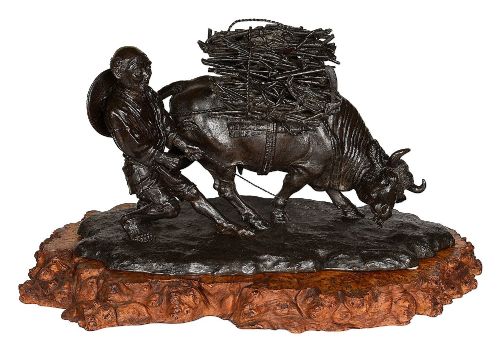


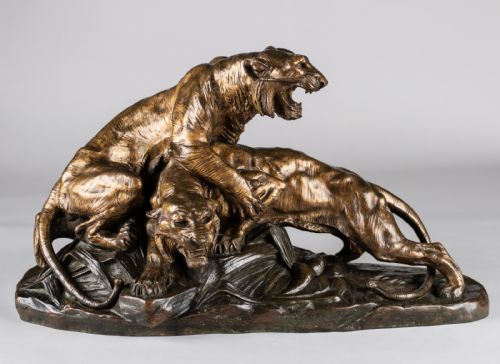
Bronze Animal Group
A bronze animal group captures nature in tension, bringing the dramatic encounters of wildlife into the room through master metalwork.
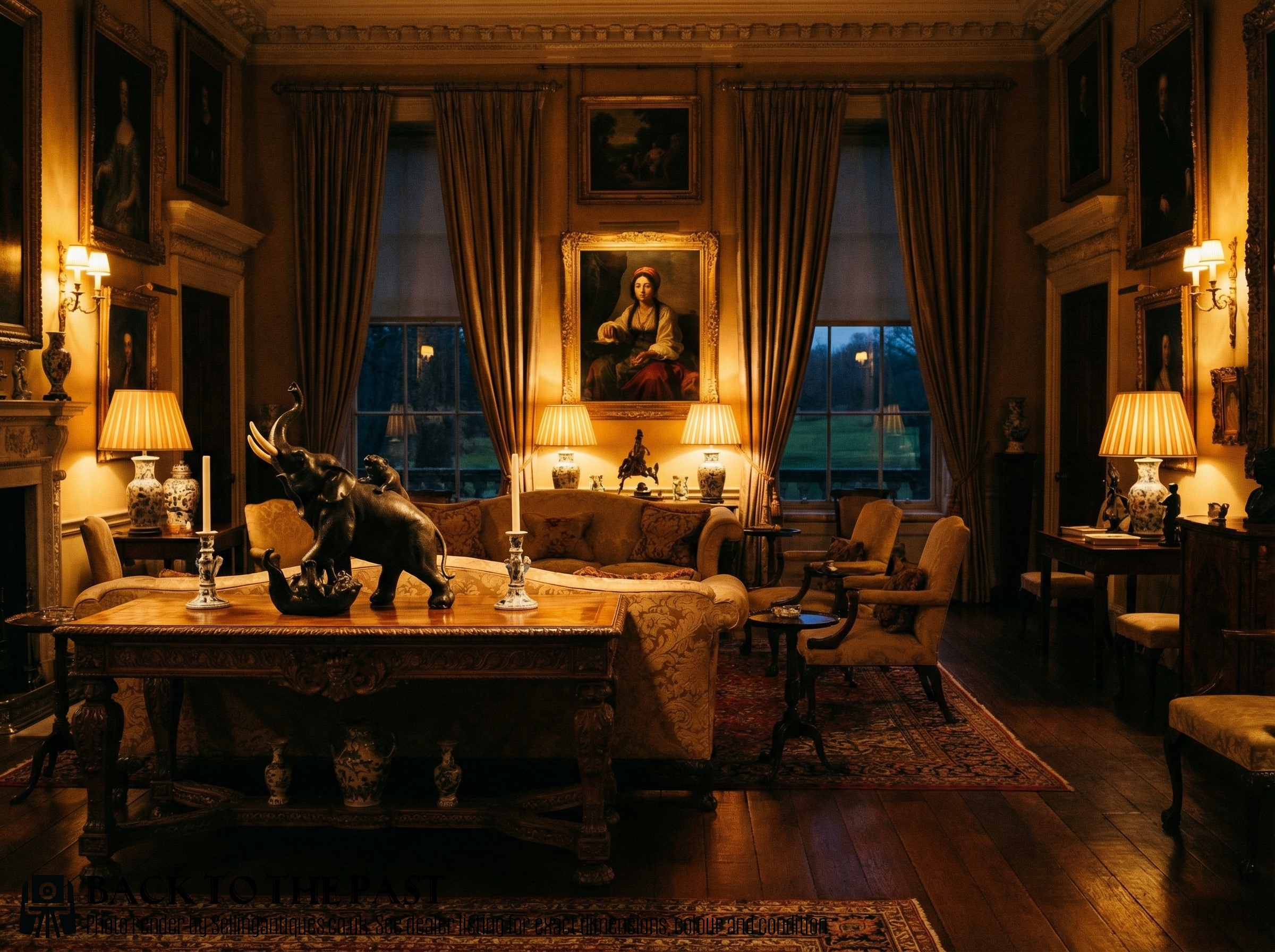
Bronze Animal Group
A bronze animal group presents two or more creatures interacting, whether predator and prey or domestic pairs locked in dynamic motion. These sculptures draw the eye through complex compositions where multiple figures share a single base.
The versions most common here span the nineteenth century and the early twentieth century, originating from European animalier foundries and Japanese Meiji period workshops. French makers and Japanese metalworkers dominate the selection, offering contrasting interpretations of natural behaviour.
Forms range from large floor-standing okimono featuring elephants and tigers to smaller cabinet bronzes of hunting hounds, deer, hares and foxes. Each piece records a specific moment of conflict or companionship captured in cast metal.
Materials and casting methods
Foundries cast these groups in bronze and spelter, frequently mounting the heavier metal sculptures on bases of marble, onyx, burr wood or hardwood. The primary medium receives varied surface treatments, from deep dark patination to nuanced multi-toned finishes.
Japanese pieces from the Meiji period utilise intricate lost-wax casting techniques alongside finely detailed chasing to render the texture of fur, hide and foliage. European animalier sculptors employ similar foundry methods to translate clay models into enduring metal compositions.
Tigers repeatedly find themselves outmatched by elephants in nineteenth-century bronze foundries, locked in eternal tabletop skirmishes.
What separates the best examples
Quality rests in the anatomical conviction of the animals and the ambition of the group composition. The strongest pieces convey tension and weight accurately, making the interaction between the creatures entirely believable.
Surface finishing dictates the upper tier of the range, where chiselling and patination define muscle, texture and expression without masking the underlying metalwork. The mounting also plays a role, with carefully fitted marble or hardwood bases completing the work.
Auguste Nicholas Cain·G. Gardet·Vannetti·Alfred Dubucand·I. Rochard·E. Drouot·Genryusai Seiya·Kaniya Kuniharu
The Bronze Animal Group Glossary
- Animalier
- A nineteenth-century artistic movement focused on the realistic depiction of animals, particularly in sculptural groups. Practitioners studied live specimens closely to capture authentic movement and anatomy.
- Okimono
- A Japanese term for a decorative object intended for display, often carved from ivory or cast in bronze. These pieces range from subtle studies to large, complex animal groups.
- Spelter
- An alloy of zinc and lead or copper used as a less expensive alternative to bronze. It appears frequently in later decorative animal groups and requires careful handling.
- Patina
- The surface coloration and sheen developed naturally over time or applied chemically by the foundry. It enhances the depth and texture of the metal.
- Lost-wax casting
- A traditional method where a model is coated in wax, encased in a mould, and melted out to create a cavity for molten metal. This technique allows for exceptional detail in complex animal groupings.
Bronze Animal Group: Frequently Asked Questions
What is an animalier bronze group?
An animalier bronze group is a nineteenth-century sculpture depicting multiple animals, often locked in combat or natural interaction. These works reflect a growing scientific and artistic interest in wildlife anatomy during the period.
European foundries and Japanese workshops produced these pieces in substantial numbers, ranging from dramatic predatory scenes to calm pairings of deer or hounds.
How do I tell Japanese Meiji bronzes from French ones?
Japanese Meiji pieces often feature distinct subjects like elephants, tigers and woodcutters, executed with meticulous surface detailing and specific signature plaques. They frequently capture narrative moments or complex structural balance.
French animalier bronzes tend to focus on European fauna such as lions, stags, hounds and hares, cast in naturalistic poses with rich patination. The bases and signatures on French works typically follow Western foundry conventions.
Where should I display a heavy bronze group?
These substantial sculptures require stable, level surfaces capable of supporting considerable weight, particularly when mounted on heavy marble or hardwood bases. Low tables or sturdy sideboards offer ideal viewing heights.
Keep the metal away from direct heat sources and strong moisture fluctuations to protect both the bronze surface and the stone or wood plinth.
Are spelter animal groups older than bronze ones?
Spelter groups often date from the late nineteenth or early twentieth centuries, serving as an accessible alternative to solid bronze during the Art Deco era and earlier. The alloy is lighter and softer than bronze.
Examining the underside and finish helps distinguish spelter from bronze, as spelter accepts patination differently and shows a lighter metal beneath surface wear.