







Bronze and Ormolu Cassolettes
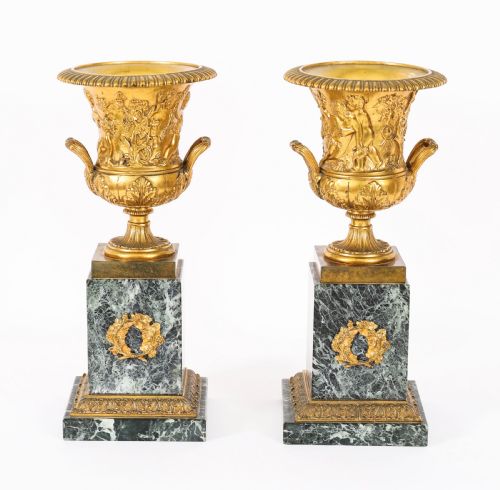
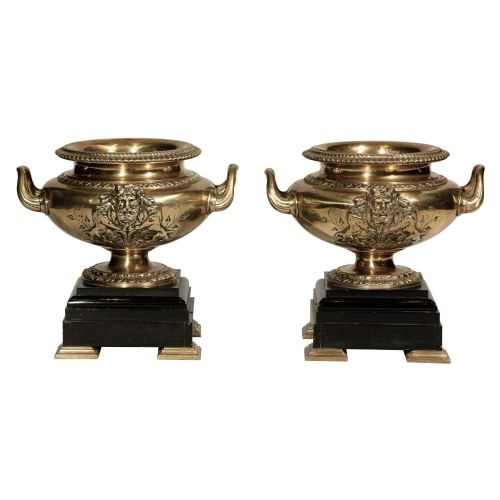
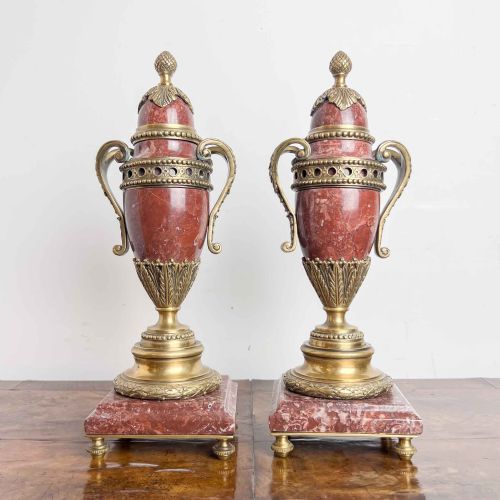
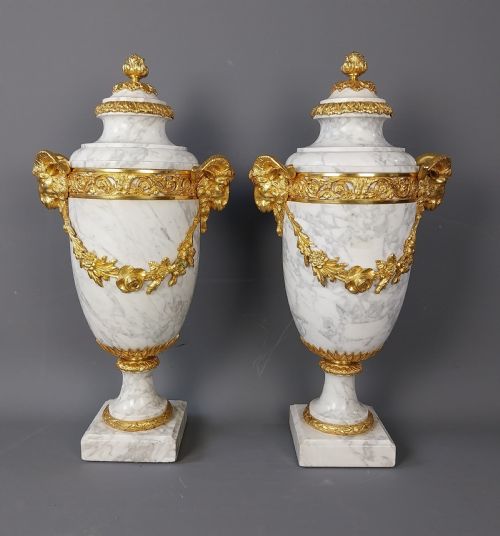
These bronze and ormolu cassolettes are reversible decorative urns that bring classical French elegance to a mantelpiece.
Bronze and Ormolu Cassolettes
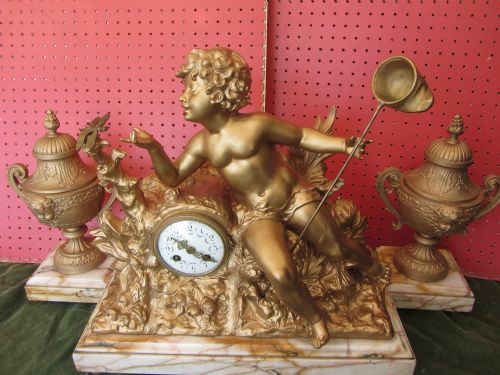
Bronze and ormolu cassolettes are dual-purpose decorative vessels designed to function either as lidded urns or inverted vases, originating predominantly from nineteenth-century French workshops. The versions most commonly met on this page span the Victorian era, the Grand Tour period, and the late nineteenth century, frequently following Louis XVI or Neoclassical styles.
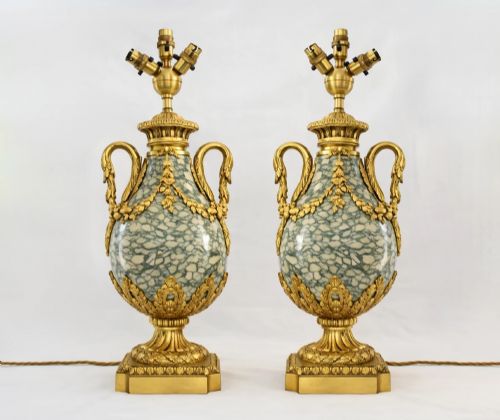
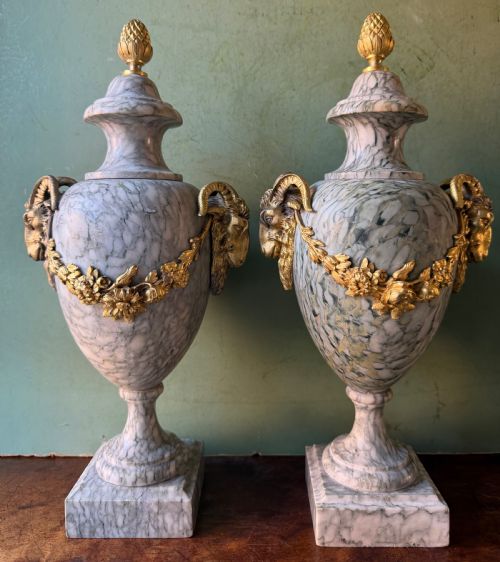
These pieces typically combine cast metal mounts with bodies carved from various stones, including white, green, rouge, and grey-veined marble, alongside onyx and quartz. Formats range from paired decorative urns and table lamps to components of larger clock garnitures, often incorporating porcelain panels or enamel detailing.
Materials and construction methods
Maker workshops combined cast bronze with mercury gilding to produce the bright, durable ormolu mounts that frame the stone and ceramic elements. The bodies were turned from solid blocks of coloured marble or onyx, then fitted with precise metal collars, handles, and reversible lids.
Detailing often involved champlevé enamel work or hand-painted porcelain inserts, such as Sevres-style panels, secured into the metal framework with threaded pins and screws.
Bronze and Ormolu Cassolettes Retail Price Guide 2026
Typical asking prices for bronze and ormolu cassolettes among the pieces listed under this phrase on Sellingantiques today, from the lower quarter to the upper quarter. They describe what is for sale here now, not the wider market.
Some nineteenth-century cassolettes were cleverly engineered with hidden compartments beneath their reversible lids to store fragrant flower petals.
Assessing quality in execution
Quality rests primarily on the crispness of the bronze chasing and the depth of the ormolu gilding, where finer pieces retain sharp leaf and dart motifs rather than soft, rounded casting edges. The selection and turning of the marble also set standards, with superior examples displaying balanced natural veining and precise symmetry in the stone body.
Integration between the metal mounts and the stone or ceramic components marks the division between standard production and exceptional work. Tightly fitted mounts that require no adhesive fillers indicate superior craftsmanship in nineteenth-century French metalwork.
The Bronze and Ormolu Cassolettes Glossary
- Cassolette
- A decorative vessel with a reversible lid that can be turned to present either a solid top or an aperture for potpourri. These dual-function pieces became particularly popular in French neoclassical interior decoration.
- Ormolu
- Finely chopped high-zinc bronze gilded with a mercury amalgam, producing a rich gold-coloured surface finish. The technique was widely utilised by French bronze-makers during the eighteenth and nineteenth centuries.
- Champlevé
- An enamelling technique where troughs or cells are hollowed out of a metal surface and filled with vitreous enamel paste before firing. This method creates colourful geometric or floral patterns on bronze mounts.
- Garniture
- A coordinated set of decorative objects, typically consisting of a central clock flanked by matching vases or cassolettes. Such sets were designed to sit symmetrically upon a fireplace mantel.
- Grand Tour
- A cultural journey through continental Europe undertaken by wealthy young Britons, during which many classical bronze and marble ornaments were acquired. Objects brought back often reflected ancient Roman or French aesthetic styles.
Bronze and Ormolu Cassolettes: Frequently Asked Questions
What is a cassolette?
A cassolette is a decorative vessel featuring a specially designed lid that reverses to serve either as a closed urn or an open vase. This versatility allowed the piece to function ornamentally or to hold scents.
Most nineteenth-century examples combine cast bronze or ormolu mounts with bodies of carved marble or porcelain. They were designed principally as decorative ornaments for mantelpieces and console tables.
How do I use them in a room?
These pieces suit traditional mantels, sideboards, or console tables where symmetrical placement enhances their architectural lines. Paired arrangements work well to anchor either side of a mirror or painting.
Care should be taken to place them on stable surfaces away from heavy foot traffic, as the marble bases and protruding mounts can be vulnerable to sharp impacts.
How do I tell Louis XVI style from Empire?
Louis XVI style pieces display restrained classical proportions, featuring delicate leaf motifs, beading, and fluted columns derived from ancient Roman art. The ormolu work tends to be fine and intricate.
Empire pieces, by contrast, are heavier and more militaristic or imperial in character, often incorporating sphinxes, laurel wreaths, and dense, dark patinated bronze contrasted with bright gilding.
What is Campan vert marble?
Campan vert is a distinctive green-veined marble quarried in the Pyrenees, known for its mottled grey and green appearance. It was frequently utilised by nineteenth-century French makers for decorative urns and clock cases.
The natural patterning varies significantly between blocks, meaning each pair of marble vases displays unique geological formations within the stone.