
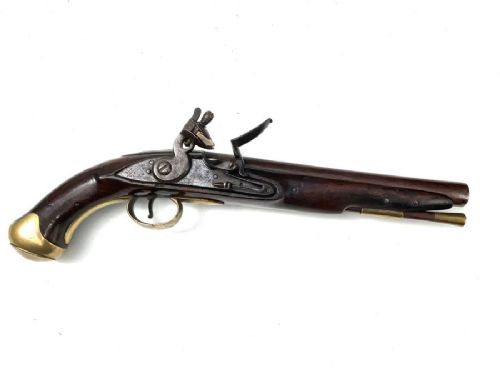


British Flintlock Firearm
A british flintlock firearm is a mechanical antique of iron, brass and walnut, prized for its tactile ignition system and military history.
British Flintlock Firearm
A british flintlock firearm is a historical arm spanning the Georgian and Victorian periods, encompassing both military service pieces and civilian pocket or dueling weapons. Collectors encounter martial muskets, heavy cavalry holster pistols, and specialised arms such as blunderbusses with sprung bayonets.
The objects on this page originate primarily from the eighteenth and early nineteenth centuries, reflecting the manufacturing output of London and Birmingham makers. Common configurations include long barrelled dragoon pistols, Brown Bess muskets, and private officers' sidearms.
Military arms often bear government inspection stamps and Tower markings, linking them directly to state service during the Napoleonic and Revolutionary wars. Civilian variants trade standardised utility for finer finish and specialised concealment formats like overcoat pistols.
Materials and Construction
Construction relies upon traditional firearm materials, primarily forged iron and steel for barrels and locks, paired with shaped walnut stocks. Brass furniture frequently appears on service pistols and blunderbusses to provide durability and corrosion resistance in marine or field environments.
The mechanical heart of each piece is the flintlock mechanism, which generates a spark via a flint striking a steel frizzen to ignite gunpowder. Metal components display hand-finished filing and proof marks, while wooden stocks show distinct shaping to accommodate the barrel tang and lockplate.
Some items served inspectors monitoring mail coaches, guarding correspondence against highwaymen on muddy eighteenth-century roads.
Assessing Quality and Execution
Quality in a british flintlock firearm is measured by the crispness of the lock action, the legibility of maker signatures and proof marks, and the preservation of the original wood stock. Examples bearing recognised London or Birmingham maker names command greater attention from collectors than unsigned armory pieces.
The degree of original finish, sharpness of martial stamps on the brass or iron, and structural integrity of the walnut stock differentiate standard service arms from elite private commission pieces. Modest utilitarian weapons perform their historic function simply, while officer and dueling grades exhibit refined metal polish and more sophisticated stock geometry.
Harrison of London·T. Potts London·Sargant and Son Birmingham·Brasher·Dutton·Wilson
The British Flintlock Firearm Glossary
- Flintlock
- An ignition mechanism utilising a flint held in a cock to strike a steel frizzen, producing sparks to ignite the priming powder. This system dominated small arms manufacture for centuries.
- Brown Bess
- A generic term used to describe the standard-pattern British muzzle-loading smoothbore flintlock musket. It served British land forces for over a century.
- Proof Marks
- Official stamps struck onto the barrel to indicate that the piece has undergone pressure testing with gunpowder. These marks help verify the origin and period of manufacture.
- Frizzen
- The vertical steel plate struck by the flint to create sparks and cover the priming pan. Its correct hardening is essential for reliable ignition.
- Escutcheon
- A small plate of brass or silver inset into the wrist of the stock, often engraved with initials or crests. It serves both decorative and structural strengthening purposes.
British Flintlock Firearm: Frequently Asked Questions
How do I care for a flintlock?
Keep the metal lightly oiled with a neutral gun oil to prevent active corrosion and store the piece in a dry environment away from extreme temperature shifts.
Avoid dry-firing the lock mechanism, as the impact of the cock against the frizzen without a flint can weaken the spring or damage the steel edge.
Are these firearms legally antique?
These pieces belong to the eighteenth and nineteenth centuries, categorized as obsolete caliber antiques under standard heritage definitions.
They function as historical artefacts and display items rather than modern sporting arms, reflecting the martial technology of the Georgian era.
What is the difference between a musket and a pistol?
Muskets are long guns designed for shoulder firing by infantry units, exemplified by the Brown Bess, requiring two hands to support the weight.
Pistols are shorter arms intended for one-handed operation by cavalry troopers, officers, or civilians for personal defence during travel.
How can I identify the date of a piece?
Look for stamped maker names, government ownership cyphers such as Crown over GR, and official proof marks on the barrel flat or breech.
Stylistic indicators like brass furniture shapes, stock carving, and lockplate profiles also help narrow down the manufacturing decade.