



British Castle Artwork
These pieces of british castle artwork capture centuries of fortress history across watercolours and oils on canvas and wood.
British Castle Artwork
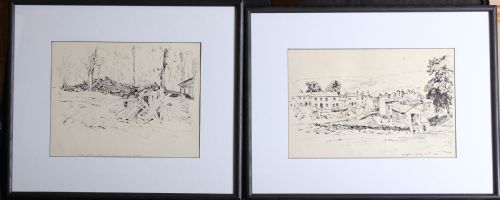
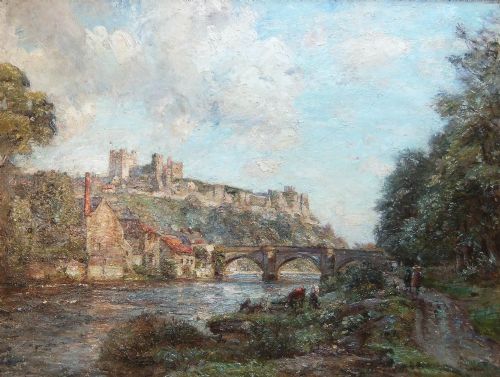
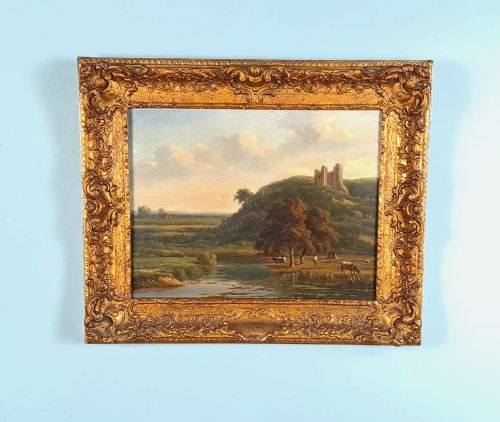
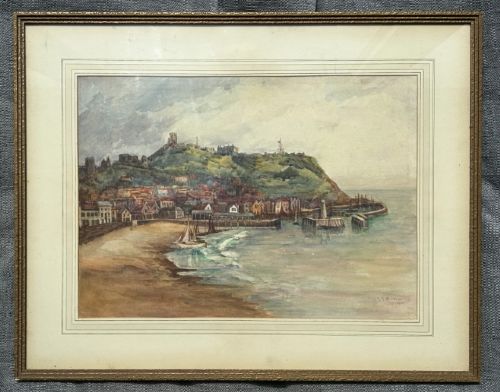
British castle artwork comprises historical paintings and works on paper depicting famous fortresses and strongholds across the landscape. The pieces on this page span from the eighteenth century through to the mid-twentieth century, recording sites such as Windsor, Bolton, and Richmond. These works range from intimate ink and watercolour drawings to large oil paintings executed on canvas or oak panels.
Buyers encounter works produced during distinct historical periods, notably the Victorian and Edwardian eras, alongside pieces from the 1920s, 1930s, and 1940s. The subjects focus heavily on topographical accuracy paired with the atmospheric conditions of the British countryside. Many representations place the ancient stone structures within river valleys or coastal settings.
The selection includes both signed original compositions by known regional artists and unattributed works from the wider English school. These paintings serve as historical documents of architectural appearance and surrounding landscapes prior to modern development. Collectors acquire them for their combined interest in local history, topography, and traditional painting mediums.
Materials and Construction
Artists created these works primarily utilising oil paint and watercolour pigment applied to canvas, paper, wood, or board. Oil paintings often demonstrate considerable texture through the build-up of pigment on stretched canvas or wooden panels, whilst works on paper utilise fluid watercolour washes sometimes reinforced with ink or sepia drawing lines.
The supports reflect the period of creation, moving from early oak panels and hand-made paper to commercially prepared canvases and boards in the nineteenth and twentieth centuries. Framing historically accompanied these pieces to protect the delicate painted surfaces and paper edges from environmental damage.
Listings feature works spanning the eighteenth, nineteenth, and twentieth centuries, executed in oil, watercolour, and ink on paper, canvas, wood, and board.
Evaluating Quality and Execution
Quality in these works rests upon the artist's handling of light, scale, and architectural perspective within the landscape. Superior examples demonstrate confident brushwork or delicate wash control that brings depth to the fortress walls and the surrounding water or foliage.
The distinction between standard topographical records and exceptional fine art lies in the composition's atmospheric impact and the artist's ability to render stone and natural terrain convincingly. Stronger pieces display a sophisticated balance between the heavy masonry of the castle and the fluid elements of rivers, skies, and hills.
Alfred Young Nutt·Fred Lawson·Herbert Royle·T C Hofland·F A Roylance·James Orrock·William Mellor·Thomas Whittle the Younger·George Lambert·Willie Stephenson·William Edward Webb·George Willis Pryce·Victor Haddrell
The British Castle Artwork Glossary
- Watercolour pigment
- A colourant suspended in a water-soluble binder, utilised extensively on paper for landscape and architectural studies. It allows for translucent washes of colour that capture changing weather and light.
- Oil on canvas
- Pigment mixed with drying oil applied to a stretched woven fabric support. This technique provides rich colour saturation and allows for both smooth blending and thick impasto texture.
- Topographical art
- Artwork that depicts specific real-world locations with a degree of geographical and architectural fidelity. These views serve as historical records of buildings and landscapes.
- Impasto
- Paint applied thickly to a canvas or panel, standing out in relief from the surface. This technique adds tactile dimension and captures light dynamically across the painted area.
- Sepia
- A brown pigment derived from the ink sac of the cuttlefish, often used alone for monochromatic drawings and watercolour underpaintings. It imparts a warm, aged tone to historical works on paper.
British Castle Artwork: Frequently Asked Questions
What periods do these castle paintings represent?
The listings encompass works created from the eighteenth century through to the mid-twentieth century, capturing British fortresses as artists viewed them across generations.
Many pieces reflect Victorian and Edwardian aesthetics, alongside later twentieth-century interpretations by regional painters.
Which materials were commonly used by the artists?
Painters utilised oil on canvas, wood panels, and board for heavier, textured compositions, whilst works on paper frequently employed watercolour pigments and ink.
These varied supports reflect the changing availability of artist materials throughout the nineteenth and twentieth centuries.
How can I identify the specific castle depicted?
Titles often record the exact name of the fortress and its surrounding region, such as Windsor, Richmond, or Bolton Castle. Inscriptions on the reverse or contemporary documentation further confirm the specific topography.
Many works include notable geographical landmarks like rivers or bridges to aid identification.
How do these artworks fit into a modern interior?
These traditional landscapes provide a focal point through their historical subject matter and natural colour palettes of earth tones, greens, and blues.
They pair effectively with both period interiors and contemporary spaces seeking a connection to British heritage.