





Breakfront Compactum
A breakfront compactum offers grand scale and disciplined interior division, combining hanging space with linen drawers in a single piece.
Breakfront Compactum
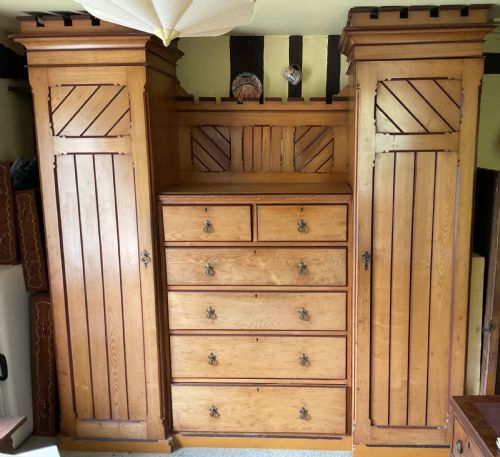
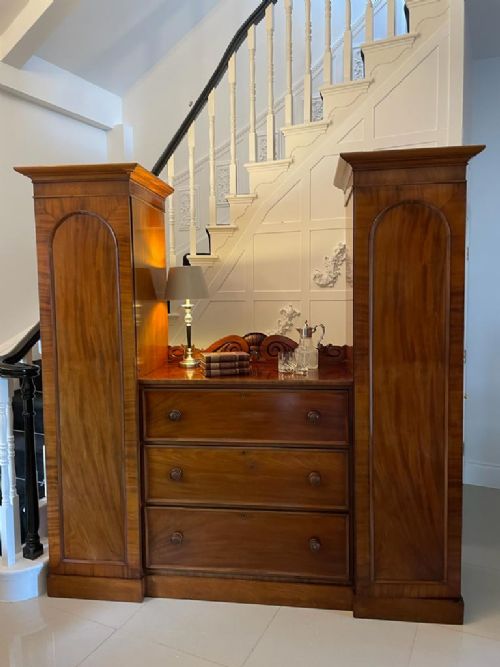
When searching for a breakfront compactum, you are looking at substantial bedroom furniture designed to house clothes, linen and accessories in an architectural carcass. These pieces project forward centrally, creating distinct vertical sections that break up the mass of timber along a bedroom wall. Most examples encountered here belong to the Victorian and Edwardian eras, though earlier Georgian and Regency roots inform their disciplined proportions.
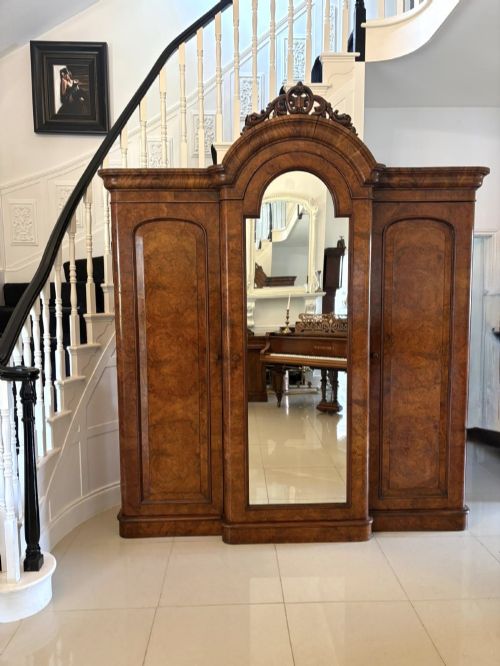
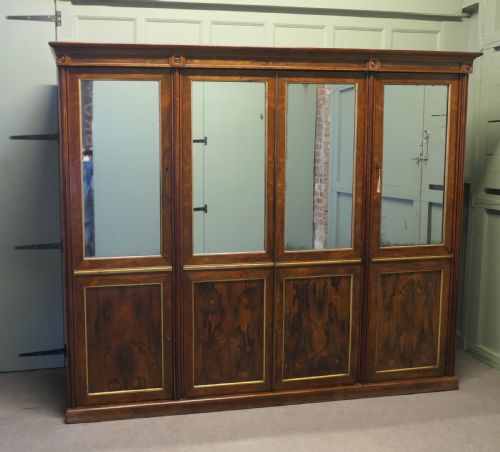
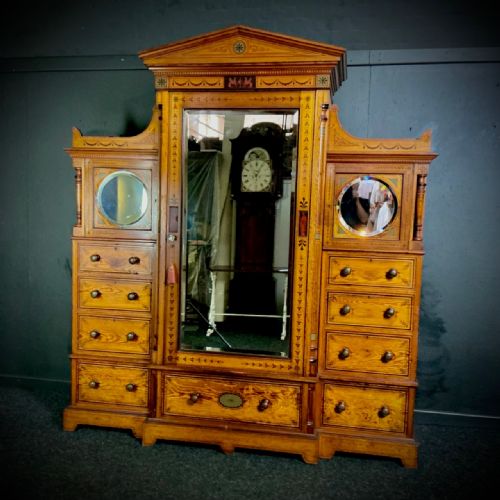
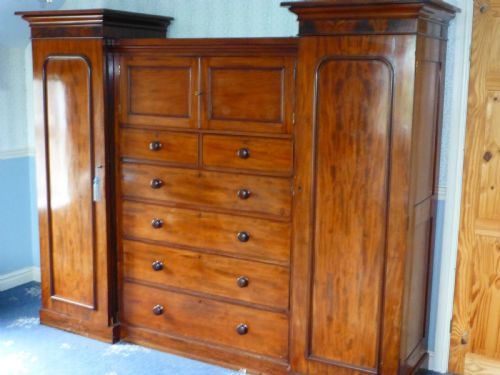
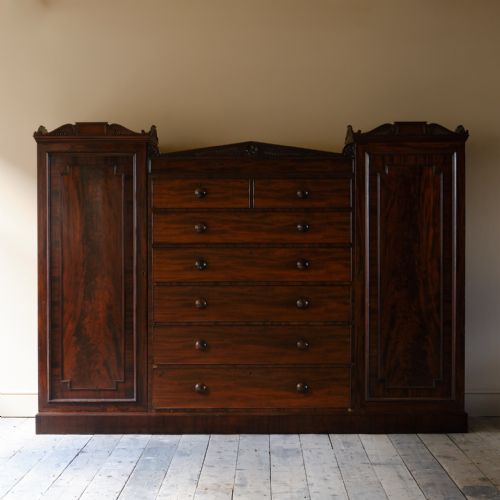
The form functions as a combination wardrobe and linen press, often uniting hanging compartments with internal banks of drawers and sliding trays behind multiple panelled doors. Oak or pine carcases receive finely figured mahogany, burr walnut or satinwood veneers, frequently arranged in symmetrical patterns across the projecting central block. Side wings accommodate long garments, while the central tower provides modular storage for folded items.
Victorian iterations display deep flame mahogany and rich burr walnut, sometimes incorporating mirrored glass doors or inlaid Sheraton Revival motifs. Edwardian variations tend toward lighter mahogany with delicate boxwood stringing, or occasionally pale satinwood. Understanding this typology means recognising how cabinetmakers balanced exterior architectural presence with internal domestic utility.
How they were made
Cabinetmakers constructed these large wardrobes from sturdy secondary timbers like pine or oak, onto which they applied choice veneers of mahogany, burr walnut, pollard oak or satinwood. Flame mahogany and burr walnut veneers required steady hands and hot animal glues to secure the swirling grain patterns across wide door panels without lifting or splitting. Inlaid examples integrated contrasting woods like boxwood and ebony through precise stringing and marquetry techniques.
Internal components relied on traditional joinery, with hand-cut dovetails joining drawer boxes and solid timber runners supporting sliding linen trays. Brass hardware, including locks, bolts and hanging rails, was fitted flush into mortises cut by hand. Carved details and moulded cornices were worked directly from solid timber and pegged or glued into the main architectural frame.
Breakfront Compactum Retail Price Guide 2026
Typical asking prices for breakfront compactum among the pieces listed under this phrase on Sellingantiques today, from the lower quarter to the upper quarter. They describe what is for sale here now, not the wider market.
Several Victorian compactums retain discreet internal boot pullers tucked away near the floorboards.
What varies in quality
Quality in a breakfront compactum rests upon the selection of timber veneers and the harmony of the architectural proportions. The finest pieces employ book-matched burr walnut or figured mahogany that flows symmetrically across the advancing central section and flanking doors. Lesser examples rely on plain timber boards or routine veneer matching that lacks depth and visual movement.
Internal execution further distinguishes superior workshop output from standard production. Top-tier pieces feature complete banks of cedar or mahogany lined trays, fine dovetailing on every internal drawer, and original brass fittings stamped by known makers. Poorer quality often reveals replacement internal fittings, plain deal secondary woods behind the fancy facades, or doors that have warped due to seasonal humidity changes.
Gillows·Lamb of Manchester·Edwards & Roberts·Maples & Co
The Breakfront Compactum Glossary
- Breakfront
- An architectural furniture form where the central section projects forward from the flanking wings. This creates visual depth and breaks up the horizontal line of large wardrobes.
- Compactum
- A multi-functional wardrobe designed to hold a complete gentleman's or lady's wardrobe by combining hanging space with drawers, shelves and sliding linen trays.
- Burr walnut
- A prized timber veneer harvested from the wart-like growths on walnut trees. It yields intricate, swirling grain patterns full of small knots.
- Flame mahogany
- A veneer cut from the fork of a mahogany tree where the branches meet the trunk. The grain resembles flickering tongues of fire.
- Linen press
- A piece of furniture with upper doors enclosing sliding shelves for folded linen, above a base section fitted with drawers.
Breakfront Compactum: Frequently Asked Questions
How do I dismantle a breakfront compactum?
These large wardrobes were invariably built to come apart into manageable sections - usually a cornice, a plinth, a central tower and two flanking hanging wings - to allow passage through doorways.
Reassembly requires patience, ensuring the modular carcasses sit level on the floor before securing internal bolts and hanging the heavy panelled doors.
Can I fit modern hangers inside?
Most antique compactums were built when garments were shorter or folded over rails, meaning older wooden hanging pegs or shallow depths might restrict modern wire hangers.
Many owners adapt the interior by replacing or extending brass hanging rails front-to-back rather than side-to-side to accommodate wider contemporary suits and coats.
What is the difference between a wardrobe and a compactum?
A standard wardrobe provides primarily vertical hanging space behind doors, perhaps with a single long drawer at the base.
A compactum integrates multiple storage formats into one carcass, dividing the interior between hanging compartments, banks of linen trays and specialised drawers for smaller items.
How do I care for the veneer?
Burr walnut and flame mahogany veneers respond poorly to extreme fluctuations in temperature and direct sunlight, which can dry out the animal glue beneath.
Maintain a stable room climate and feed the timber periodically with traditional beeswax to preserve the moisture and depth of the polished surface.