

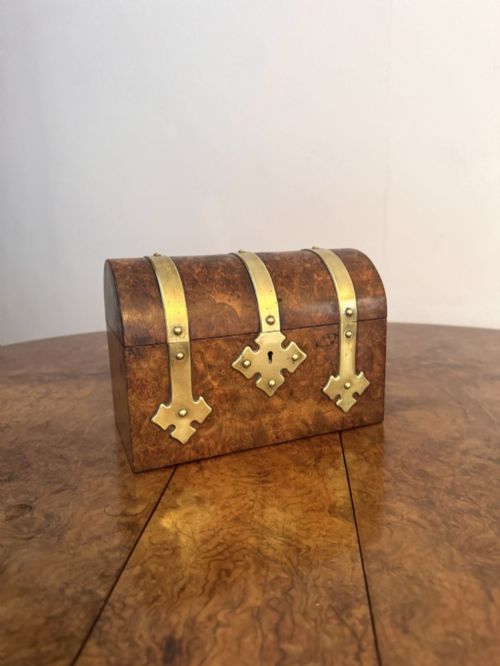

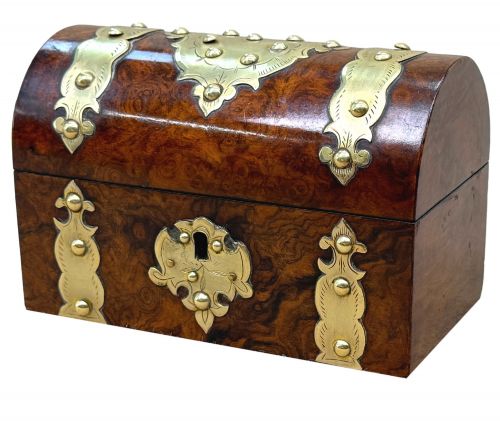


Brass Strapwork Stationery Box
A brass strapwork stationery box brings Victorian desk organisation to life, combining rich timbers with robust metal mounts to keep correspondence tidy.
Brass Strapwork Stationery Box
A brass strapwork stationery box serves as a functional desktop receptacle for letters and paper, commonly emerging during the Victorian era. These pieces reflect the period's taste for orderly and decorative writing accessories.
The variations seen on this page range from walnut and burr walnut cabinets to coromandel caskets and pollard oak dome tops. Many items incorporate structural brass mounts or bound edges that define the aesthetic of these desk accessories.
Origins span English workshops alongside French Second Empire examples, with styles touching upon Gothic Revival influences. The typical form is a desk box or cabinet designed to house correspondence efficiently.
How they were made
Cabinet makers utilised dense hardwoods such as walnut, burr walnut, and coromandel as the primary carcass materials for these boxes. These timbers were selected for their striking grain patterns and durability on the desk.
Brass strapwork, ormolu mounts, and metal bindings were applied to reinforce corners and articulate the geometric surfaces. Silk linings and hand-painted porcelain insets occasionally supplemented the internal and external decorative scheme.
Brass Strapwork Stationery Box Retail Price Guide 2026
Typical asking prices for brass strapwork stationery box among the pieces listed under this phrase on Sellingantiques today, from the lower quarter to the upper quarter. They describe what is for sale here now, not the wider market.
Periods represented span the Victorian era, including pieces dated around 1860 and 1880 alongside broader nineteenth-century examples.
What varies in quality
The distinction between standard production and superior execution lies in the choice of timber veneer and the precision of the brass strapwork fitting. Selected burr walnut or figured coromandel displays richer grain movement than plain oak surfaces.
Superior examples incorporate complex dome-top silhouettes or integrated multi-piece desk sets with matched porcelain and metalwork. The integration of interior dividers and robust hinges separates utilitarian boxes from cabinet-maker pieces.
Trussell Brighton
The Brass Strapwork Stationery Box Glossary
- Strapwork
- Ornamental bands or strips of metal, such as brass, applied to the exterior of a box for reinforcement and decoration. This technique creates a geometric pattern across the timber surface.
- Burr Walnut
- A specialised wood cut from the burl growth of a walnut tree, prized for its swirling, highly figured grain patterns. It forms a decorative veneer on luxury Victorian cabinets.
- Coromandel Wood
- A dense, heavy hardwood originating from Asia, characterised by dark brown colouring with contrasting stripes. It was frequently utilised for high-end nineteenth-century caskets and desk sets.
- Ormolu
- Gilt bronze mounted onto furniture and decorative objects to provide bright metallic highlights. The technique involves applying a gold amalgam to a bronze base.
- Gothic Revival
- An architectural and decorative style drawing inspiration from medieval forms, featuring pointed arches and structural metalwork. This aesthetic appears on Victorian desk accessories.
Brass Strapwork Stationery Box: Frequently Asked Questions
How were stationery boxes used?
Victorians used these boxes on writing desks and library tables to keep correspondence organised and out of sight. The fitted interiors held folded papers, cards, and writing implements.
In a period when letter writing was a daily necessity, these caskets kept private notes secure and writing surfaces uncluttered.
How do I live with a stationery box?
These boxes sit comfortably on modern desks, sideboards, or console tables, where they continue to function as storage for small items. Their rich timbers and polished brass add texture to contemporary or traditional rooms.
Keeping the wood polished with appropriate wax and avoiding direct sunlight helps preserve the finish of the veneer and metal.
How do I tell periods apart?
Nineteenth-century pieces often display specific stylistic markers like Gothic Revival strapwork or French Second Empire porcelain insets. The choice of timber, such as coromandel or pollard oak, helps indicate the decade of manufacture.
Examining the construction methods, hinges, and interior silk linings also aids in placing a box within the Victorian era.