



Brass Silhouette Frame
These brass silhouette frames house profile portraits from the Georgian and Regency eras, offering an intimate window into early domestic likenesses.
Brass Silhouette Frame
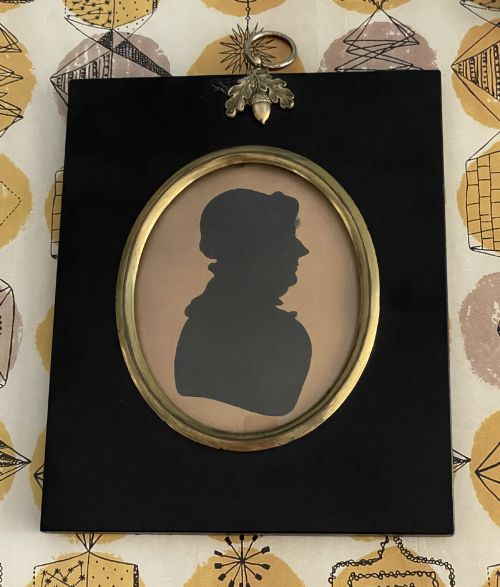
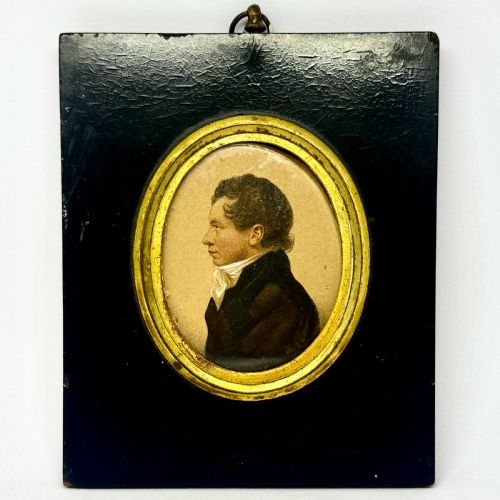
A brass silhouette frame holds miniature profile portraits executed in cut paper, painted pigment, or directly upon plaster and glass. These pieces emerge from the Georgian, Regency, and nineteenth century periods, capturing subjects with striking economy of line.
The most common format on this page is the smaller wall-hanging portrait, often encased in ebonised wood or papier-mache surrounds with pressed brass bezels and hangers. They range from simple brass rims to ornate gilded brass mounts framing detailed miniature likenesses.
Makers such as John Miers, J. Deacon, Thomas London, James Gillespie, and George Atkinson produced these works, showing the transition from stark cut paper to painted glass and plaster profiles.
Materials and construction
Makers fashioned the surrounds from pressed brass, often combining them with ebonised wood or papier-mache to create a sharp contrast against the pale profile and dark background. Glass protects the delicate paper, watercolour, or plaster surfaces within.
The portraits themselves rely on varied techniques, including hollow-cut paper, painted silhouettes on glass, and profiles rendered in watercolour on paper or mounted on plaster.
Brass Silhouette Frame Retail Price Guide 2026
Typical asking prices for brass silhouette frame among the pieces listed under this phrase on Sellingantiques today, from the lower quarter to the upper quarter. They describe what is for sale here now, not the wider market.
Several profiles immortalise children as young as nine years old, immortalised forever in brass and black paper.
Factors of quality
Quality rests upon the crispness of the silhouette cutting or the precision of the brushwork, alongside the preservation of the original brass mounts and protective glass. Signed works by noted artists command greater attention.
The crispness of the cast or pressed brass bezel and the depth of the ebonised frame or papier-mache backing indicate the original care taken in assembly.
James Gillespie·Thomas London·J. Deacon·George Atkinson·John Miers
The Brass Silhouette Frame Glossary
- Brass bezel
- The metal rim holding the glass and portrait within the outer frame. It provides a bright metallic border to the dark profile.
- Ebonised wood
- Timber stained or painted black to imitate ebony. This dark finish creates the traditional high-contrast background for silhouette portraits.
- Papier-mache
- A durable moulded material made from paper pulp and binder. It is frequently found forming the deep outer body of Regency miniature frames.
- Hollow-cut
- A silhouette technique where the profile is cut out from a sheet of paper, which is then laid over a dark background fabric or paper.
Brass Silhouette Frame: Frequently Asked Questions
What periods do these frames represent?
The listings span the late eighteenth century through the nineteenth century, covering Georgian and Regency periods. These eras saw the height of domestic profile portraiture before photography took over.
Most pieces date specifically between the 1780s and the 1820s, showing stylistic shifts from plain cut paper to elaborate gilded highlights on glass.
How were these portraits displayed?
Owners typically hung these small pieces in groups on parlour walls or placed them on cabinet surfaces. Their compact size suited the intimate domestic spaces of Georgian and Regency homes.
The brass hangers integrated into the frames allowed for secure wall mounting, often arranged alongside larger family oil paintings.
How do I identify a Regency frame?
Regency examples often feature convex glass held by a polished brass bezel, set within a deep, rounded papier-mache or ebonised wood surround. They frequently include small brass acorn or ring hangers at the top.
In contrast, earlier Georgian pieces lean toward simpler square or oval wooden profiles with minimal brass hardware, focusing attention entirely on the cut or painted likeness.
Are the silhouettes hand painted?
Many profiles are hand painted using dark pigments on glass, paper, or plaster, while others are meticulously cut from black paper. Some Regency examples incorporate subtle gold leaf highlights to define hair ornaments, lace collars, or clothing details.
Artists like John Miers specialised in delicate plaster works, whereas others focused on ink or watercolour on flat surfaces.